Clear Sky Science · en
Enhancing depression diagnosis with augmented brain signal driven decorrelated graph neural networks
Why this research matters to everyday life
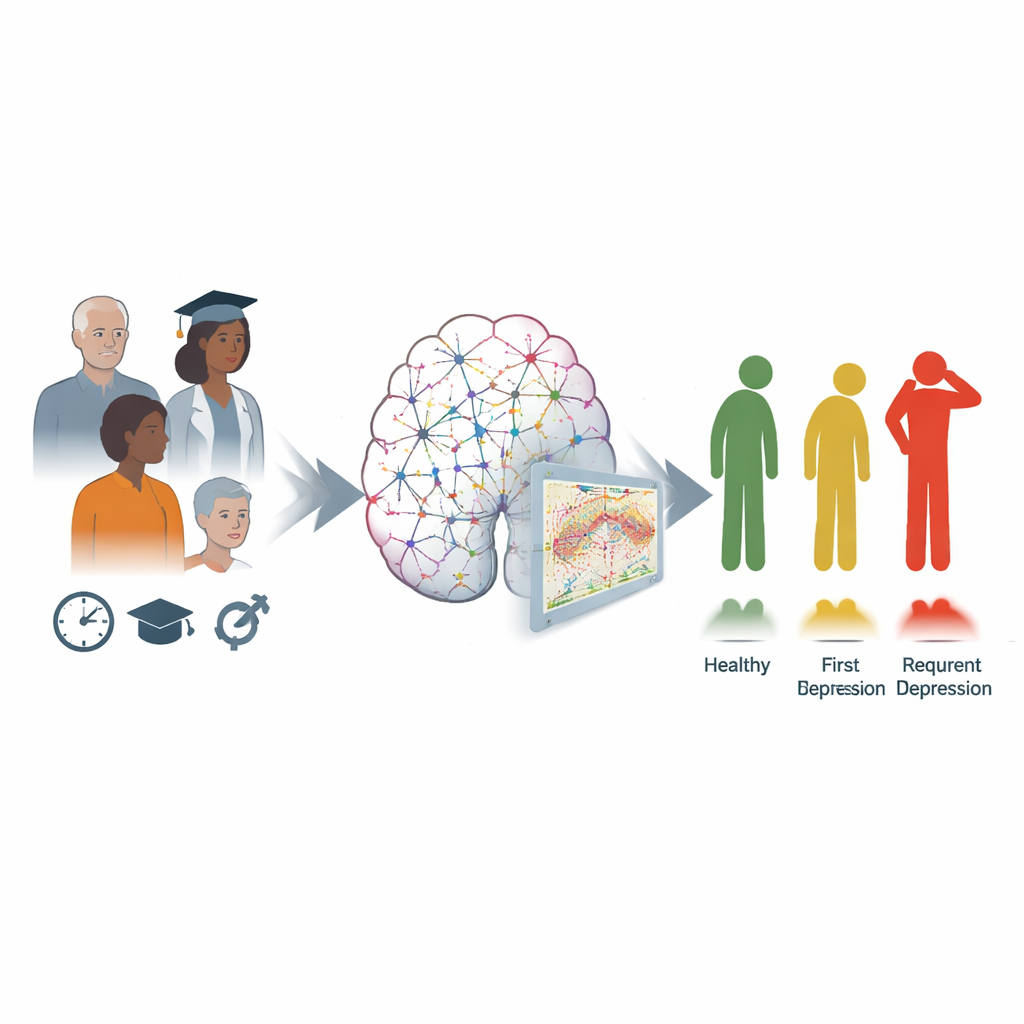
Depression is more than feeling sad; it is a brain and body disorder that can derail work, family life, and physical health, and it often returns in waves over the years. Doctors still diagnose it mainly by talking with patients, which can be imprecise and slow. This study explores whether patterns in brain activity, combined with basic personal information like age, gender, and education, can help computers recognize depression more accurately and even distinguish between people in their first episode and those with recurring illness.
Looking inside the resting brain
The researchers worked with a very large collection of brain scans from people in China, including hundreds with major depressive disorder and hundreds of healthy volunteers. The scans were taken while people rested quietly in the scanner, a technique called resting-state functional MRI. This method captures how different regions of the brain naturally “chat” with each other over time. Earlier work had shown that depression alters these communication patterns, especially in networks involved in self-reflection, emotions, and memory. But turning this complex web of connections into a reliable diagnostic tool has been difficult, in part because each study usually has limited data and the brain’s wiring is intricate.
Turning brain signals into networks a computer can read
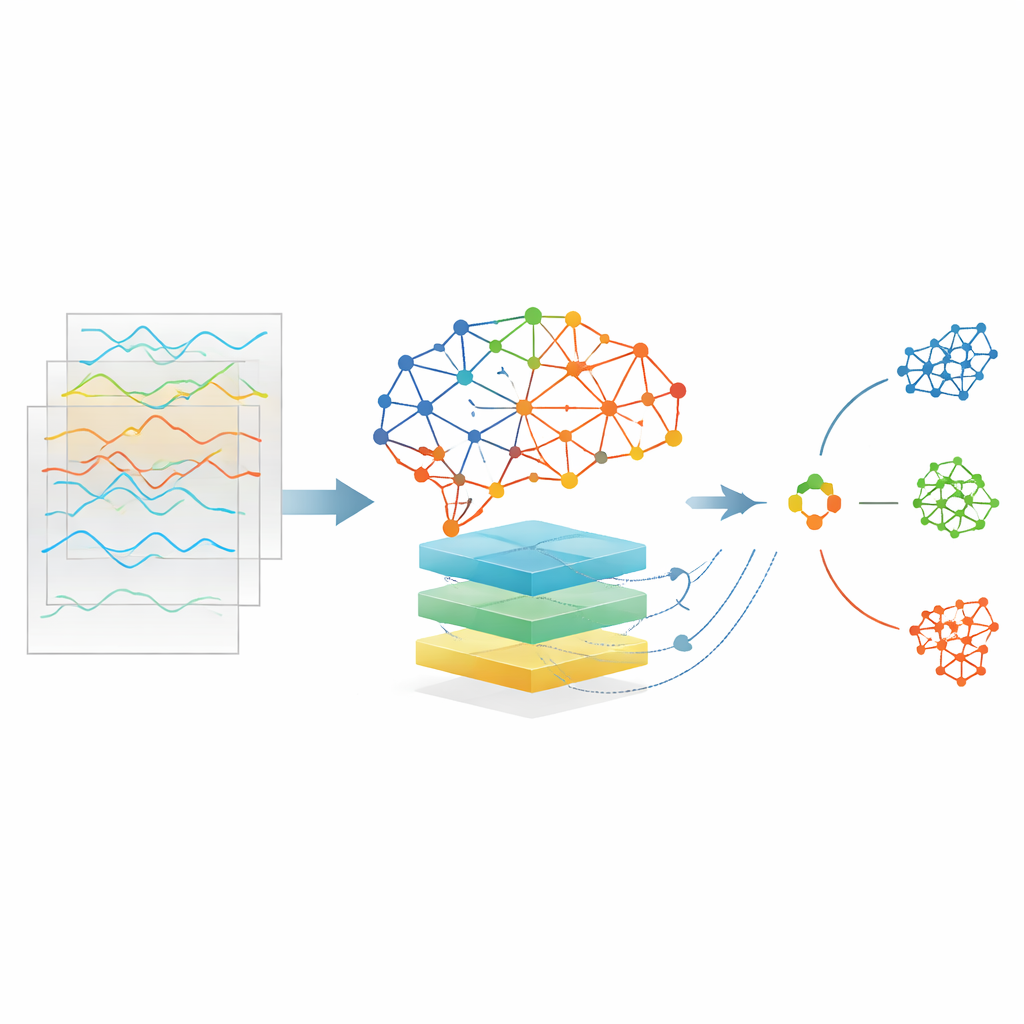
To tackle this, the team built a framework they call BrainADNet. First, they cut each person’s brain-signal recordings into overlapping time segments, like slicing a long song into many short clips. This clever step multiplies the amount of usable data and evens out differences between hospitals. For each segment, they measure how strongly pairs of brain regions rise and fall together, building a map of connections that can be viewed as a network: regions are dots, and their interactions are lines. Basic demographic details such as age, gender, and years of education are then woven into these network features, acknowledging that depression does not affect everyone in the same way.
Teaching a smart network to spot depression
The heart of BrainADNet is a specialized type of artificial intelligence called a graph neural network, designed to work directly with networks rather than flat images. The model, enhanced with “skip” connections, examines brain networks at several depths and then combines what it has learned from each level, much like a reader who uses both the big picture and fine details to understand a story. To avoid the system becoming overconfident about a narrow set of patterns, the authors add a decorrelation step that nudges the model to discover many different, non-overlapping features in the data. Training this system on thousands of brain-network snapshots, they then test whether it can tell healthy volunteers apart from patients, and further separate patients in their first, drug-free episode from those with repeated episodes.
What the model discovers about the depressed brain
Across a wide range of tests, BrainADNet consistently beats traditional machine-learning methods and several modern deep-learning approaches. It is better at distinguishing depressed individuals from healthy ones and at identifying whether someone is facing a first or recurrent episode. The model also travels well: when trained on scans from some hospitals and tested on a completely new hospital, its performance remains strong, hinting that it captures general features of depression rather than site-specific quirks. By using a technique that highlights which brain regions drive its decisions, the team finds that certain areas, such as parts of the parietal and frontal lobes and a structure called the cingulum, are especially important in both men and women, though each gender also shows its own distinct hotspots. The researchers further show that the hidden connection patterns learned by the model change systematically from healthy volunteers to first-episode patients and then to those with recurrent illness, reflecting how brain communication shifts as depression deepens.
How this work could shape future care
For non-specialists, the takeaway is that depression leaves detectable fingerprints in brain activity, and smart computer models like BrainADNet are getting better at reading them. While this system is not yet a tool your doctor can order in the clinic, it shows that combining brain scans with simple personal information can sharpen diagnosis, reduce mislabeling, and reveal how the condition differs between men and women and across stages of illness. In the long term, such approaches may support more personalized treatment plans, help identify people at high risk of relapse before symptoms flare, and guide new therapies that aim to restore healthy communication within the brain’s networks.
Citation: Barman, J., Yusuf, M., Kumar, S. et al. Enhancing depression diagnosis with augmented brain signal driven decorrelated graph neural networks. Commun Med 6, 211 (2026). https://doi.org/10.1038/s43856-026-01395-y
Keywords: major depressive disorder, functional MRI, brain connectivity, graph neural networks, computer-aided diagnosis