Clear Sky Science · en
A neural network for modeling human concept formation, understanding and communication
How minds turn sights into ideas
When you hear the word “dinner,” you can picture a table, smells, and sounds, even without seeing any food. This ability to turn rich sights and sounds into compact ideas and then call them back later underpins language, planning, and shared understanding. The paper introduces a new kind of artificial neural network that tries to capture this everyday magic of the human mind, offering insight into how brains might organize knowledge and how future machines could think in more humanlike ways.
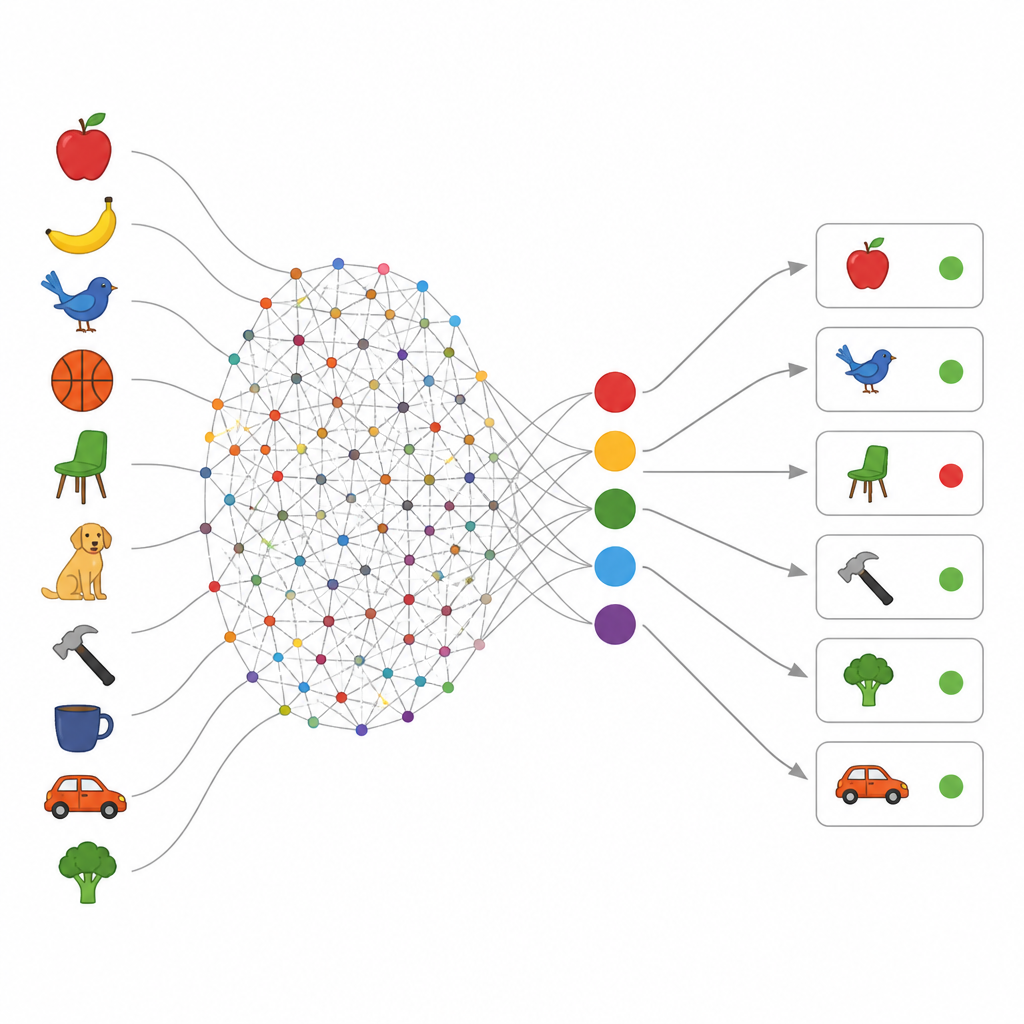
Packing rich experience into simple codes
The authors start from a simple question: how does the brain compress detailed sensory input into a smaller set of concepts, and then use those concepts flexibly? Current artificial networks are very good at recognizing images, but they hide what they learn inside millions of parameters, making it hard to reuse knowledge or share it with other systems. Large language models, on the other hand, depend on human words that already exist, rather than building concepts directly from pictures and sounds. The new framework, called CATS Net, is designed to model both concept formation and concept use within a single system, starting only from visual tasks.
Two cooperating modules for concepts and decisions
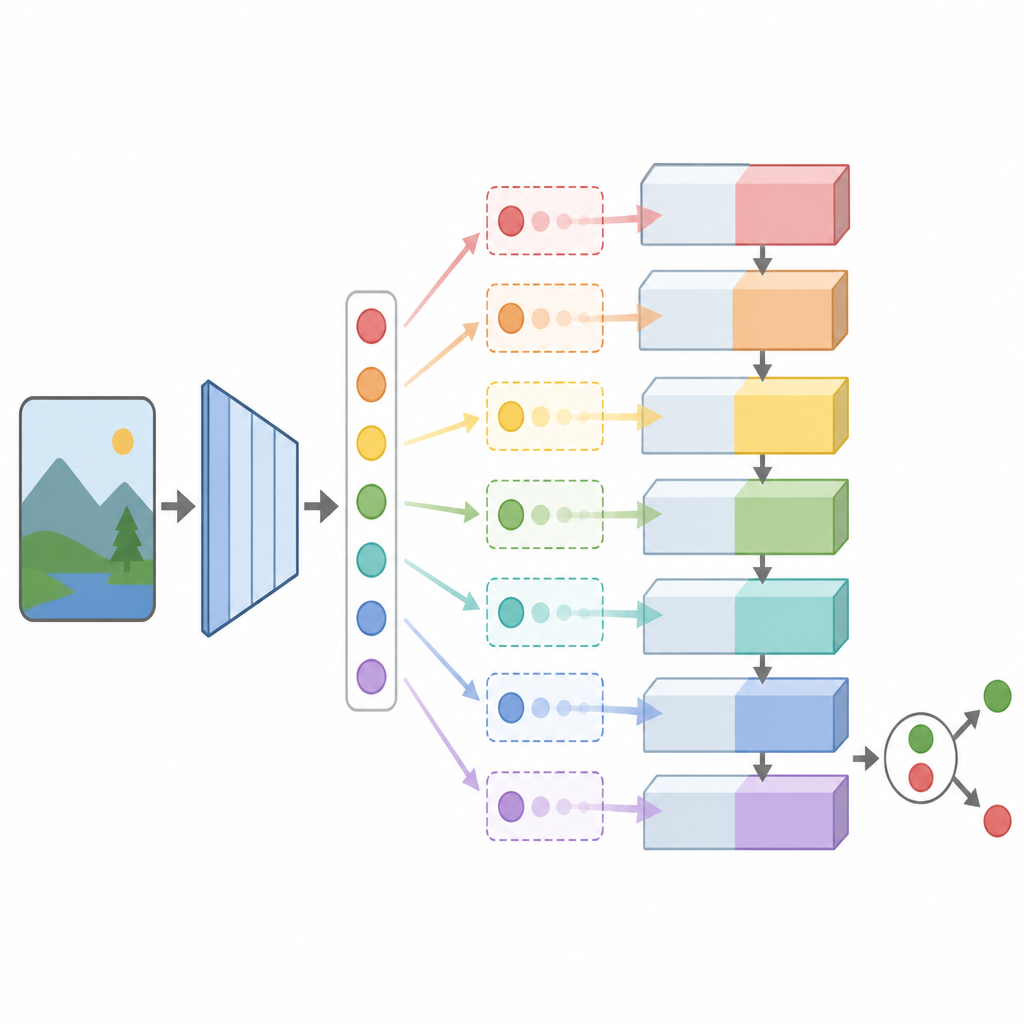
CATS Net splits thinking into two interacting parts. A concept abstraction module learns a short numerical code, or “concept vector,” for each kind of object, such as apples or buses, based on visual examples. A separate task solving module receives image features from a standard vision backbone and must answer simple yes or no questions like “Is this an apple?” The key trick is a gating process: the concept vector controls how activity flows through the task solving layers, reshaping the same network to handle different concepts without changing its core wiring. Training alternates between tuning the modules and adjusting the concept vectors, so that both the network and its internal concepts gradually specialize.
Discovering a humanlike map of meaning
Once trained on large image datasets, CATS Net not only classifies unseen pictures with high accuracy but also develops an organized “concept space.” Nearby codes tend to stand for related things, such as animals clustering together or tools forming their own group. The authors show that this arrangement is not arbitrary: it matches patterns found in human studies where people rate how similar objects feel, and in language based models that describe meaning along many dimensions, such as food, furniture, or emotional value. Remarkably, when the researchers compare the network’s internal similarity patterns to brain scans taken while volunteers name objects, they find that the concept layer aligns with activity in a high level visual region and that the gating module resembles areas involved in controlling access to meaning.
Sharing knowledge through concepts alone
The study also explores whether low dimensional concepts can serve as a common currency between different networks. The team trains separate “teacher” and “student” versions of CATS Net on overlapping sets of categories, then adds a small translation module that maps concept vectors from the teacher’s space to the student’s space. Without changing the main network weights, the student can use a translated concept vector for a category it never saw during training and still perform well above chance on yes or no judgments. In other tests, CATS Net successfully uses human derived concept spaces built from language statistics and behavioral data, treating them as if they were its own internal codes.
Why this matters for minds and machines
Taken together, these results suggest that compact concept codes, combined with flexible gating of sensory processing, may offer a workable recipe for humanlike conceptual thinking. The model shows how rich visual experiences can be compressed into reusable, shareable representations that line up with patterns in both human behavior and brain activity. Although the work focuses on concrete objects we can see and name, it points toward future systems that could also capture more abstract ideas, bringing artificial intelligence a step closer to the way people form, understand, and communicate concepts.
Citation: Guo, L., Chen, H., Chen, Y. et al. A neural network for modeling human concept formation, understanding and communication. Nat Comput Sci 6, 497–511 (2026). https://doi.org/10.1038/s43588-026-00956-4
Keywords: concept formation, neural networks, semantic cognition, brain alignment, concept communication