Clear Sky Science · en
Exoproteome of calorie-restricted humans identifies complement deactivation as an immunometabolic checkpoint reducing inflammaging
Why eating a bit less could matter for healthy aging
Many people have heard that cutting calories can help animals live longer, but it has been unclear how this might work in humans. This study followed adults who gently reduced their calorie intake for two years and looked deep into their blood to see how their bodies changed. The researchers focused on how the immune system and metabolism interact as we age, and they uncovered a specific blood signal that may help explain why eating a little less can ease the slow burn of age-related inflammation.
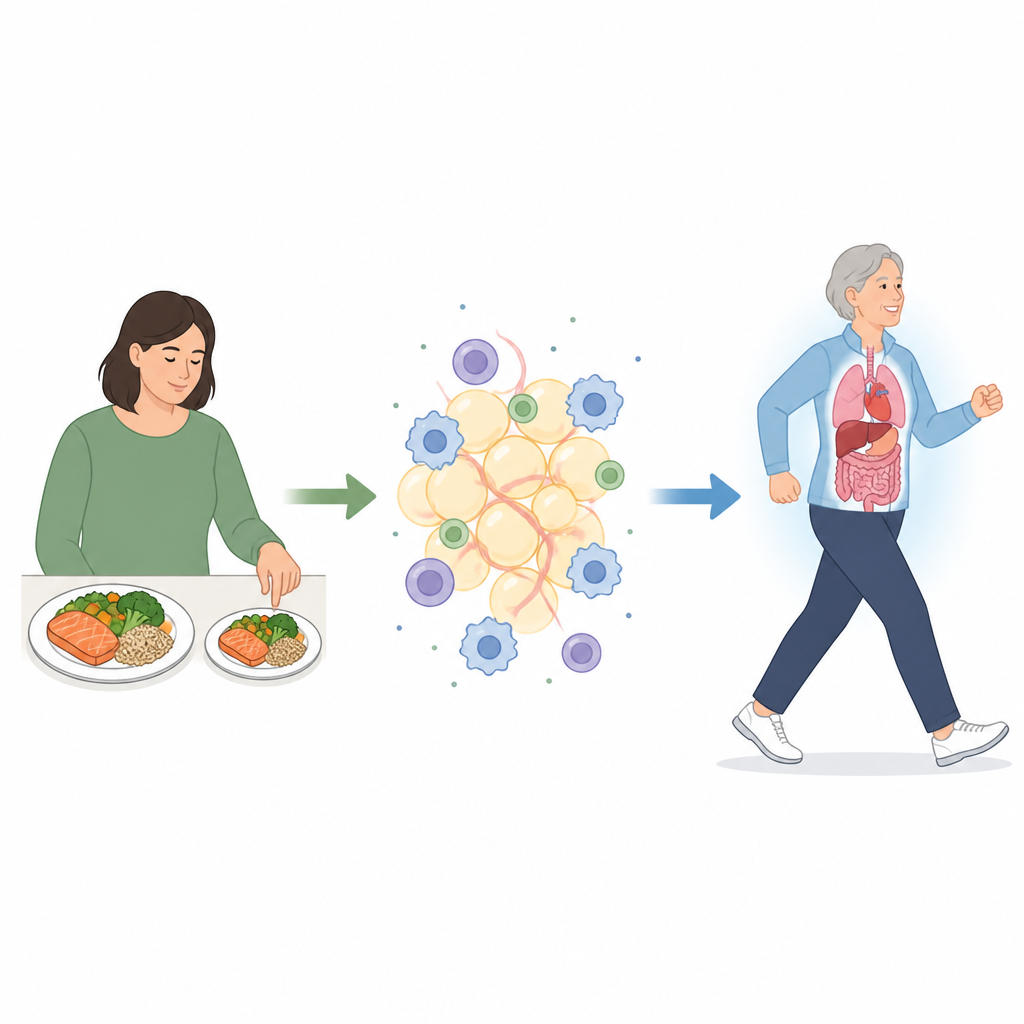
Following people who chose smaller portions
The participants were 42 healthy men and women in their 30s and 40s who were not obese. They took part in a trial where one group reduced their daily calories by about 14 percent for two years, a cut small enough to be practical but large enough to cause about 10 percent weight loss. The team used a high-throughput method to measure over 7,000 proteins in plasma, the liquid part of blood, at the start of the study and after two years. This broad survey let them see how many biological pathways shifted in response to long-term modest calorie reduction, from hormone regulation to immune activity.
Signals of slower aging in fat tissue
When the researchers analyzed which proteins changed, they saw patterns that have been linked to healthier aging in animals. Levels of proteins that make insulin-like growth factor more active, often tied to growth and aging, moved in a direction suggesting lower growth drive. Hormones related to fat tissue health, such as adiponectin and leptin, also shifted in a favorable way. Using a computational tool that infers how “old” different organs appear based on blood proteins, the team found that calorie reduction mainly made adipose tissue, or body fat, look younger, while most other organs showed little change. This pointed to fat as a key site where eating less may slow aspects of aging.
Turning down an overactive immune alarm
One of the strongest changes was a broad drop in components of the complement system, a set of blood proteins that help fight infections. In aging, these proteins often become chronically elevated and can drive low-grade inflammation. The study found that a particular fragment called C3a, which is generated when the central complement protein C3 is cut, fell significantly in people who reduced calories, even after accounting for changes in body mass index. At the same time, many other inflammatory markers decreased, suggesting that lower C3a goes hand in hand with a calmer, less overactive immune state in midlife adults.
Zooming in on fat and immune cells in mice
To understand where C3a comes from and how it fuels age-related inflammation, the researchers turned to mice. They showed that as mice age, C3a levels rise, and the most active source of C3 cutting lies in visceral fat, the fat that surrounds internal organs. Within this tissue, a specific group of macrophages, a type of immune cell, produced more C3 and responded to its fragment C3a through a self-stimulating loop. This loop switched on a signaling pathway inside the cells and boosted production of inflammatory molecules. When the team blocked C3a directly in the fat of old mice with a targeted antibody, inflammation in the tissue and blood decreased, and immune cell populations shifted toward a more balanced, less inflammatory mix.
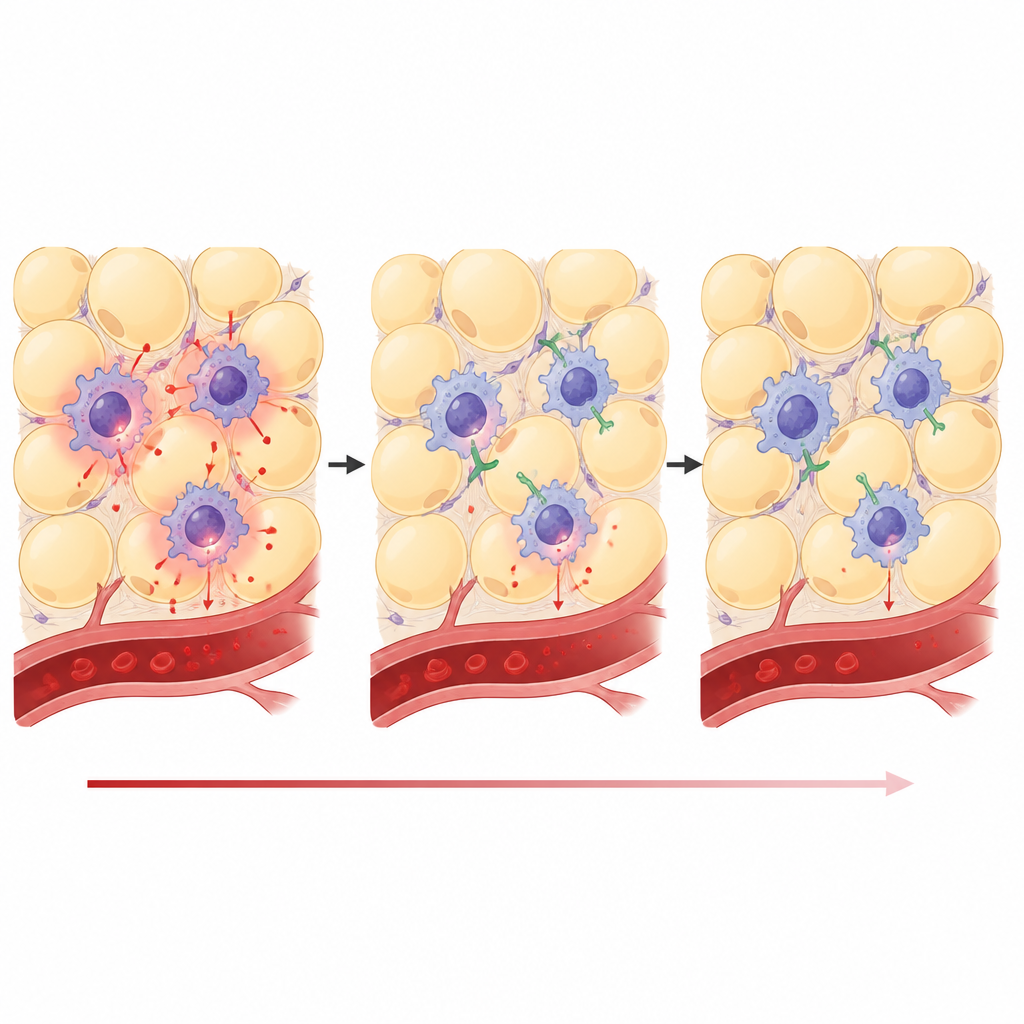
How calorie cutting connects to longevity signals
The study also linked C3a to other longevity-related pathways in mice. Animals engineered to have higher levels of the hormone FGF21, or to lack the enzyme PLA2G7, both of which have been connected to longer healthspan, showed reduced cutting of C3 in their fat tissue. This suggests that lower C3a may be a common thread uniting several interventions that extend healthy life in animals, including calorie restriction. The work highlights complement deactivation as an immunometabolic checkpoint, meaning a control point where metabolism and immune activity meet to influence aging.
What this means for healthy aging
For a lay reader, the key message is that modest, sustained calorie reduction in humans appears to quiet a specific immune alarm linked to aging, especially in deep belly fat. By dialing down C3a, the body may reduce smoldering inflammation that accumulates with age, known as inflammaging, without shutting off the immune system entirely. While more work is needed before any treatment could be recommended, including careful trials of complement-blocking drugs, this research suggests that both lifestyle choices and targeted medicines might one day help people age with less chronic inflammation and better metabolic health.
Citation: Mishra, M., Kim, HH., Youm, YH. et al. Exoproteome of calorie-restricted humans identifies complement deactivation as an immunometabolic checkpoint reducing inflammaging. Nat Aging 6, 1064–1078 (2026). https://doi.org/10.1038/s43587-026-01107-0
Keywords: calorie restriction, inflammaging, visceral fat, complement C3a, healthy aging