Clear Sky Science · en
Coordinated volatile isoprenoid production and leaf turnover strategy protect central Amazon Forest trees against stress
Why Amazon trees and their scents matter
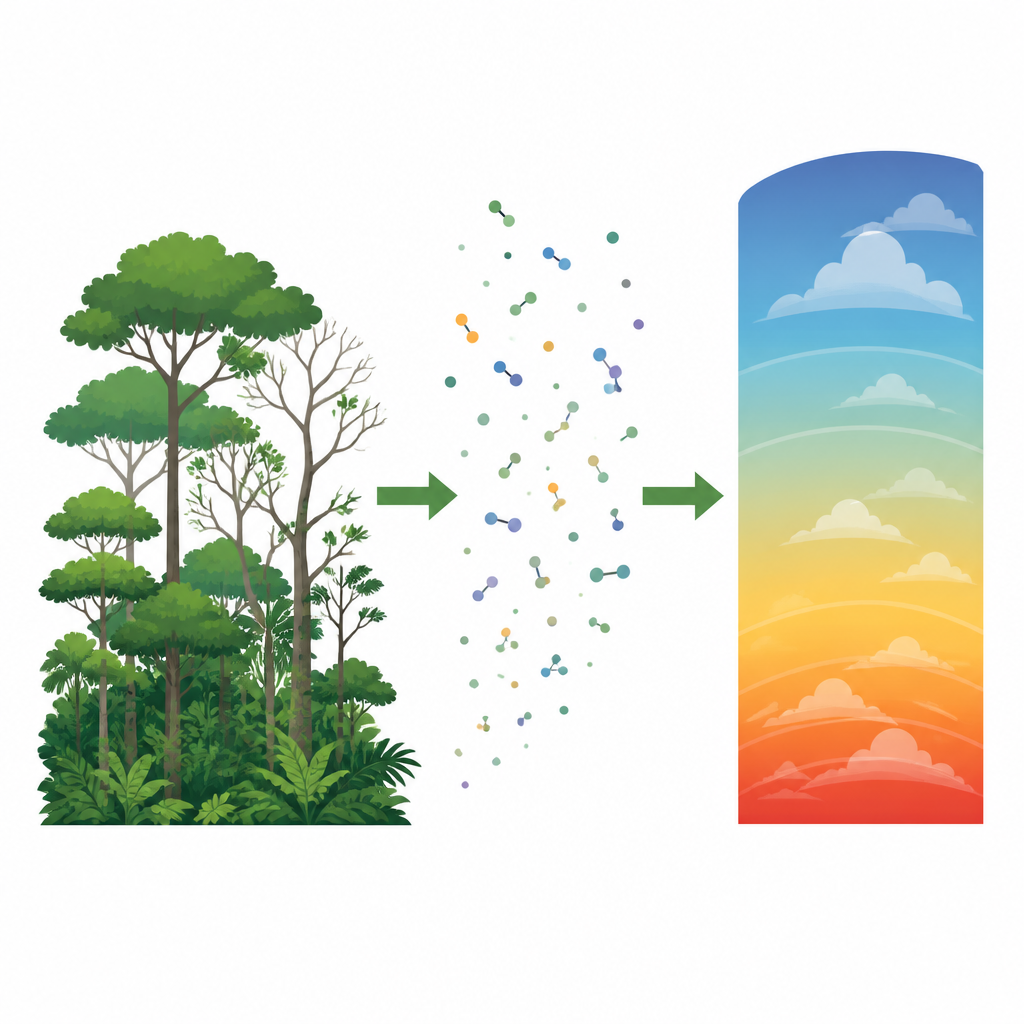
The Amazon Forest is not only a huge storehouse of carbon, it is also a powerful chemical factory. Its trees constantly release invisible gases that interact with sunlight and air, helping to shape clouds, air quality, and climate. This study explores how different types of Amazon trees trade leaves and release protective vapors as the forest warms and dries, revealing hidden strategies that could influence the future of the region and the planet.
Two ways to keep leaves alive
Amazon trees do not all follow the same script when it comes to their leaves. Some species are evergreen, holding on to foliage year round and replacing it gradually. Others are brevideciduous, dropping most of their crowns for a few weeks during the dry season before flushing a fresh set of leaves. Scientists suspected that this leaf turnover pattern might help trees cope with drought and insect attack. The new work shows that these contrasting leaf habits are tightly linked to how trees use and protect their leaves under heat and light stress.
Protective vapors in a warming forest
Trees release a family of carbon based vapors known as volatile isoprenoids, which include isoprene, monoterpenes, and sesquiterpenes. These gases act like chemical shields, helping leaves tolerate high temperatures and repel herbivores, but they also cost carbon that could otherwise go into growth. By measuring emissions from 12 tall canopy trees in the central Amazon under controlled light and temperature, the researchers found that all compounds increased with leaf temperature. Brevideciduous trees showed especially strong rises in heavier, more reactive monoterpenes and sesquiterpenes as leaves heated up, while evergreens tended to respond more gently.
Different survival strategies in the canopy
The team also tracked how efficiently leaves used light and handled heat. Brevideciduous trees that emit isoprene showed superior baseline photosynthesis and tended to work well under stronger light, matching the idea that isoprene helps them run hard during hot, bright periods. At the same time, these trees invested heavily in reactive vapors when leaves approached their thermal limits, sometimes losing more than ten percent of their photosynthetic carbon to emissions and even tapping stored carbon once photosynthesis stalled. Evergreen trees that did not emit isoprene followed another path: they kept higher baseline stomatal opening and more thermally stable light harvesting, relying less on chemical clouds and more on steady gas exchange and water transport safety.
From leaf level chemistry to atmosphere wide effects
Because these vapors oxidize rapidly in the air and can form particles that seed clouds or promote ozone, changes in their mix and amount can ripple far beyond the forest. The researchers showed that as leaves warmed, the balance shifted from lighter to heavier vapors with different lifetimes and reactivity, meaning that heat waves can alter both the cost to the tree and the impact on the atmosphere. Using their leaf level measurements, they recalculated canopy isoprene fluxes for a well studied Amazon site and compared them with values from a standard global model that ignores leaf turnover strategies. The common model consistently overestimated isoprene release, especially from the dominant evergreen trees, by up to several fold.

Rethinking how we simulate the Amazon
For a layperson, the bottom line is that not all Amazon trees protect themselves in the same way, and these differences matter for climate predictions. Brevideciduous species appear to rely on coordinated bursts of leaf replacement and potent chemical defenses during the dry season, whereas evergreens lean on more stable water and energy use. Current computer models smooth over this variety, which leads them to misjudge how much protective vapor the forest sends into the air. By building models that respect these leaf level strategies, scientists can better estimate how the Amazon will respond to hotter, drier conditions and how its vast green canopy will continue to influence clouds, air chemistry, and the global climate system.
Citation: Robin, M., de Souza, V.F., Byron, J. et al. Coordinated volatile isoprenoid production and leaf turnover strategy protect central Amazon Forest trees against stress. Commun Earth Environ 7, 451 (2026). https://doi.org/10.1038/s43247-026-03668-9
Keywords: Amazon forest, leaf phenology, isoprene emissions, plant stress, atmospheric chemistry