Clear Sky Science · en
Anthropogenic radionuclides as tracers of climate change in the Pacific Ocean
Invisible markers in a changing ocean
The Pacific Ocean quietly soaks up most of the planet’s extra heat and a large share of our carbon emissions, helping to slow atmospheric warming. Yet this vast reservoir is hard to observe directly. This study explains how traces of human-made radioactivity left by nuclear tests, accidents and facilities act like dye in a bathtub, revealing how Pacific waters move, mix and respond to climate change over decades.
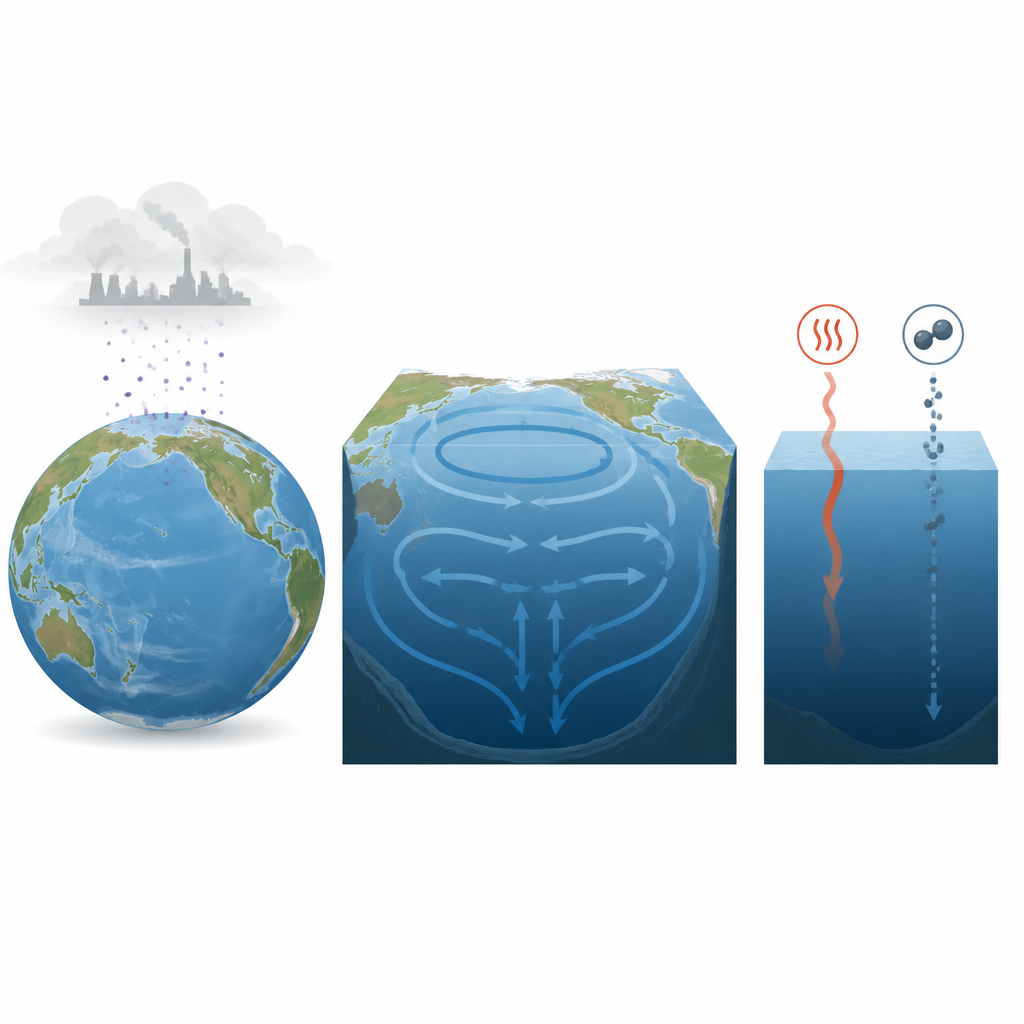
How human signals entered the sea
During the 1950s and 1960s, atmospheric nuclear weapons tests released clouds of radioactive particles that eventually settled worldwide, with a large share falling on the Pacific. Later, nuclear accidents and carefully controlled discharges from nuclear plants added more material, though on a smaller scale. The authors focus on three main substances: tritium, a form of hydrogen that moves with the water itself; cesium 137, which mostly stays dissolved; and plutonium isotopes, which readily stick to particles. Because scientists know when and where these materials entered the environment, their changing patterns in seawater and sediments provide time stamps that track ocean circulation and mixing.
Following tritium and cesium through the Pacific
Long records of tritium measurements along key north–south lines show how this tracer has slowly penetrated from the surface into the ocean interior. Since the 1970s, tritium has reached deeper layers, but its total amount in the upper ocean is decreasing more slowly than expected from radioactive decay alone. This slowdown points to reduced ventilation, meaning that surface waters are mixing less efficiently with the deep. Cesium 137 tells a complementary story. After peaking in the 1960s from global fallout, surface levels have generally declined, but not at a constant rate. Models and measurements suggest circulation in parts of the northwest Pacific has slowed, allowing cesium to linger longer. The Fukushima accident in 2011 briefly rebrightened this tracer, and its spread across the North Pacific confirmed pathways that connect surface waters to the deeper layers and to other ocean basins.
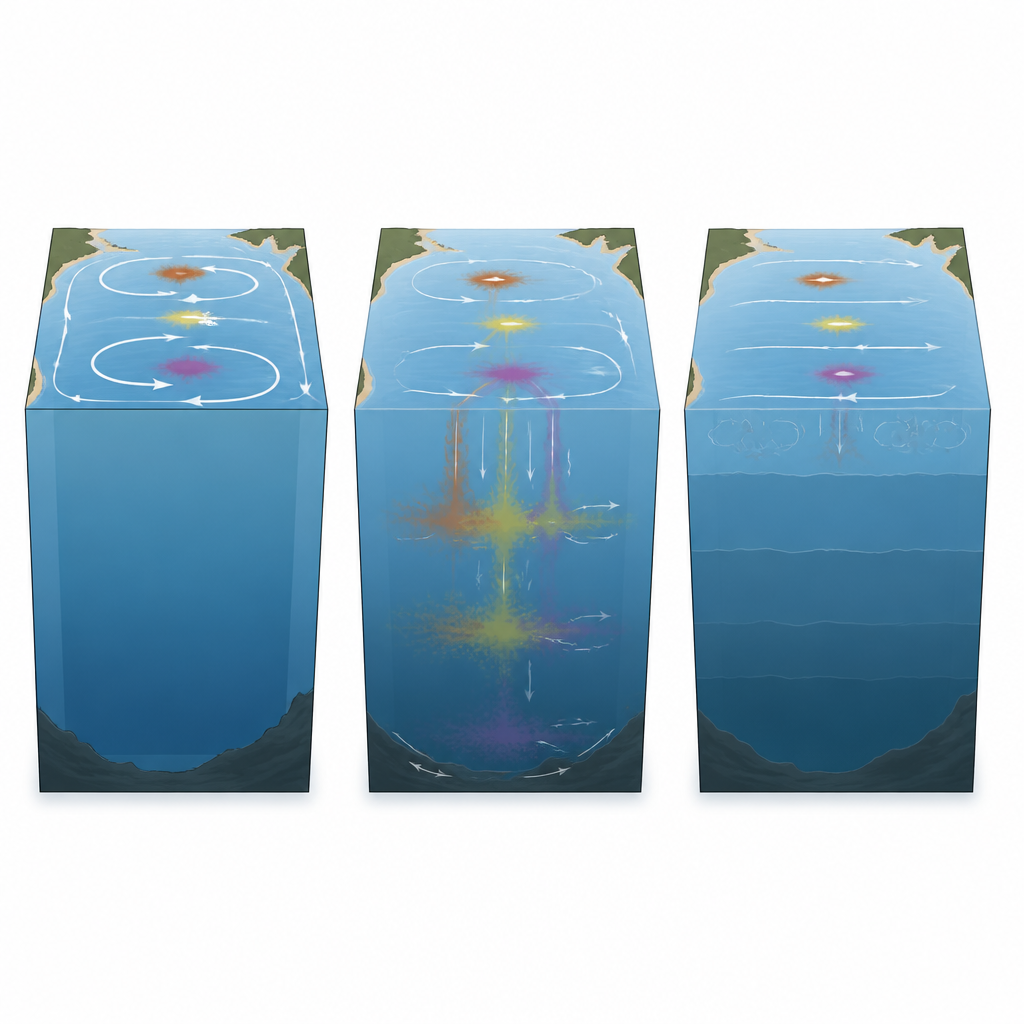
What sticky particles say about deep waters
Plutonium behaves differently because it clings to tiny particles that sink, dissolve and sink again, shuttling the element up and down. Its various isotopes carry distinct fingerprints from different test sites, allowing scientists to distinguish material from global fallout versus close-in tests in the tropical Pacific. Over the last few decades, mid-depth peaks of plutonium in the North Pacific have faded without building up at greater depths, implying that currents have swept this material sideways toward the Southern Hemisphere. Changes in the ratio of plutonium to cesium with depth reveal shifts in how quickly particles fall, where they break down, and how strongly waters are stirred vertically. These patterns are tied to how efficiently the ocean’s “biological pump” can lock carbon away in the deep sea.
Connecting ocean basins and a warming marginal sea
By combining tracer observations with computer models, the authors show that the North Pacific acts as a major source of tagged water for the Indian and South Atlantic Oceans, feeding the planet-spanning overturning circulation sometimes called the global conveyor belt. Traces of cesium and plutonium help outline routes through narrow passages like the Indonesian seas and around southern Africa, constraining how quickly waters move between basins. A smaller, semi-enclosed basin, the Sea of Japan, serves as a natural laboratory. There, strong warming at the surface has weakened deep winter mixing and slowed the renewal of cold bottom waters. Time series of plutonium, cesium and strontium in this sea clearly record these changes, and the swirling eddies that dominate its circulation leave sharp, short-term signatures in the tracer patterns.
What these tracers reveal about climate change
Taken together, the radionuclide records support a picture of a Pacific Ocean whose upper layers are warming and becoming more stratified, with slower exchange between surface and depth and signs of a broader weakening of the global overturning circulation. Rather than focusing on radiation hazards, the study uses these faint human-made signals as practical tools for tracking heat, carbon and nutrients across the world’s largest ocean. Continued measurements of these tracers, especially in poorly sampled southern regions, will help scientists refine climate models and better understand how the ocean’s ability to buffer climate change may evolve in the future.
Citation: Povinec, P.P., Hirose, K., Hong, GH. et al. Anthropogenic radionuclides as tracers of climate change in the Pacific Ocean. Commun Earth Environ 7, 427 (2026). https://doi.org/10.1038/s43247-026-03639-0
Keywords: Pacific Ocean circulation, anthropogenic radionuclides, tritium and cesium tracers, plutonium isotopes, climate driven ocean change