Clear Sky Science · en
Rhodoliths can act as daily resolution paleotemperature archives in the Red Sea
Why tiny reef stones matter
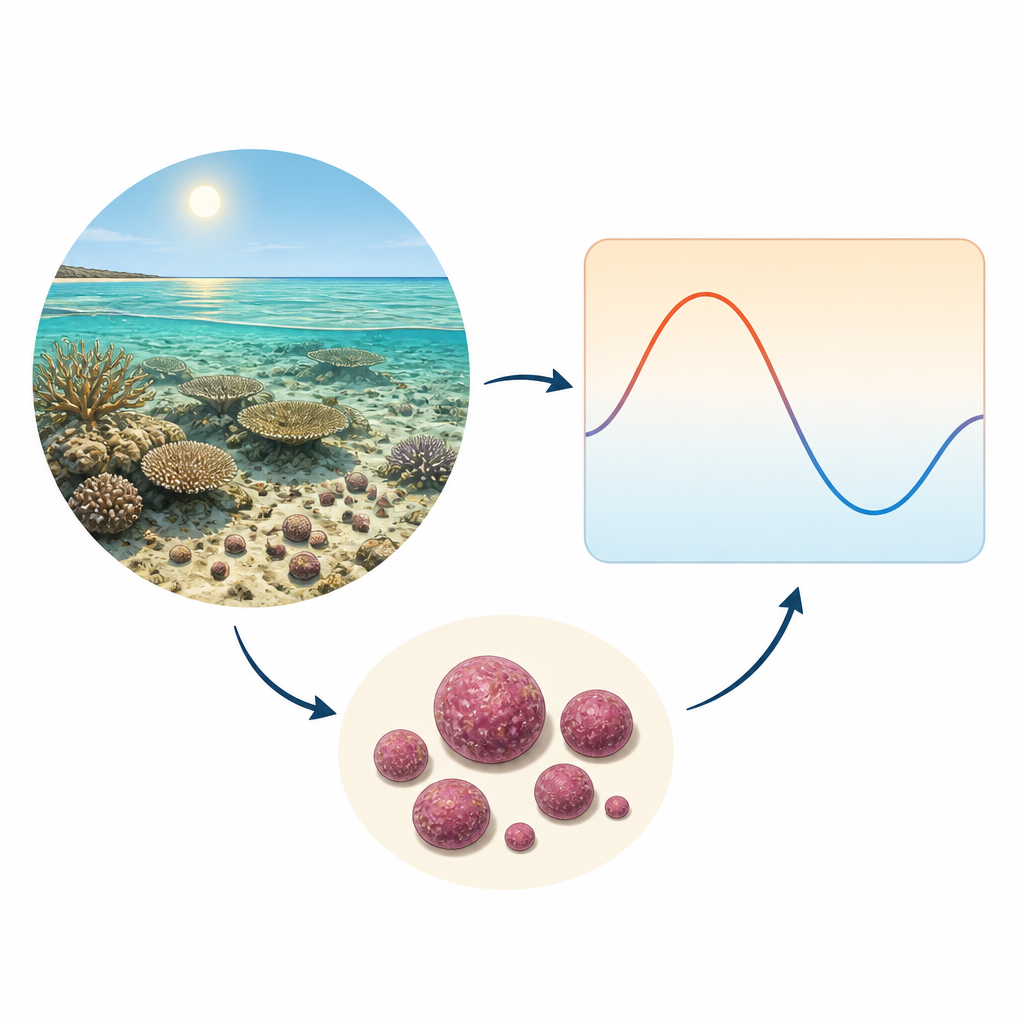
In the race to understand how fast oceans are warming and how coral reefs will cope, scientists need records of past seawater temperatures that are as detailed as possible. Thermometers in the sea and satellite images can tell us how warm the surface is, but they miss the fine daily swings that reef creatures actually experience. This study shows that small, freely rolling nodules of red algae called rhodoliths can capture day by day temperature changes in the Red Sea, opening a new window into the thermal history of some of the planet’s hottest reefs.
Natural recorders on the reef floor
On shallow reef flats in the central Red Sea, temperatures can swing from about 18 to nearly 38 degrees Celsius, sometimes changing by more than 10 degrees in a single day. These harsh conditions threaten corals but are ideal for testing which organisms can reliably record temperature. Rhodoliths are globe like clusters of hard, pinkish red algae that roll around on the seafloor as they grow. Unlike many corals and shellfish, similar coralline algae live in many oceans and depths, making them an attractive, but so far underused, natural archive of environmental change.
Turning growth bands into a calendar
The challenge with rhodoliths is that their branches grow in complex three dimensional patterns, breaking their history into many small pieces rather than a neat layered stack. The researchers worked with one rhodolith from a Red Sea reef flat, first marking its living surface with a special red stain before placing it back on the reef for about four months. When they later recovered it, they could clearly see where new skeleton had formed after staining. Using powerful micro computed tomography scans, they built three dimensional images of 21 tiny branches and measured the thickness of growth bands formed during the 133 day experiment.
Reading chemistry as a thermometer
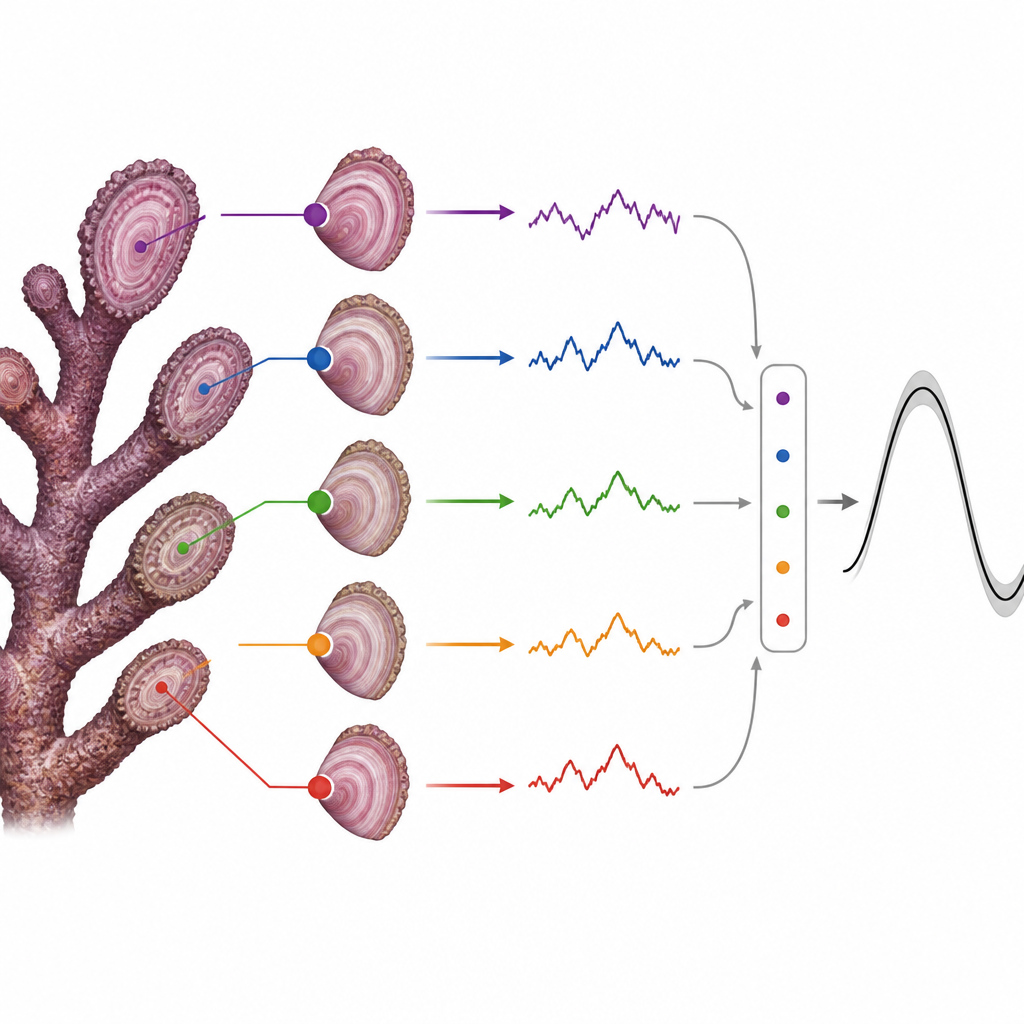
From seven of the best preserved branches, the team sampled the skeleton along the direction of growth and measured many trace elements relative to calcium. The ratio of magnesium to strontium in the skeleton turned out to be especially useful because magnesium reflects temperature while strontium is tied to how fast the algae calcify. By combining these two signals into a single ratio, the scientists reduced much of the biological noise that usually blurs such records. They compared these chemical patterns with temperatures recorded every hour by instruments next to the rhodolith cages and tested different mathematical combinations to find those that tracked temperature most closely.
Weaving scattered strands into one timeline
Because each rhodolith branch grew at its own pace, the daily signals in the chemistry did not line up neatly from one branch to the next. To solve this, the team used a technique called dynamic time warping, which carefully stretches and compresses the individual chemical time series so that similar patterns align in time without making biologically unrealistic jumps. They added constraints so that the alignment could not shift dates by more than about a month and checked with statistical tests that the strong match to measured temperatures could not be reproduced by random data. When they averaged the aligned records from all seven branches, the combined reconstruction matched the in situ temperature loggers with high precision.
What this means for coral reef futures
The study shows that rhodoliths can serve as finely detailed paleothermometers capable of resolving daily to sub weekly temperature changes in a tropical reef setting. By pairing advanced three dimensional imaging with multi element chemistry and careful time alignment, the authors created a proof of concept framework that achieves an accuracy of about two thirds of a degree Celsius over 133 days. For a lay observer, this means that humble pink stones on the seafloor can tell the story of how hot reefs have been in the recent past. As corals and other traditional climate archives become more stressed by warming and acidification, resilient coralline algae like these may provide crucial records of small scale temperature swings that influence bleaching, reef growth, and the long term health of tropical oceans.
Citation: Li, L.Y., Bernal-Tamayo, J.P., Hetzinger, S. et al. Rhodoliths can act as daily resolution paleotemperature archives in the Red Sea. Commun Earth Environ 7, 439 (2026). https://doi.org/10.1038/s43247-026-03603-y
Keywords: rhodoliths, Red Sea, coral reefs, paleotemperature, ocean warming