Clear Sky Science · en
Macroalgal and seagrass species generate variable amounts of recalcitrant dissolved organic carbon in coastal Japan
Why underwater plants matter for climate
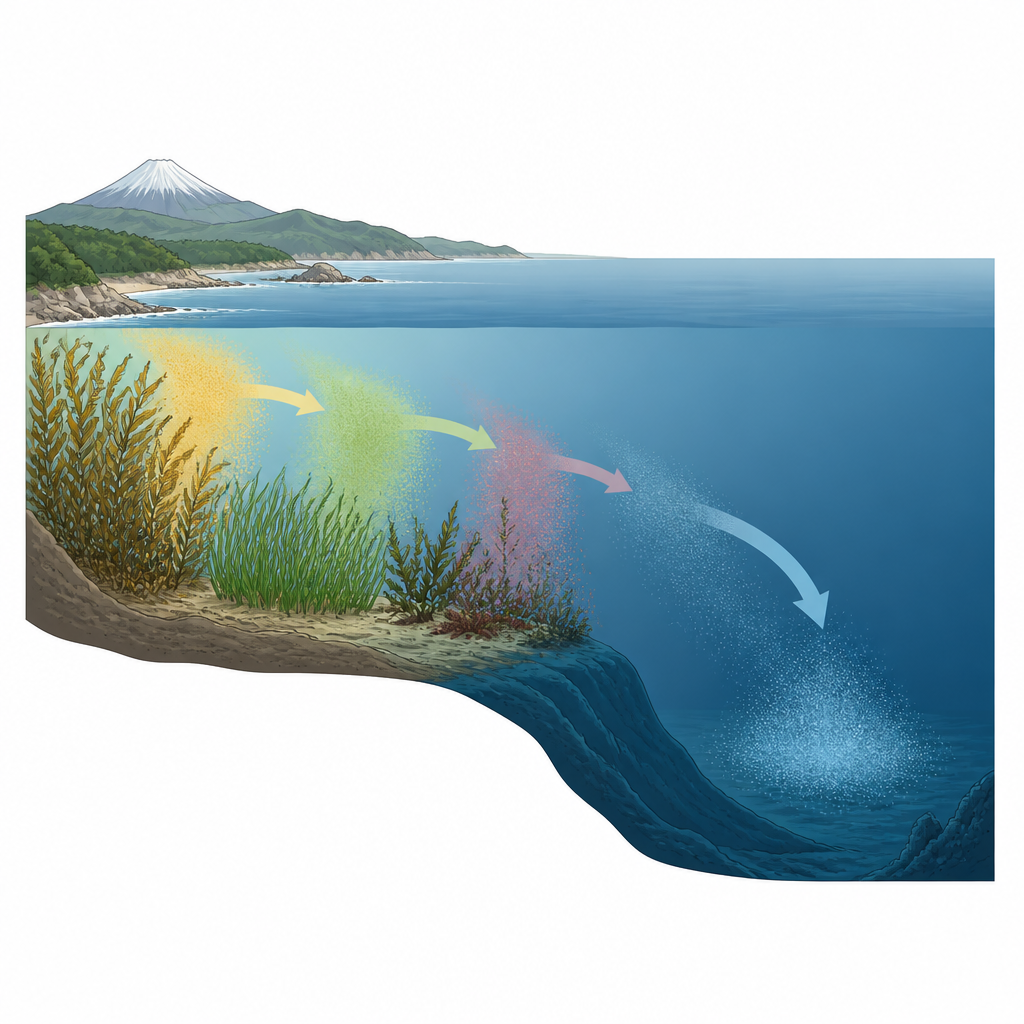
Along many Japanese coasts, forests of seaweeds and meadows of seagrass quietly pull carbon dioxide from the air–sea system and turn it into organic matter. This study asks what happens to a particular invisible product of that growth: dissolved organic carbon, a carbon-rich mix that leaks from plant tissues into seawater. By tracking how much of this material resists decay for decades, the researchers show that these coastal plants help lock away carbon in the ocean for climate-relevant timescales.
Hidden carbon from seaweeds and seagrass
Seaweeds and seagrasses, known together as marine macrophytes, do not only store carbon in their leaves and stems. They continually release part of their production as dissolved organic carbon, which mixes into surrounding waters and can be carried far from the shore. Until now, scientists had only rough ideas of how much of this dissolved carbon lingers in the ocean rather than being quickly broken down. This uncertainty has made it hard to judge how important coastal vegetation is for long term carbon storage, often referred to as blue carbon.
Testing coastal waters across Japan
The team carried out field experiments at 18 sites from cold northern waters to subtropical seas around Japan, working with more than twenty seaweed species and six seagrass species. They enclosed freshly collected plants in large water bags in their natural habitat for a few hours to measure how much dissolved carbon they released and how much they grew through photosynthesis. On average, both seaweeds and seagrasses released roughly a quarter to a third of their daily production as dissolved carbon, though individual species and locations varied by two orders of magnitude. Red seaweeds and some small leafy species showed especially high leakage.
Following dissolved carbon over months and decades
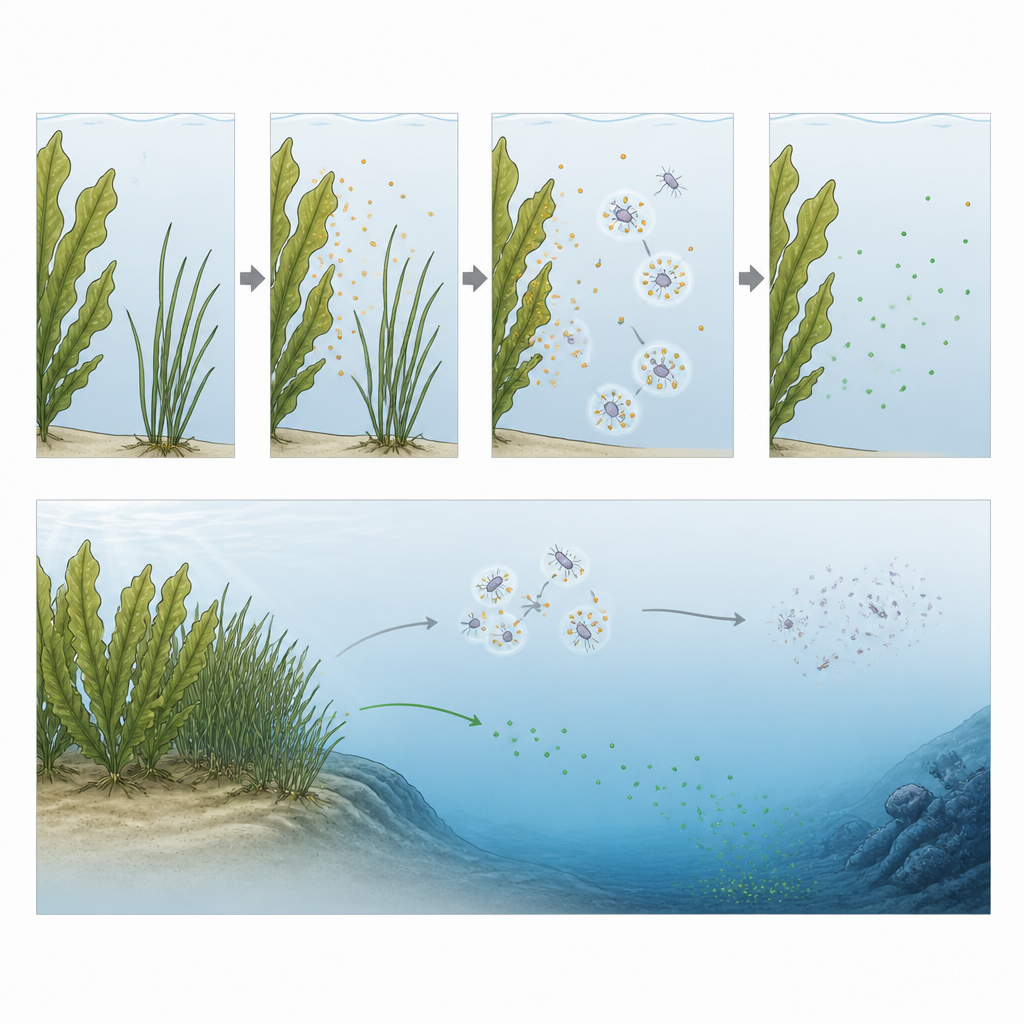
To see what fraction of this dissolved carbon endures, the scientists then incubated the collected seawater in the dark at a fixed room-like temperature for up to 300 days. Most of the dissolved carbon disappeared within the first three months, but a substantial fraction remained and broke down only very slowly. Using a mathematical description called a reactivity continuum model, they projected how much would still be present after 25 and 100 years. They estimated that about 25 percent of seagrass-derived dissolved carbon and 14 percent of seaweed-derived dissolved carbon could still be present after a century, meaning it behaves as a long-lived reservoir on human timescales.
What makes some dissolved carbon last
The researchers probed the chemical nature of this stubborn carbon by shining light of different colors through the water and analyzing the resulting glow, a method that reveals broad types of dissolved compounds. Components with humic-like signals, which resemble dark, plant-derived substances found in soils and rivers, tended to increase during the months-long incubations and were strongly linked to the amount of long lived dissolved carbon. In contrast, protein-like components declined as microbes consumed them. Additional tests that exposed samples to sunlight, extra nutrients, and new microbial communities showed that even when conditions favored breakdown, a sizeable pool of dissolved carbon still persisted, suggesting that chemical structure, not just lack of microbes or nutrients, makes it hard to decompose.
Implications for ocean carbon storage
By combining the measured release rates with the century-scale persistence estimates, the team calculated that, on average, about 4 percent of the yearly carbon production of seaweeds and 8 percent of that of seagrasses can end up as long lasting dissolved carbon. These fractions are comparable to or larger than earlier estimates of carbon stored as sinking particles from the same habitats. In plain terms, underwater forests and meadows do not only trap carbon in their sediments; they also feed a slow moving dissolved carbon pool that can stay in the ocean for decades as currents carry it away. Recognizing this hidden pathway strengthens the case for protecting and restoring seaweed beds and seagrass meadows as part of broader climate strategies, while also highlighting the need to better track how this long lived dissolved carbon moves through the global ocean.
Citation: Watanabe, K., Hori, M., Kubo, A. et al. Macroalgal and seagrass species generate variable amounts of recalcitrant dissolved organic carbon in coastal Japan. Commun Earth Environ 7, 456 (2026). https://doi.org/10.1038/s43247-026-03600-1
Keywords: blue carbon, seagrass, macroalgae, dissolved organic carbon, carbon sequestration