Clear Sky Science · en
Supply-security narratives have dominated EU raw materials policy, while demand reduction has been sidelined
Why Europe’s raw materials story matters
From smartphones to wind turbines, modern life in Europe runs on metals and minerals that mostly come from elsewhere. This article looks at how the European Union has talked and thought about these raw materials over the past 25 years, and asks a simple but powerful question: why has cutting demand and using less remained a side note, while securing more supply has dominated policy? 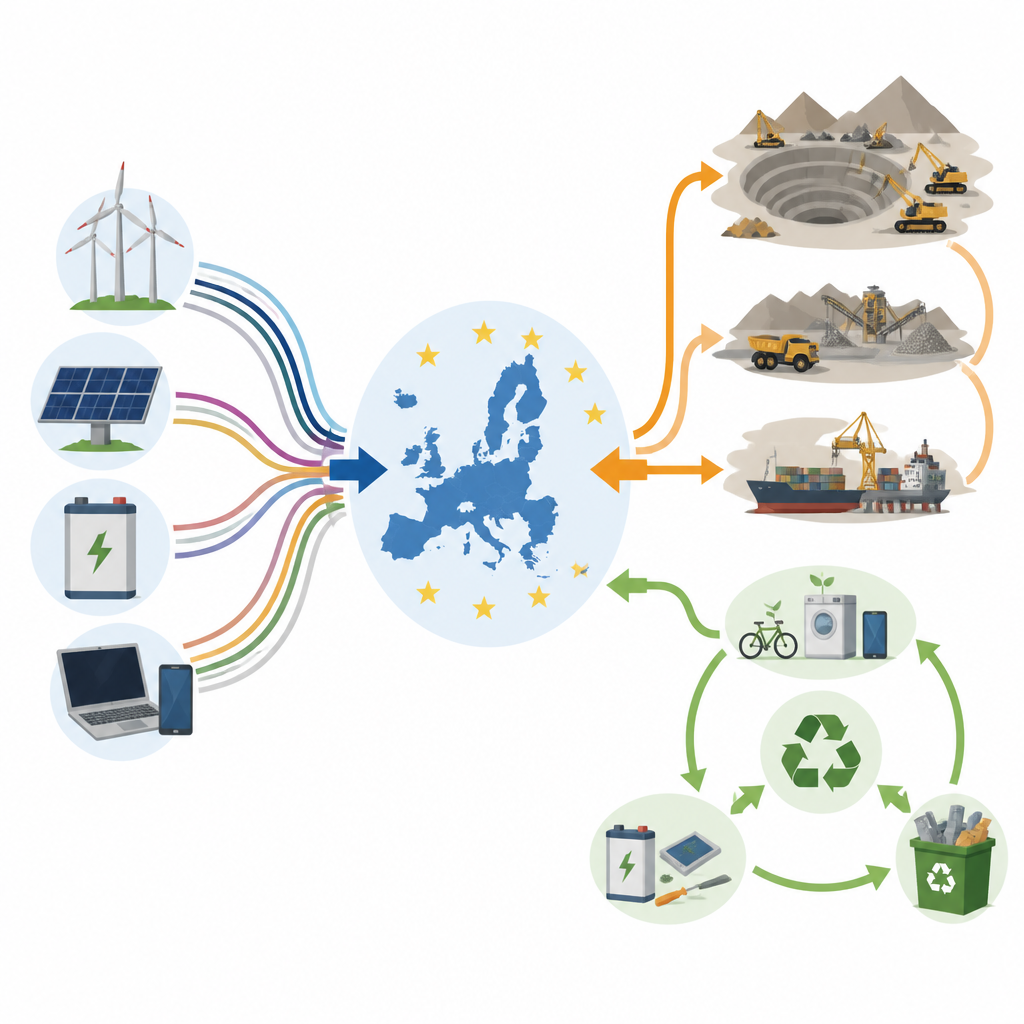
How Europe came to focus on getting more
The authors analyzed 183 policy documents produced between 2000 and 2024 by EU institutions, industry groups, researchers and civil society. They found that official thinking has centered on a single concern: keeping European industry supplied so it can stay competitive. Early on, this took the form of a “corporate competition” story, pushed mainly by business groups. Rising global demand, higher prices and export limits from countries like China were framed as threats to Europe’s status as an industrial powerhouse. The answer was to secure access to raw materials through new trade deals, lighter rules for mining at home, improved monitoring and support for companies.
Green goals without using much less
After the financial crisis and with climate change climbing the agenda, a second story took shape: the EU as a “green frontrunner.” In this version, the same metals and minerals were recast as the building blocks of a clean energy future, from solar panels to electric cars. Policies began to speak of a circular economy, responsible mining and conflict-free supply chains. Yet, the basic logic stayed the same. Raw materials were still treated mainly as fuels for growth, and environmental and social rules were often justified as a way to protect Europe’s long-term economic strength, rather than as reasons to reduce overall demand.
Voices calling for fairness and sufficiency
Parallel to these official stories, non-governmental groups and some researchers promoted alternative narratives. First came a “neo-extractivism” story, which highlighted how Europe’s hunger for minerals shifts pollution, land conflicts and human rights abuses to communities in the Global South. Later, a broader “resource justice” story emerged, arguing that even green technologies can harm people and nature if mining expands unchecked. These voices called for absolute demand reduction, stricter company duties, meaningful involvement of affected communities and the right for them to refuse projects. However, their ideas were rarely turned into binding rules, and when elements were picked up, they were often softened and fitted back into the dominant growth-focused frame.
Geopolitics and the rush for “strategic autonomy”
In the 2020s, the COVID-19 pandemic and Russia’s invasion of Ukraine exposed how fragile global supply chains could be. A third major story rose to prominence, centered on “strategic autonomy.” Raw materials are now framed as vital for Europe’s security, defense and digital future, not just for industry or climate targets. This has led to the Critical Raw Materials Act, which aims to boost mining, processing and recycling within Europe and to build new partnerships abroad, often with faster permits and special financial support. Circular economy ideas are still present, but mainly as tools to reinforce self-sufficiency rather than as ways to rethink what level of material use is acceptable. 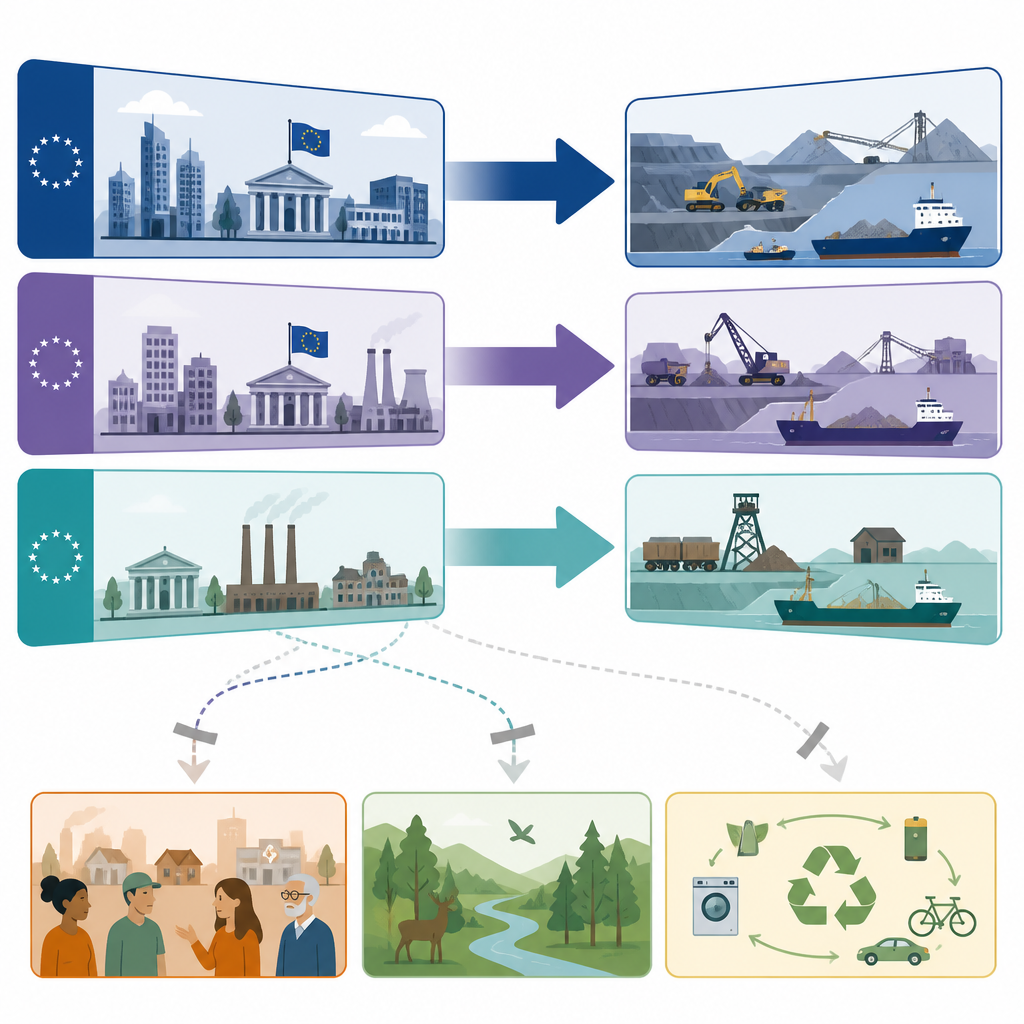
What this means for Europe’s choices ahead
By tracing these stories across two and a half decades, the authors show that Europe’s raw materials policy has repeatedly been reshaped in language, but not in its core priorities. Securing more supply for economic and geopolitical reasons has remained at the center, while using less and sharing burdens more fairly has stayed at the margins. The article argues that this “lock-in” of ideas narrows what feels politically possible. Opening space for real alternatives, such as sufficiency and stronger resource justice, will require new narratives and coalitions, including more active involvement from scientists who can help develop and communicate different visions of how Europe might live well with fewer materials.
Citation: Herdlitschka, T., Luo, A. & Leipold, S. Supply-security narratives have dominated EU raw materials policy, while demand reduction has been sidelined. Commun Earth Environ 7, 435 (2026). https://doi.org/10.1038/s43247-026-03593-x
Keywords: EU raw materials, critical minerals, circular economy, resource justice, demand reduction