Clear Sky Science · en
Interplay among self-thinning, efficiency of space occupation and biodiversity in terrestrial plant communities
Why crowded plant patches matter
Walk across a meadow or an empty lot and you might think of plants as a peaceful crowd. In fact, they are locked in a constant contest for room to grow. This study asks a simple but powerful question: when many species grow together, how tightly can plants pack themselves, and what does that mean for how many species can share the same patch of ground?
How plants naturally thin their own ranks
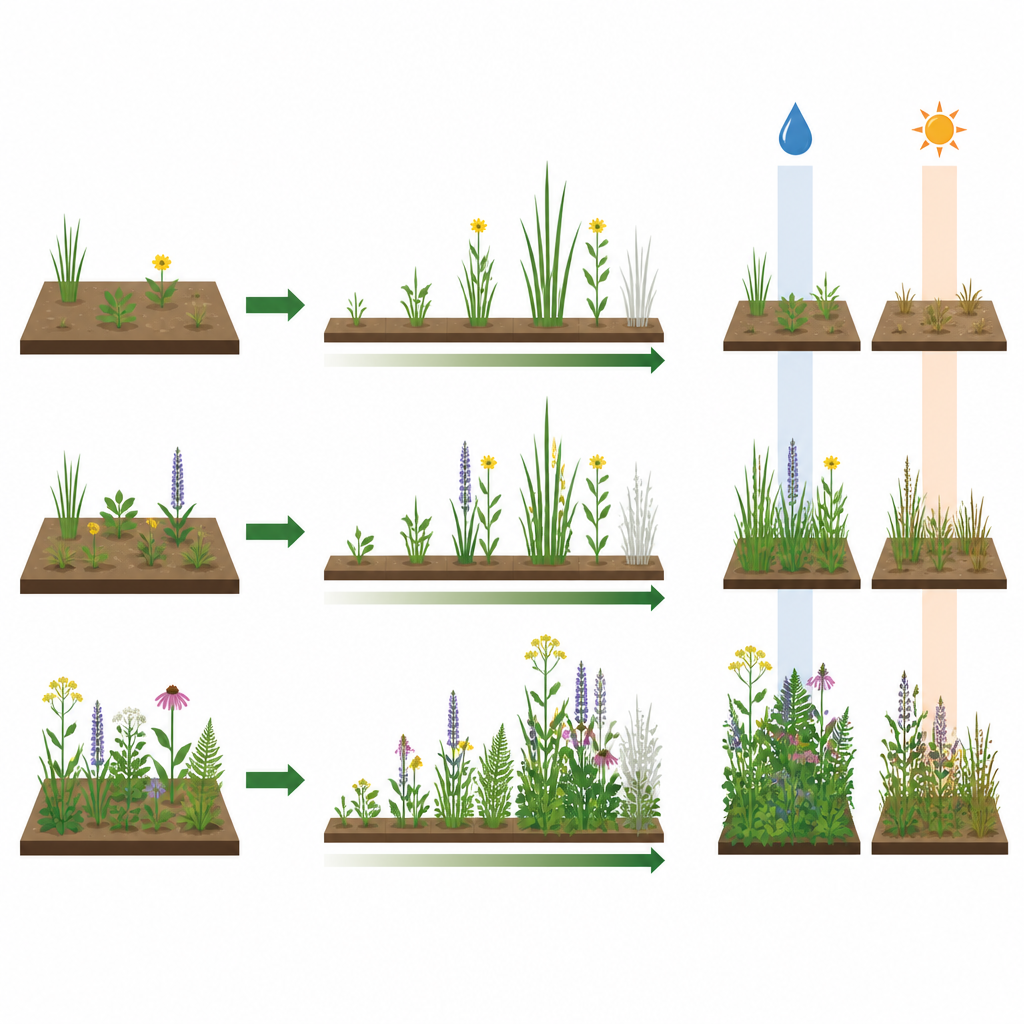
For decades, foresters have noticed that when many seedlings sprout close together, they do not all survive. As the stand grows, some individuals die while others get bigger, following a regular pattern called self thinning. Earlier work focused on single species stands such as tree plantations or crop fields. In this study, the authors tested whether the same rule holds in wild communities where dozens of species share the space. They monitored more than 17,000 individual plants belonging to 46 types in small plots near Lisbon, Portugal, tracking how many plants and how much dry mass occupied each patch through one growing season.
Watching diversity rise and fall through the season
The team compared three situations: bare sandy soil in a wetter year, soil covered by a thick mat of dead lawn in that same wet year, and bare lawn soil in a much drier year. At the start of winter, patches held many tiny seedlings and little biomass. As spring approached, some plants grew tall while others died, and the total mass per area increased even as the number of individuals fell. This showed that whole communities also follow a self thinning path. Water availability strongly shaped how far the plants could go along this path. In the wet year, stands reached higher biomass and used space more efficiently. In the dry year, growth stalled earlier, leaving more empty space between plants.
When more species help and when they hurt
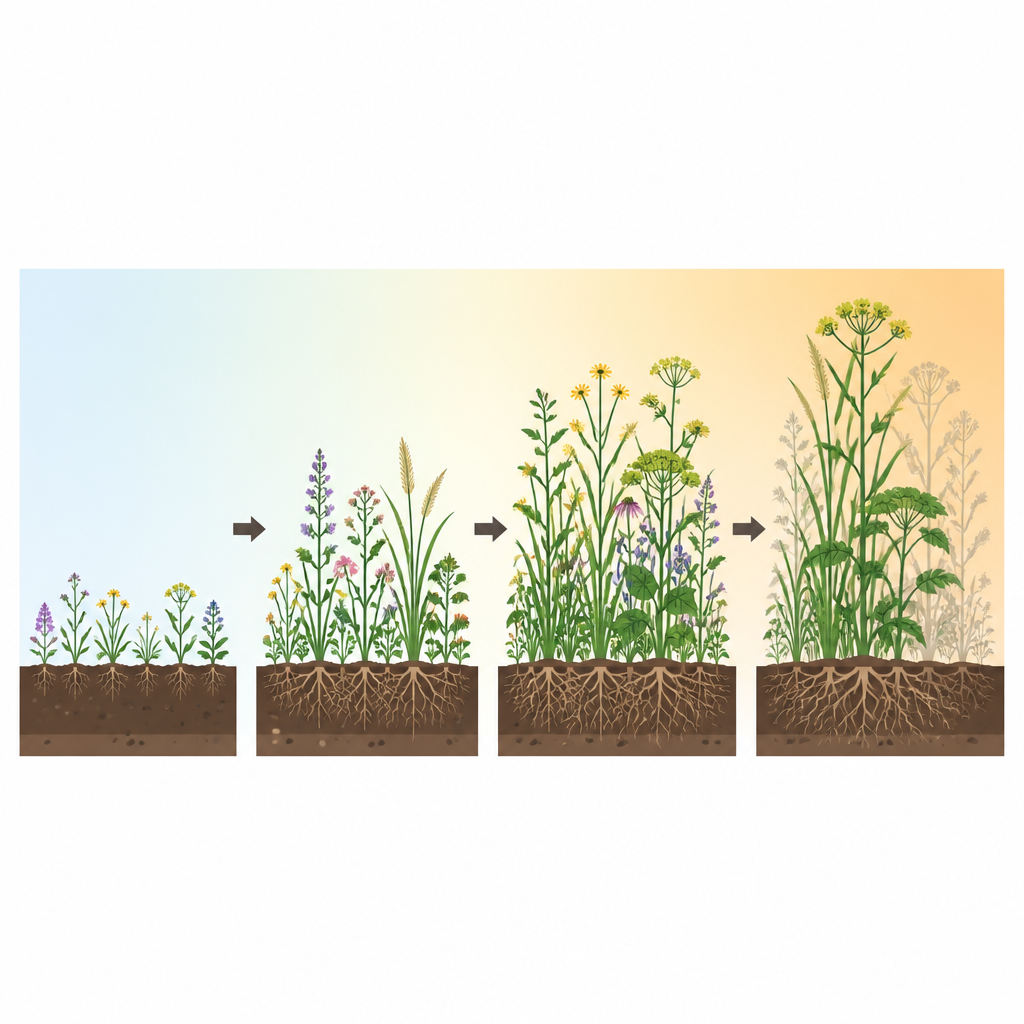
The researchers then linked how tightly plants packed biomass into space with how many species were present in each small patch. They found that intermediate diversity and intermediate crowding gave the best use of space. With very few species, patches did not fill the available room, wasting light and soil resources. As more species joined, they fit together like puzzle pieces, weaving canopies and roots into a more complete cover. But once biomass became very dense, competition for light and space turned intense. The most competitive species and individuals squeezed out weaker ones, so diversity declined. This creates a hump shaped pattern through time: at first, low crowding and low diversity; then rising diversity and efficiency; finally, near maximum crowding, strong self thinning and loss of species.
Invaders, dead grass, and space to grow
The study also examined an invasive weed, Oxalis pes caprae, and a thick layer of dead lawn. Early in the season, Oxalis sprouted fast and covered the ground, blocking winter blooming native species from establishing. Later, as its leaves withered, they formed a protective layer that shaded the soil and sheltered young spring species, which then flourished in the gaps. Likewise, the mat of dead lawn did not choke new growth. Instead, it hosted a slightly different but still diverse plant community, and in the wet year it allowed stands to pack biomass just as efficiently as bare soil. Overall, water supply mattered more than dead plant litter in setting how productive the community could be.
What this means for real landscapes
To a lay observer, these results explain why the richest plant communities often appear neither too sparse nor completely choked with growth. Moderate crowding lets many species coexist and jointly fill space, while extreme crowding triggers a shakeout in which only the toughest persist. The work links several classic ideas in ecology, including the self thinning rule, the hump shaped link between productivity and diversity, and the notion that moderate disturbance can favor variety. It also challenges claims that simply leaving dead grass on the ground causes desertification. Instead, in this study, dead plant material and even an invader at certain times created microclimates that helped other species recruit, while changing which plants ultimately won the contest for space.
Citation: Vieira, V.M.N.C.S., Jongen, M., Lapa, K.R. et al. Interplay among self-thinning, efficiency of space occupation and biodiversity in terrestrial plant communities. Commun Earth Environ 7, 431 (2026). https://doi.org/10.1038/s43247-026-03583-z
Keywords: plant competition, biodiversity, self thinning, space occupation, grassland ecology