Clear Sky Science · en
Sea ice loss drives a regime shift in Arctic Ocean nitrogen biogeochemistry
Why this matters for our changing Arctic
The Arctic Ocean is warming fast, and its shrinking sea ice is often held up as a visible sign of climate change. But below the surface, another, less obvious transformation is under way: the basic nutrients that feed Arctic marine life are being rearranged. This study shows that the Arctic has crossed a threshold where nitrogen, one of the key plant nutrients, is now in short supply over much of the region. That quiet shift could reshape which organisms thrive in Arctic waters and how much carbon the ocean can absorb from the atmosphere.
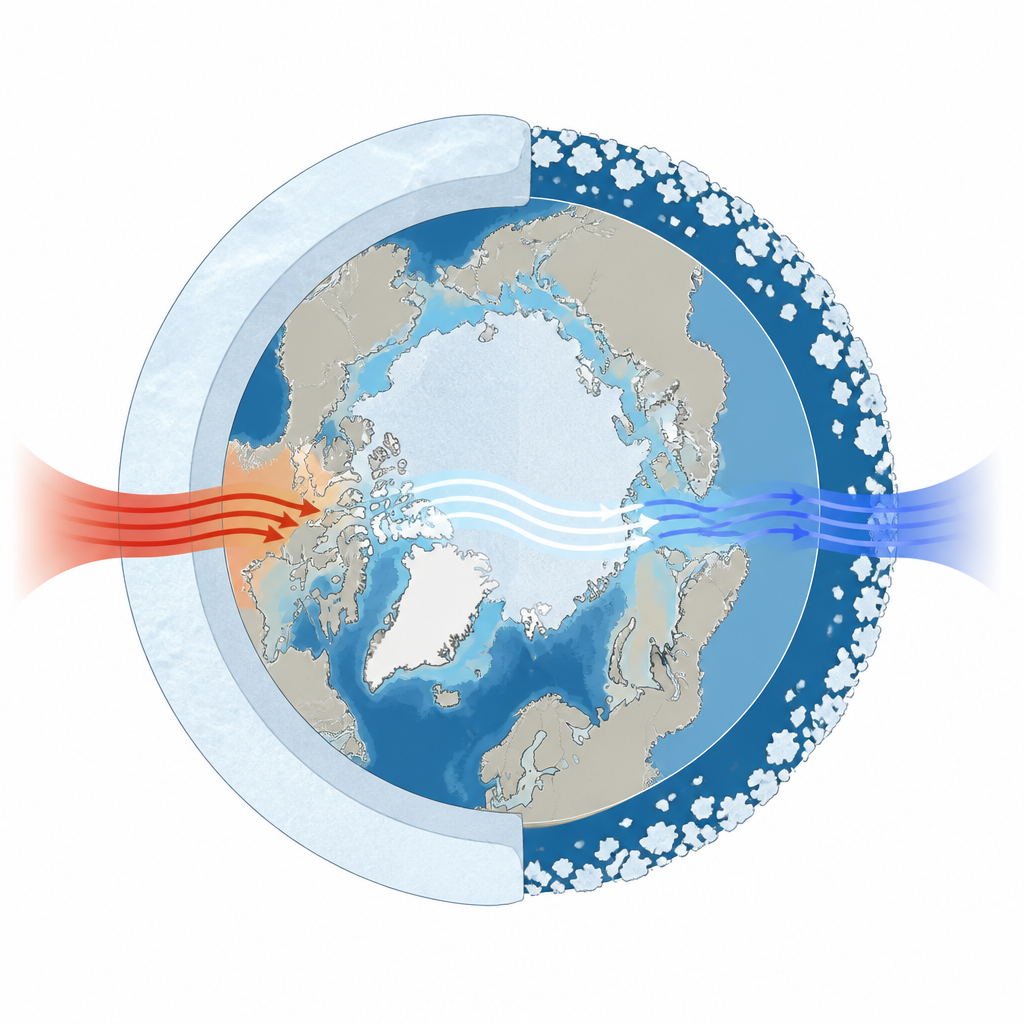
A new picture of Arctic surface waters
Using data from repeated ship surveys through the Fram Strait between Greenland and Svalbard, the authors compiled a 20‑year record of temperature, salinity and nutrients in the cold Polar Surface Waters that flow out of the Arctic Ocean. Around 2009, they observed a clear break in the pattern: average nitrate levels in these surface waters dropped from about three units to less than two, with near‑zero values appearing far more often. At the same time, the balance between different nutrients shifted. The ratio of nitrogen to phosphorus fell, while the ratio of silicon to nitrogen rose, signalling that nitrogen rather than light had become the main brake on plant growth in these waters.
Hidden work on the seafloor
The team traced this shift back to processes on the broad, shallow shelves off Siberia, especially the Chukchi and East Siberian seas. When microscopic plants grow in surface waters and die, their remains sink and are broken down by microbes in the seafloor mud. In low‑oxygen, organic‑rich sediments, these microbes use nitrate instead of oxygen and convert it into nitrogen gas, a process known as benthic denitrification that permanently removes usable nitrogen from the ocean. By linking published estimates of plant production on each shelf with measurements of denitrification from earlier studies, the authors reconstructed how this seafloor nitrogen loss has changed since the late 1990s. Their calculations indicate that nitrogen removal on the Siberian shelves has roughly doubled over two decades, with the largest increases on the Chukchi shelf where productivity surged as sea ice retreated.
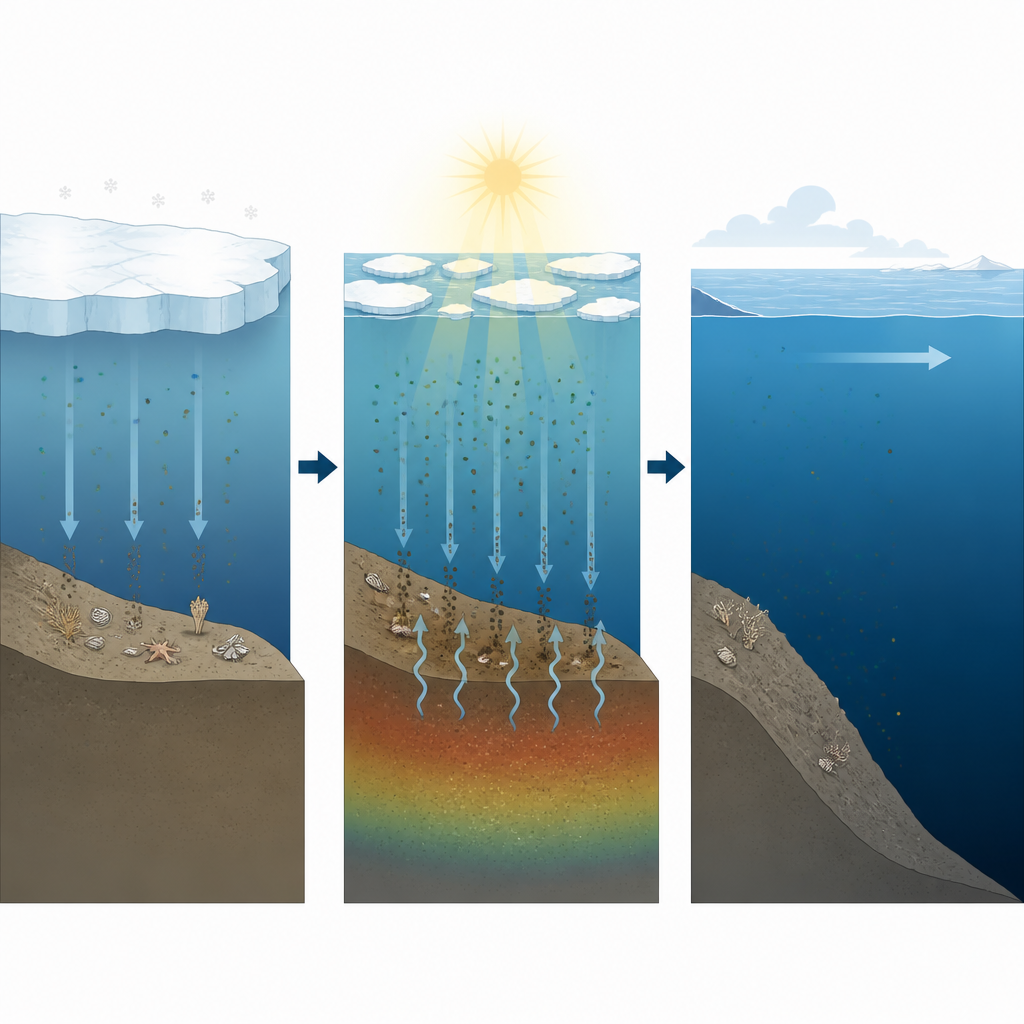
Currents that carry a changing chemical fingerprint
The story does not end on the shelves. Surface currents sweep these modified waters across the Arctic and ultimately out through the Fram Strait. To follow that journey, the researchers used a computer model to track virtual water parcels backwards from the Fram Strait over ten years. Before 2009, many of these parcels had spent most of their time over the Kara Sea shelf, where nitrogen loss is more modest. After 2009, circulation sped up along the shelf edge and a larger fraction of the water feeding the Fram Strait had passed over the strongly denitrifying Chukchi and East Siberian shelves. As a result, the chemical “fingerprint” of Polar Surface Waters shifted: more of the water reaching the central Arctic and Fram Strait had already had its nitrate stripped out on the way.
From light‑limited to nutrient‑limited seas
Earlier in the satellite era, increases in Arctic plant growth lined up closely with the area of open water created by melting sea ice, suggesting that light was the main limiting factor. The new analysis shows that this relationship broke down after about 2009. On the inflow shelf of the Chukchi Sea, productivity continues to climb as ice retreats and Pacific waters deliver fresh nutrients. Downstream, however, across the East Siberian, Laptev and Kara seas and into the central Arctic, plant growth has stalled or even declined despite more open water. This pattern matches the observed drop in nitrate and points to a new regime in which the supply of fixed nitrogen, rather than sunlight, now sets the ceiling for productivity across much of the Arctic Ocean.
What this means for Arctic life
Taken together, the observations and modelling suggest that the Arctic Ocean has crossed a tipping‑like threshold in its nutrient cycles. Benthic denitrification on a few key shelves now removes an amount of nitrogen comparable to the total nitrate entering from the Pacific, leaving the interior Arctic chronically nitrogen‑poor. Under these low‑nitrogen conditions, smaller phytoplankton that can make better use of scarce nutrients tend to replace larger, silica‑rich diatoms, and the food web may shift toward more recycling and less export to depth. Such changes are already being reported in regions like the Chukchi Sea and Fram Strait. While other nitrogen sources such as atmospheric input or nitrogen‑fixing microbes may grow in importance, they are unlikely to offset the current losses. For a lay observer, the message is clear: as Arctic sea ice vanishes, the invisible foundation of its marine ecosystem is being quietly rewired, with long‑lasting consequences for life in the far north.
Citation: Santos-García, M., Ganeshram, R.S., Oziel, L. et al. Sea ice loss drives a regime shift in Arctic Ocean nitrogen biogeochemistry. Commun Earth Environ 7, 442 (2026). https://doi.org/10.1038/s43247-026-03569-x
Keywords: Arctic Ocean, sea ice loss, nitrogen cycle, benthic denitrification, primary production