Clear Sky Science · en
Soil microbes are the tiny bioengineers running Earth’s underground factory
Why the life in soil matters to all of us
Every handful of soil is packed with invisible life that quietly supports our food, our climate, and even our medicines. This article explores how soil microbes act like tiny engineers in an underground factory, turning raw materials into nutrients for crops, locking away carbon, cleaning up pollution, and supplying chemical building blocks for drugs. By viewing soil as an information-processing network rather than just dirt, the authors show how understanding these hidden workers can help us tackle challenges such as soil degradation, climate change, and sustainable agriculture. 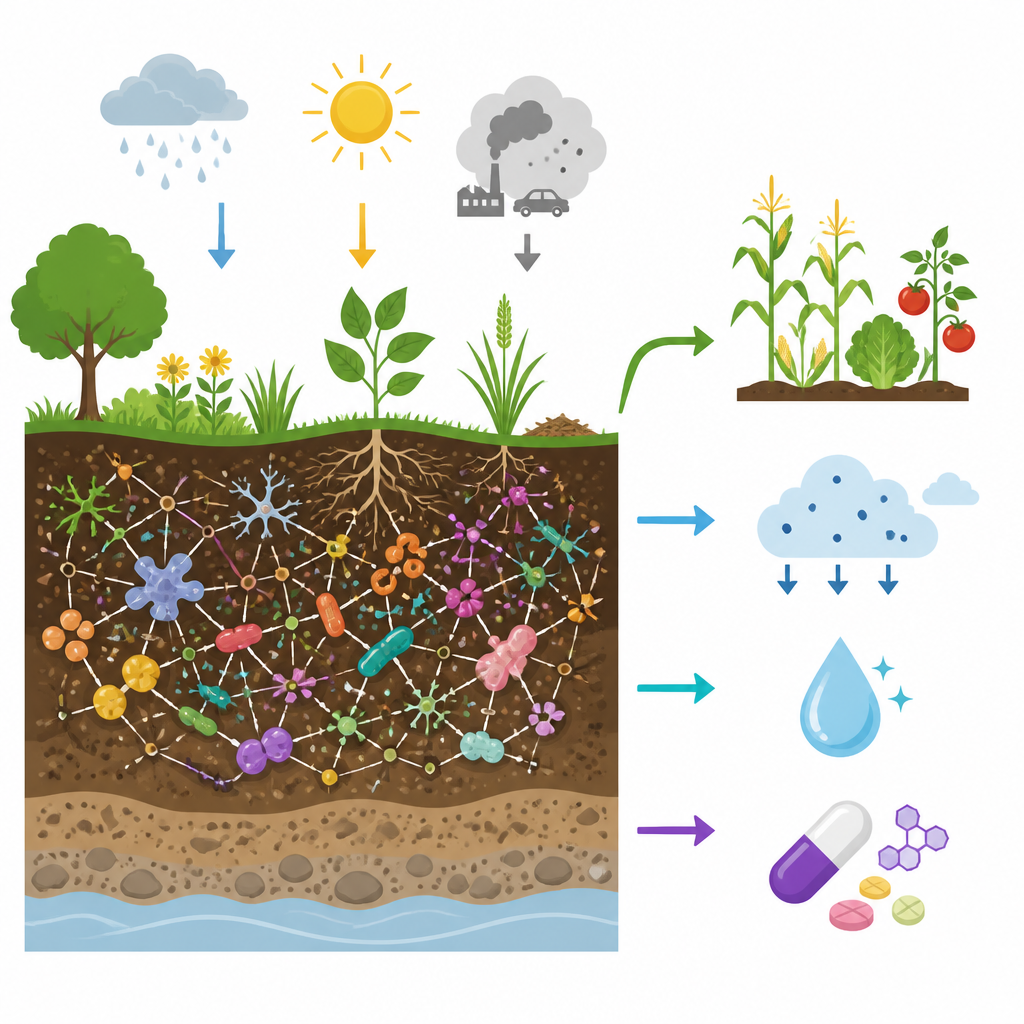
The hidden city beneath our feet
Soil holds more microorganisms in a single gram than there are people on Earth. These communities include bacteria, fungi, archaea, protists, and viruses that together control the flow of elements such as carbon, nitrogen, and phosphorus. The authors argue that instead of focusing only on which species are present, we should focus on what they do. Across many habitats, four main kinds of microbial work keep showing up: making powerful small molecules, cycling nutrients, shaping who lives with whom, and coping with stress. The combination of these activities determines how soils support plant growth, store carbon, and respond to disturbance.
The underground factory and its four main jobs
The first job is the production of special compounds, including antibiotics, pigments, and signaling molecules. Soil microbes, especially certain bacteria and fungi, are rich sources of these chemicals, many of which have become medicines for infections, cancer, and other diseases. Yet genome studies reveal far more chemical potential than we currently use. The second job is nutrient cycling, where microbes free up nitrogen, phosphorus, iron, and carbon so that plants can grow, while also influencing greenhouse gases. The third job involves community interactions: microbes compete, cooperate, trade food, and exchange genes, and these relationships can switch silent chemical pathways on or off. The fourth job is stress handling, where microbes help soils and plants withstand drought, salt, heat, and pollutants, often by building protective structures and molecules that stabilize soil and shield roots.
How soil life shapes crops, health, and clean environments
These four jobs combine to influence human health and food systems. In medicine, soil microbes are a leading source of antibiotics, anticancer agents, and other bioactive molecules, and new tools such as genome mining, synthetic biology, and machine learning are revealing many more candidates. In farming, familiar helpers like Bacillus and Pseudomonas bacteria and mycorrhizal fungi can boost plant nutrition, growth, and resilience to stress and disease, while less-studied groups are emerging as valuable partners. At the same time, results from field trials show that success depends strongly on local conditions, such as soil type, climate, and existing communities, meaning the same microbe mix will not work everywhere.
Soil microbes as climate and cleanup partners
Soil microbes also act as climate regulators and environmental cleaners. They guide whether plant carbon becomes long-lived soil material or returns quickly to the air as carbon dioxide or methane, with fungal-rich systems often favoring long-term storage. Certain bacteria remove methane before it reaches the atmosphere, while others help plants invest more carbon underground through fungal partnerships. Microbial teams can break down oil spills, pesticides, and even microplastics, or trap heavy metals in less harmful forms. They also power bioenergy and circular systems by turning plant waste into fuels and useful products. However, pollution, intensive farming, and microplastics can damage these communities and weaken their ability to protect soils. 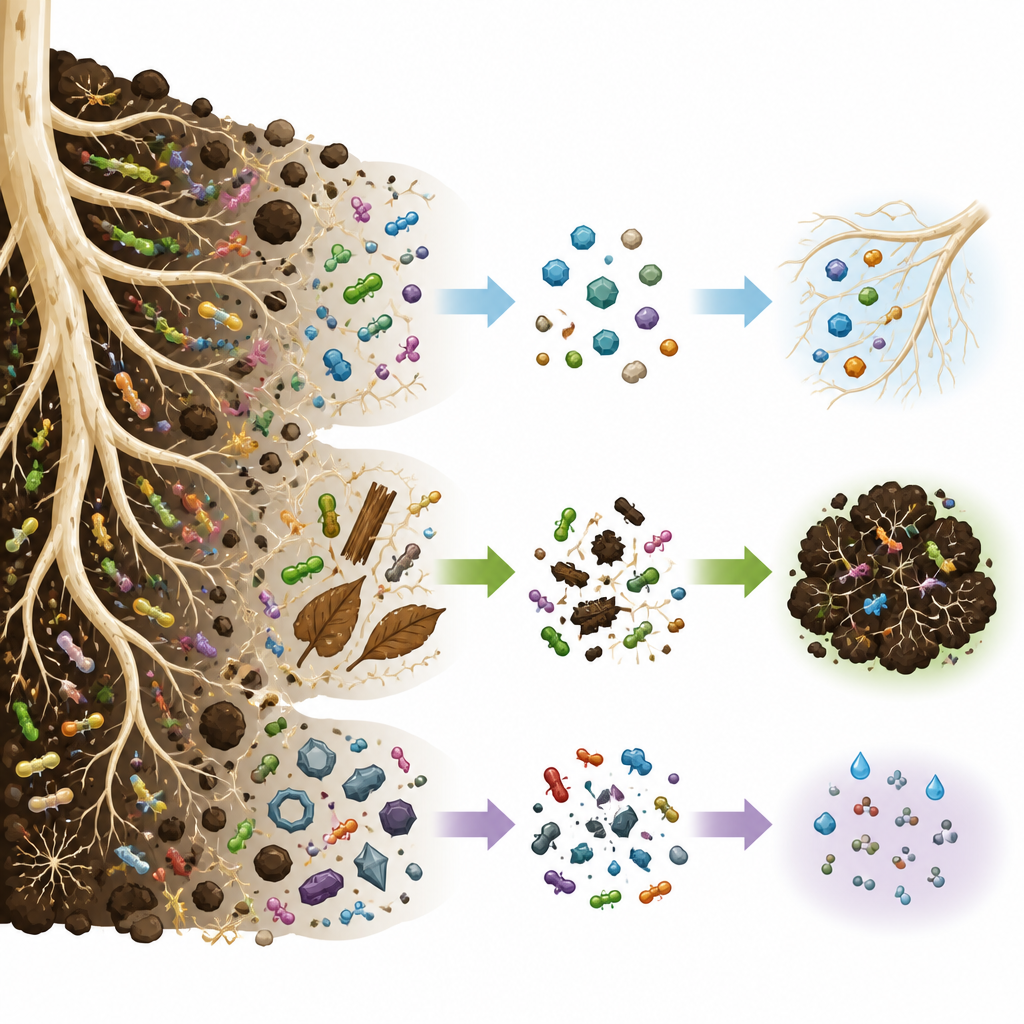
Designing with, not against, the living soil
The authors conclude that soil health is an emergent property of how physical structure, chemistry, and microbial life work together. They propose a "soil intelligence" view, in which soils act as adaptive networks that sense change, respond, and remember through microbial interactions. New technologies in sequencing, chemistry, high-throughput cultivation, and artificial intelligence now make it possible to track not just which microbes are present, but which are active and how their actions scale up to crop yields, carbon storage, and pollutant removal. To benefit from this, we must design farming, climate strategies, and biotechnologies that match microbial functions to their local context, respect ecological limits, and include long-term monitoring. Treating soil microbes as key infrastructure rather than an afterthought can help societies build more resilient and sustainable systems.
Citation: Hassan-Dalléac, S., Guiga, W. & Suau-Pernet, A. Soil microbes are the tiny bioengineers running Earth’s underground factory. Commun Earth Environ 7, 403 (2026). https://doi.org/10.1038/s43247-026-03544-6
Keywords: soil microbiome, soil health, microbial ecology, plant–microbe interactions, environmental remediation