Clear Sky Science · en
Crustal recycling and metamorphic dehydration govern the fertility of granite-associated tin systems
Why the story of buried rocks matters for future technology
Tin may not make headlines like lithium or gold, but it is essential for solder in electronics, solar panels, and electric vehicles. Most of the world’s tin comes from granites—light-colored rocks that formed from melted crust deep underground. This study asks a deceptively simple question with big implications for future supplies of this critical metal: what happened to the sedimentary rocks *before* they melted, and how does that hidden history decide whether a granite becomes rich in tin or stays barren?
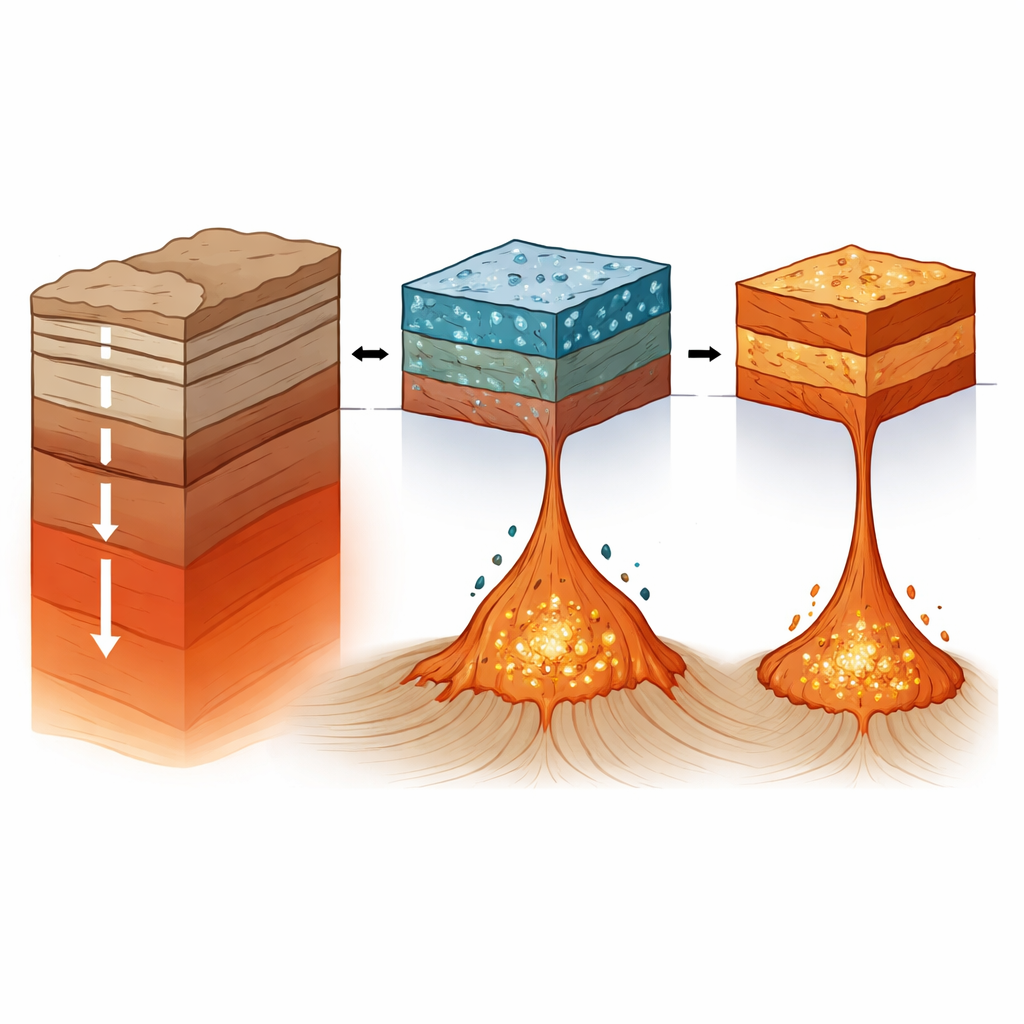
From surface mud to deep crustal kitchens
The story begins at Earth’s surface, where weathering and erosion break down older rocks and move grains and dissolved elements into rivers, deltas, and seas. Over time, these sediments can become packed into thick layers, burying small amounts of tin and other elements such as boron and mercury. Later, when continents collide and mountains rise, these sediment piles are pushed deep into the crust. There they are squeezed and heated, transforming into new rocks and, eventually, the source material for granites linked to many of the world’s tin deposits, including the Southeast Asian Tin Belt.
What makes some deep rocks “thirsty” and others “dry”
As sediments are buried and heated, they undergo metamorphism—a stepwise transformation that drives water-rich fluids out of the rock. These fluids are very good at carrying elements like boron and mercury. The authors use the natural “fingerprints” of these elements, in the form of their isotopes, to track how much volatile material was lost before melting occurred. By measuring granites, tin ores, and their surrounding basement rocks in western Yunnan, China, they show that tin-bearing granites and ores share the same crustal signatures as their metasedimentary hosts, confirming that the key ingredients came from recycled surface sediments rather than the deep mantle.
A hidden dehydration step that switches tin deposits on or off
The combined boron and mercury data reveal something crucial: not all sedimentary source rocks were processed in the same way before they melted. Some experienced only mild heating and retained much of their boron- and mercury-rich fluid content, while others lost large amounts of these volatiles through intense dehydration. In the mildly altered rocks, the remaining material stayed “wet” and chemically flexible. When such rocks later melted, they produced granitic magmas rich in volatiles. These sticky, water- and boron-bearing melts could differentiate for a long time and efficiently move tin into late-stage fluids that formed ore deposits. In contrast, rocks that had been strongly dehydrated became “dry” and poor in volatiles; when they melted, the resulting magmas were less able to separate, evolve, and concentrate tin, leading to barren or weakly mineralized granites.
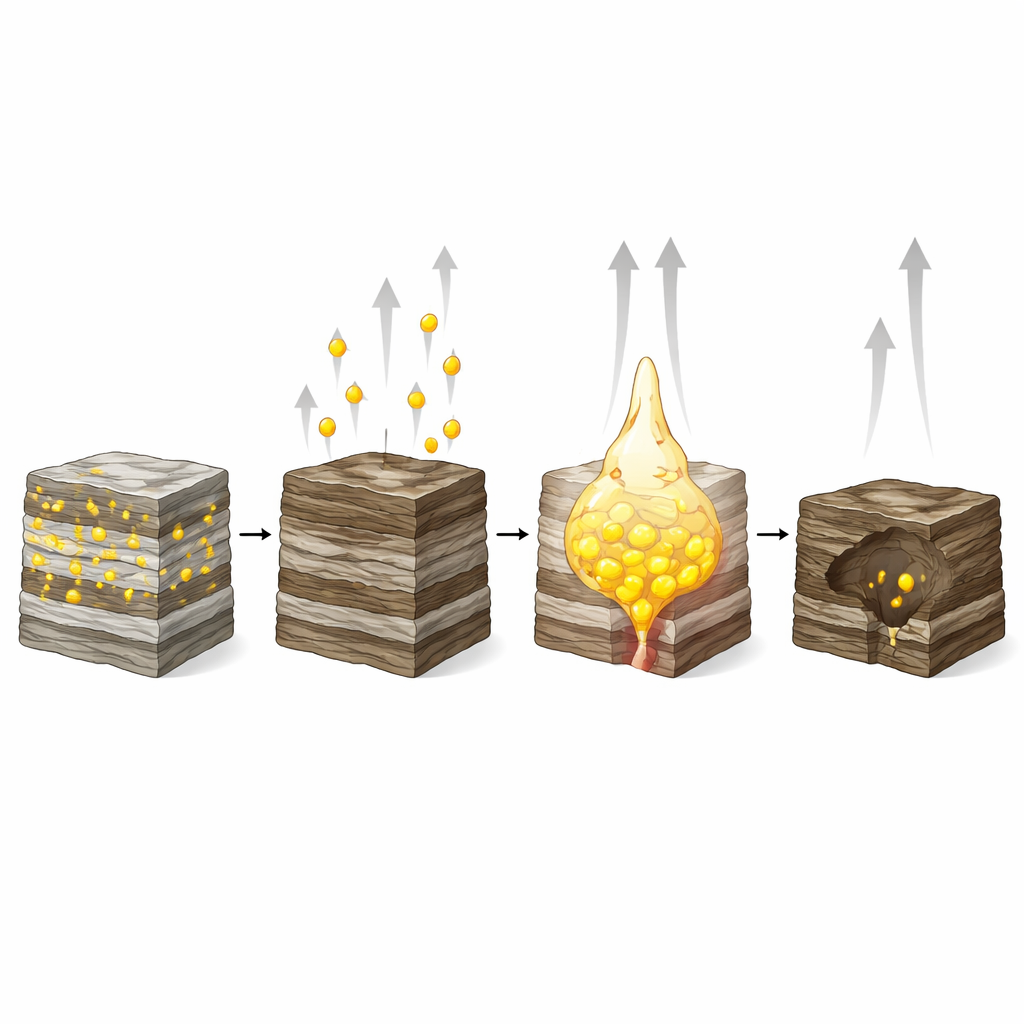
Lessons from a global tin trail
Western Yunnan is only one segment of a much larger tin belt stretching across Southeast Asia and mirrored by similar belts in South China and the Central Andes. By comparing their new data with published measurements from these other regions, the authors find a consistent pattern: world-class tin systems tend to be linked to granites derived from sedimentary sources that escaped severe dehydration. In some Andean deposits, for example, tin granites are even richer in boron than the surrounding basement rocks, reinforcing the idea that limited early fluid loss set the stage for exceptionally fertile magmas later on.
What this means for finding tomorrow’s tin
For non-specialists, the main message is that the tin potential of a granite is decided long before the magma forms. The crucial step is a “preconditioning” phase deep in the crust, where buried sediments either keep or lose their volatile cargo during metamorphism. If they stay only weakly dehydrated, they can later melt into volatile-rich magmas that concentrate tin into valuable ore deposits. If they dry out too much, the resulting granites are unlikely to host major tin resources. This insight gives geologists new tools—based on boron and mercury signals and simple element ratios—to distinguish promising regions from unpromising ones, guiding exploration toward the buried rocks most likely to feed the next generation of tin mines.
Citation: Sun, X., Xu, HC., Yang, ZM. et al. Crustal recycling and metamorphic dehydration govern the fertility of granite-associated tin systems. Commun Earth Environ 7, 381 (2026). https://doi.org/10.1038/s43247-026-03538-4
Keywords: tin deposits, granite magmatism, metamorphic dehydration, crustal recycling, critical metals