Clear Sky Science · en
Geologic stress modulates fluid mixing at fracture intersections
Why cracks deep underground matter
Far below our feet, rocks are crisscrossed by countless cracks that act like hidden highways for water, chemicals, and heat. Where these cracks cross one another, fluids from different directions meet and mix. This quiet mixing helps control everything from how pollution spreads in groundwater to how well we can lock away carbon dioxide in rock. This study shows that shifting stresses in the Earth’s crust can subtly squeeze or open these crossing points, in turn changing how well fluids mix as they move through the fractured rock.
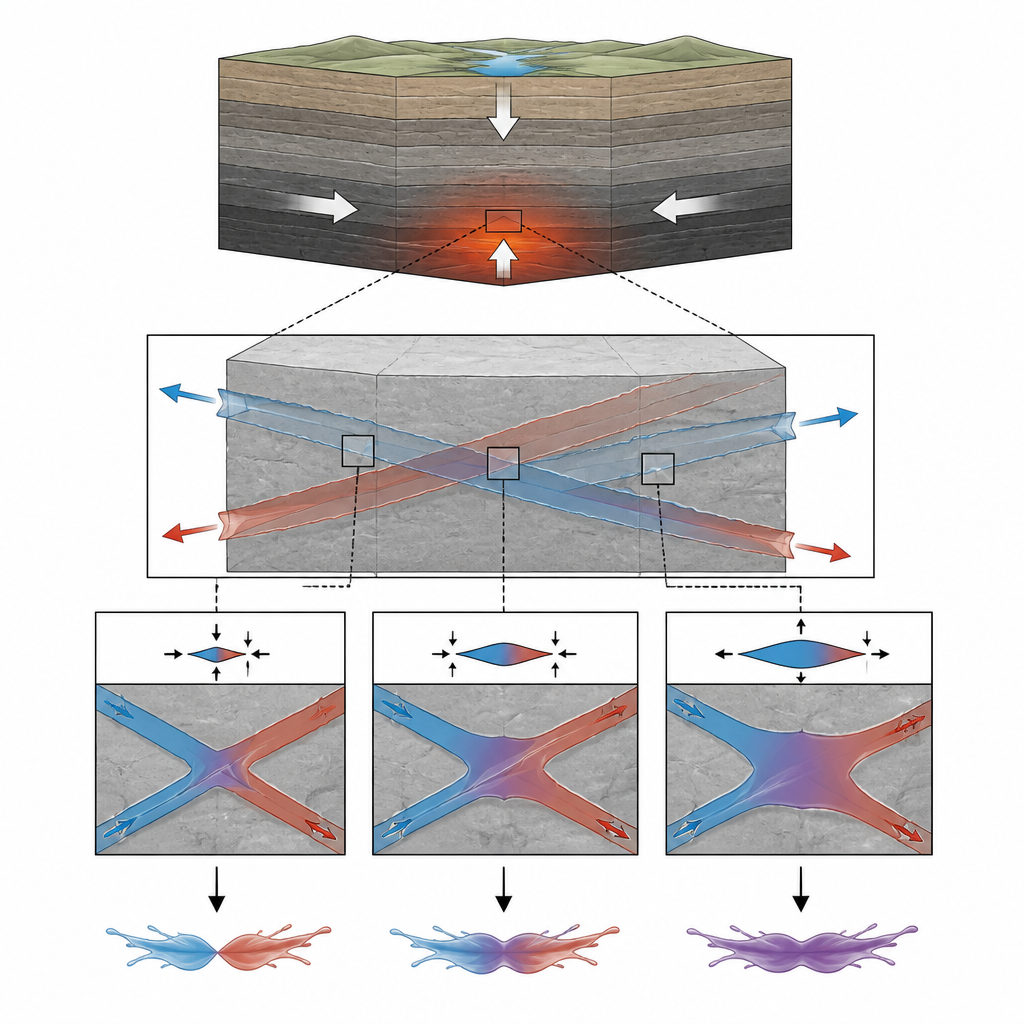
Cracks that cross like plus and cross shapes
The researchers focused on simple but common patterns where two fractures meet, forming either a plus shape (+) or an angled cross (×). Such patterns are widespread in folded rock layers in mountain belts and other geologic settings. Depending on how these fractures are oriented relative to the main direction of underground stress, they can respond very differently when the rock is squeezed. That response affects not only how wide the fractures are but also how well they stay connected at the tiny region where they intersect, which is where most of the mixing happens.
Building and imaging artificial rock cracks
To watch this process in detail, the team 3D printed clear plastic blocks with carefully designed rough surfaces that mimic rock fractures. By assembling four blocks, they created controlled + and × fracture intersections. These samples were placed in a custom loading frame and compressed in a 3D X-ray microscope. As they increased the load, they took high resolution scans and reconstructed the open spaces where fluids could flow. They then used computer simulations to send fluid and a dissolved tracer through these 3D fracture networks and measured how the tracer split and mixed at the intersection under different flow conditions.
How squeezing changes the way fluids mix
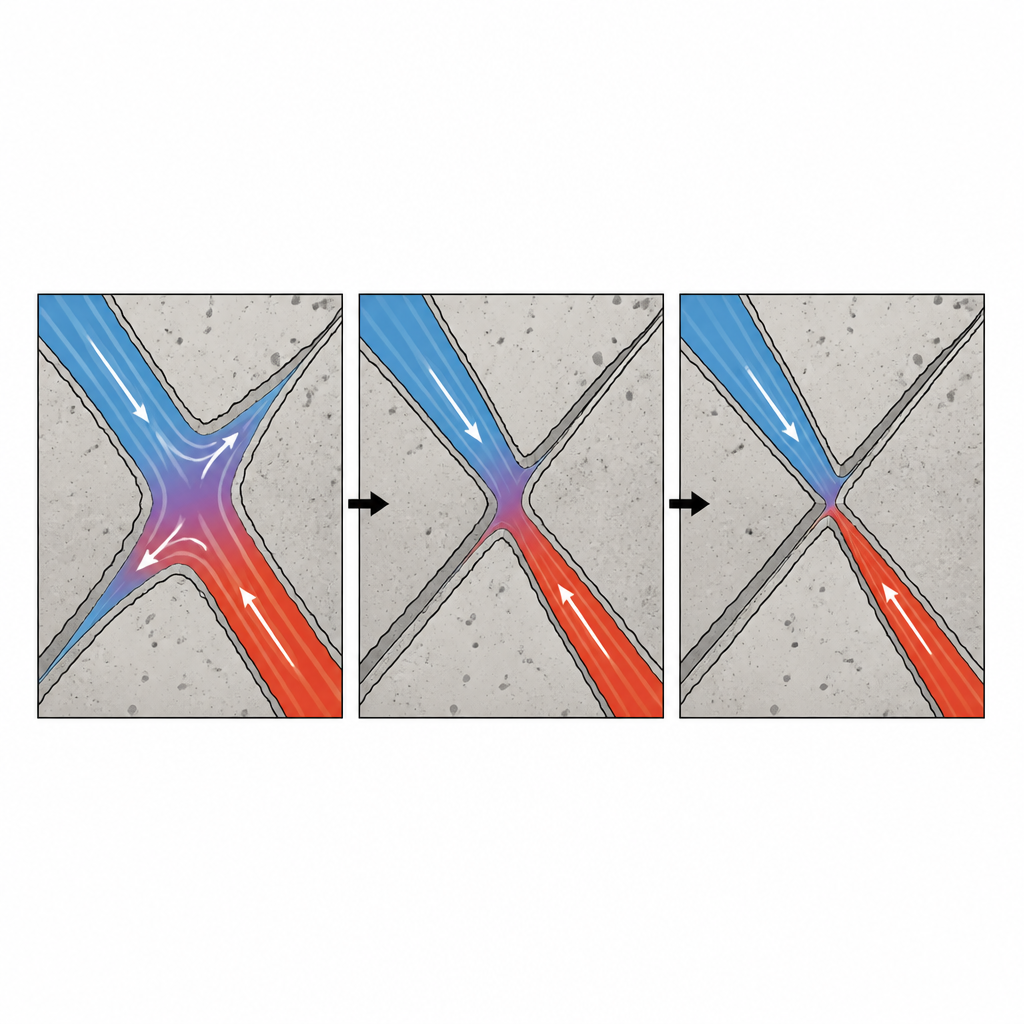
The experiments revealed a sharp contrast between the two intersection shapes. In the plus-shaped case, increasing stress mainly closed one horizontal branch, while the vertical branch and the central crossing stayed well connected. As a result, more flow and more tracer were funneled into the still open branch, but diffusion could still act across the intersection, so mixing remained relatively effective. In the cross-shaped case, however, stress first opened one branch through slight sliding while closing the other, then progressively pinched the central meeting zone. This created a narrow “throat” at the intersection that throttled both flow and diffusion between branches, so that under high stress the two fluids barely mixed at all, even when diffusion should have dominated.
Why common models can go wrong
Many large scale models of fractured rock assume that the four fracture branches around an intersection always stay well connected, and that mixing can be described by simple rules based on flow speed and diffusion. The new results show this assumption breaks down when stress partially closes the intersection throat, especially for cross-shaped geometries. Under these conditions, standard models predict more mixing than actually occurs because they ignore how contact points and narrowed openings redirect or block flow. By systematically varying the throat size in idealized simulations, the authors quantified how both advective flow and diffusive exchange fall off as the throat narrows and built correction factors that can be plugged into existing models.
What this means for subsurface technologies
For a non-specialist, the key takeaway is that the places where cracks cross in rock are not static junctions. They deform with changing stress, and this deformation can strongly control where and how fluids mix and react. The study introduces a practical way to adjust common network models so they account for stress-driven changes in the narrow connection zones at intersections. This should lead to more realistic predictions of how contaminants move, how heat and fluids circulate in geothermal reservoirs, and how injected carbon-bearing fluids spread and react in the subsurface over time.
Citation: Deng, J., Pyrak-Nolte, L.J. & Kang, P.K. Geologic stress modulates fluid mixing at fracture intersections. Commun Earth Environ 7, 463 (2026). https://doi.org/10.1038/s43247-026-03525-9
Keywords: fracture intersections, subsurface flow, fluid mixing, geologic stress, solute transport