Clear Sky Science · en
Warmer Atlantic Water intrusion energizes the Arctic Eurasian Basin
Why the Deep Arctic Is Getting Stirred Up
The Arctic Ocean is warming faster than almost anywhere else on Earth. Most people have heard about shrinking sea ice, but less obvious changes are happening far below the surface, where powerful underwater whirlpools called eddies constantly shuffle heat and salt around. This study asks an unexpected question: as the world warms, will the deep Arctic Ocean become calmer, like the deep ocean elsewhere, or more energetic? The answer matters because these hidden currents help control how quickly sea ice melts and how Arctic ecosystems respond to climate change.
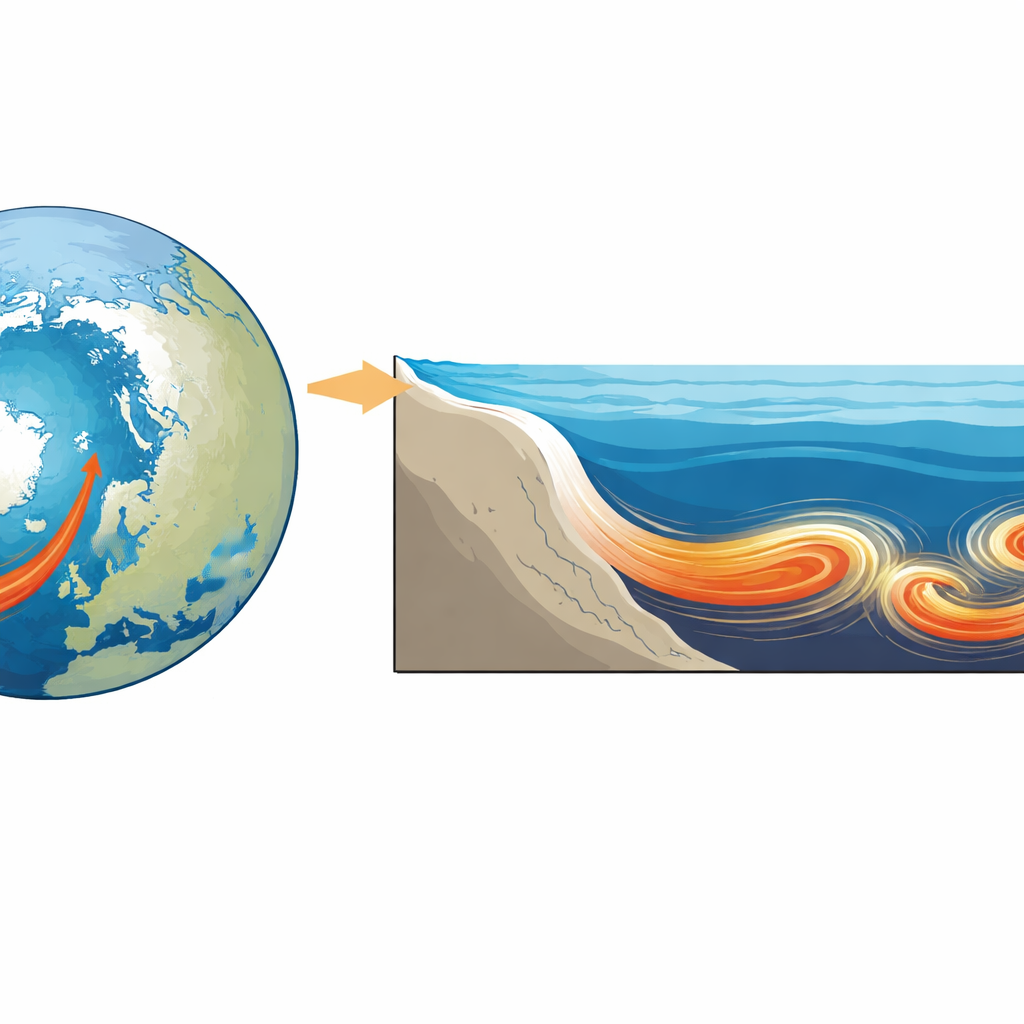
Hidden Whirlpools Beneath the Ice
Ocean eddies are swirling features tens of kilometers across that behave a bit like underwater storms. They carry most of the ocean’s motion and help move heat, salt, and nutrients both sideways and up and down. In much of the global ocean, climate models suggest that while surface eddies may strengthen as winds and currents speed up, the deeper ocean will actually grow more sluggish as density layers become more rigidly stacked. That would mean a quieter, less mixed deep ocean overall. But the Arctic is different: it is rapidly losing ice cover, and it is being flooded by ever-warmer Atlantic water, a process known as “Atlantification.” Scientists suspected this inflow might shake up the deep Arctic, but standard climate models are too coarse to clearly resolve the small eddies typical of this region.
A Sharper Look with Kilometer-Scale Models
To tackle this problem, the authors used a global ocean–sea ice model that zooms in on the Arctic with a horizontal resolution of about one kilometer—fine enough to capture most of the region’s small eddies. They first ran a century-long, moderately detailed simulation to follow the climate trajectory under a high-emissions scenario through 2100. From this, they selected two four-year windows representing today’s climate and conditions at the end of the century. For each window they then ran the ultra-high-resolution model slice, allowing them to compare present and future in unprecedented detail. They focused on two depth ranges: the upper 100 meters, strongly affected by sea ice and the atmosphere, and a deep layer from 100 to 1,000 meters, which today corresponds roughly to the core of the Atlantic Water flowing into the Eurasian Basin of the Arctic.
A Deep Ocean That Grows More Energetic
The high-resolution simulations reveal a striking result: instead of calming down, the deep Arctic becomes substantially more energetic over the 21st century. In the Eurasian Basin, both the average flow and, even more importantly, the eddy motion intensify. Across the entire Arctic Basin, the total kinetic energy of the upper kilometer of ocean is projected to increase by about 140 percent, and roughly four-fifths of this rise is due to stronger eddies rather than faster mean currents. The largest boost in eddy activity occurs in the deep Atlantic Water layer of the Eurasian and neighboring Makarov Basins, right where Atlantification is most pronounced. This marks the Arctic as a clear exception to the global tendency toward a quieter deep ocean under warming.
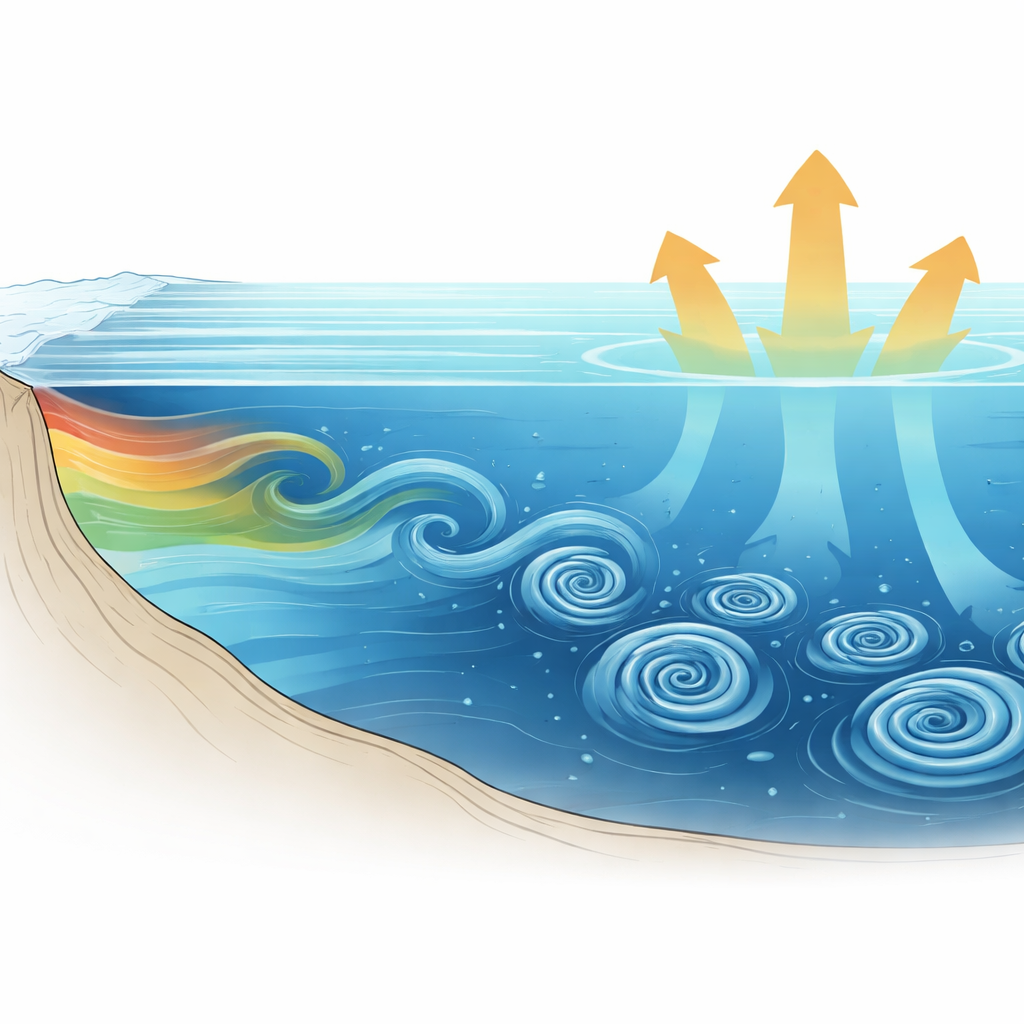
How Warm Atlantic Water Feeds the Swirl
Why does adding warm Atlantic water make the deep Arctic livelier? As this water flows northward and enters the Eurasian Basin, it warms and slightly freshens the subsurface layers, changing how dense different parts of the basin are. The result is a steeper sideways contrast in density, especially along the continental slope. This contrast represents stored “available potential energy,” a kind of fuel that can be tapped by instabilities. The study’s energy-budget calculations show that this fuel is increasingly converted into eddy motion as the century progresses. The conversion linked to these sideways density differences increases several-fold in the deep layer, far outweighing other energy exchanges between eddies and the mean flow. In simple terms, Atlantification keeps loading a tilted density structure with extra energy, and the ocean responds by generating more and stronger eddies that mix and transport heat upward and inward.
What This Means for Sea Ice and Life
For non-specialists, the central message is that the deep Arctic is not just passively warming; it is becoming more dynamically active. Stronger eddies are expected to move more warm water from narrow boundary currents into the interior of the basin and to pump more heat upward toward the underside of the sea ice. Model results indeed show rising upward heat flux carried by eddies in the Eurasian Basin. That extra stirring could accelerate sea ice melting and reshape marine ecosystems by altering nutrient pathways and the movement of plankton and other organisms. The study suggests that Atlantification influences the Arctic not only by bringing in heat, but also by energizing the whole deep circulation. As a result, the future Arctic Ocean may be more turbulent and tightly coupled to climate and ecosystem changes than previously recognized.
Citation: Chen, J., Wang, X., Wang, Q. et al. Warmer Atlantic Water intrusion energizes the Arctic Eurasian Basin. Commun Earth Environ 7, 343 (2026). https://doi.org/10.1038/s43247-026-03507-x
Keywords: Arctic Atlantification, ocean eddies, Eurasian Basin, sea ice melt, climate warming