Clear Sky Science · en
Regional aerosol hygroscopicity influences radiative forcing globally
Why tiny airborne particles matter
Most of us never think about the invisible haze of particles that floats in the air we breathe. Yet these tiny bits of dust, soot, sea salt, and pollution quietly help control how much sunlight the planet absorbs or reflects back to space. This study asks a deceptively simple question with big climate implications: how does the way these particles mix with each other, and how easily they soak up water, change Earth’s cooling from aerosols around the globe?
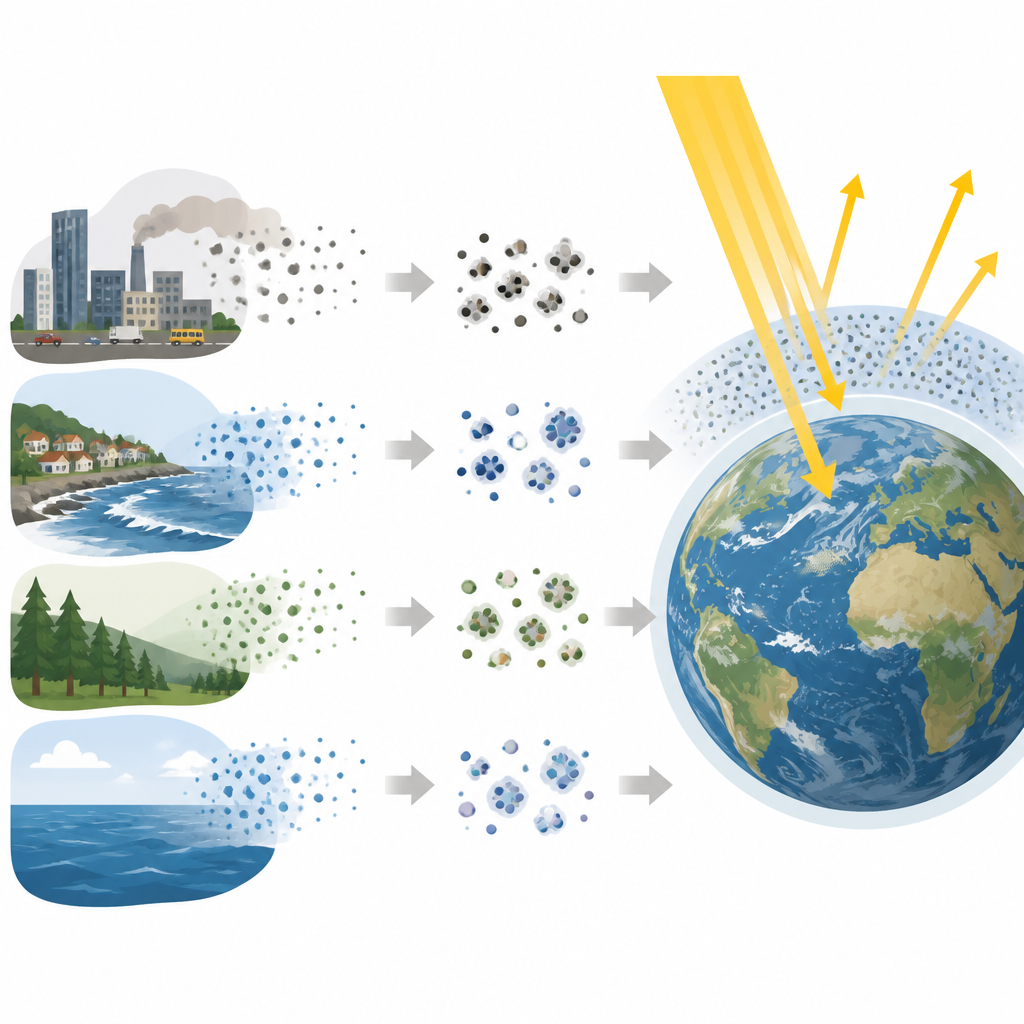
How air particles help cool or warm the planet
Airborne particles, known as aerosols, influence climate in two main ways. They can scatter sunlight directly, acting like a faint sunshade, and they can help form clouds by serving as the seeds on which droplets grow. Both roles depend strongly on how well particles take up water, a property called hygroscopicity. When the air is humid, water-loving particles swell, become more efficient at scattering light, and can more readily seed clouds. However, existing climate models often treat these particles as if they are uniformly mixed and behave the same everywhere, a shortcut that ignores the messy reality of city smog, sea spray, dust, and smoke colliding in the air.
Different places, different particle behavior
The researchers combined data from ten very different locations, including busy cities, coastal sites, remote mountain stations, and open-ocean ship cruises. They measured how much particles grew when exposed to moisture and compared this to what standard chemistry-based formulas predicted. In many urban and suburban areas, the air contained “externally mixed” aerosols: individual particles with sharply different ingredients, such as fresh traffic soot mixed into a background of older, more water-loving material. In these places, traditional formulas performed poorly, missing much of the real variation in water uptake. In contrast, cleaner or more uniform environments, such as some rural or marine sites, behaved more like the simplified picture used in models and were easier to predict with older methods.
Teaching a machine to read the haze
To capture this complexity, the team built an interpretable machine learning system trained on observations from each region. The model took in chemical composition, particle size distributions, and local weather and learned to predict how readily particles would absorb water. It reproduced measurements with high accuracy across most sites, far better than the bulk-chemistry approach. By examining which inputs mattered most, the researchers found that chemical makeup was the primary driver, with sulfate and certain oxidized organics tending to boost water uptake, while black carbon and some organic components reduced it. Information about particle sizes helped the model recognize whether particles were more internally or externally mixed, which also shaped how they behaved in humid air.
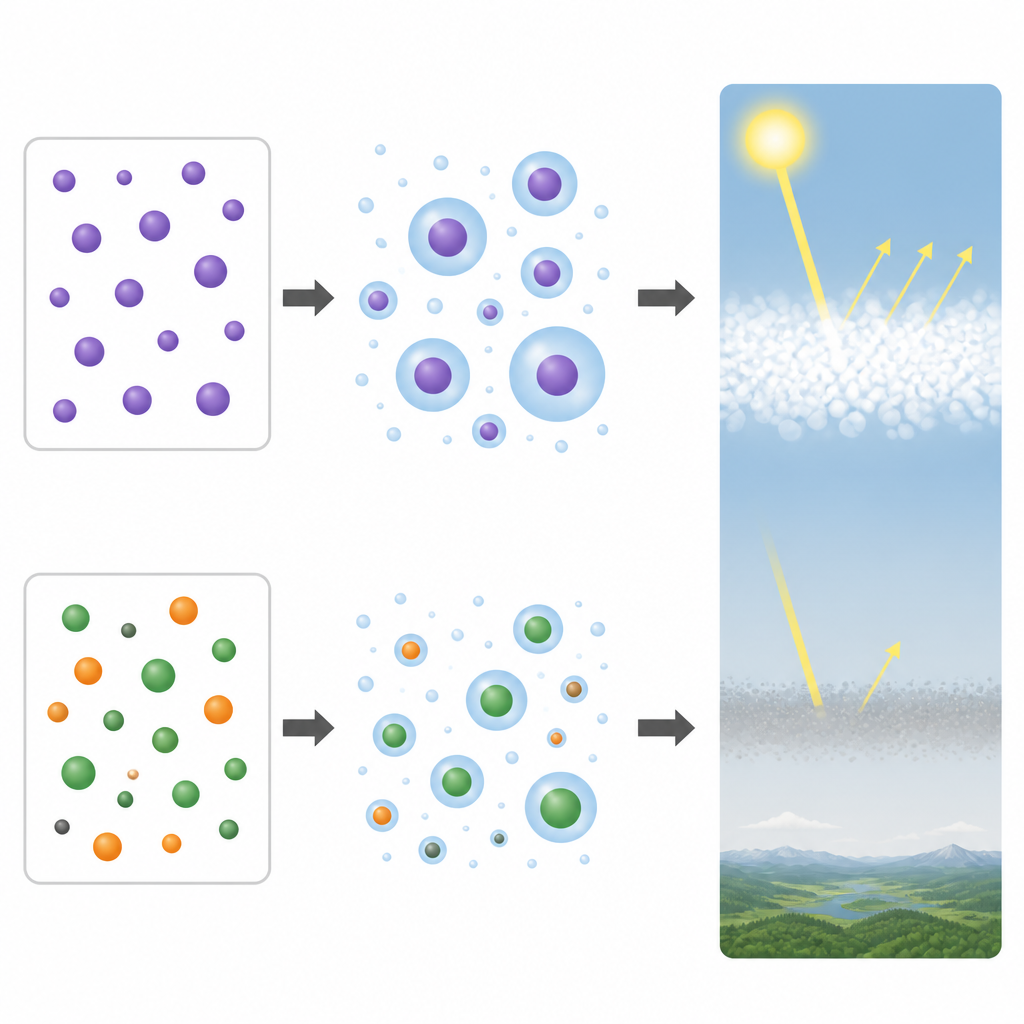
From local haze to global climate impact
The next step was to ask what these improved particle properties mean for Earth’s energy balance. Instead of rebuilding a full climate model, the authors used an existing estimate of how sensitive radiative forcing is to changes in water uptake and adjusted it with their machine learning results. Across the study sites, the revised hygroscopicity values generally led to a stronger cooling effect from aerosols than earlier estimates suggested, especially in suburban and urban regions where external mixing is common. In some locations the change was modest, but taken together the results show that misrepresenting regional differences in mixing state can bias estimates of how strongly aerosols offset greenhouse warming.
What this means for our understanding of climate
For a non-specialist, the key message is that not all haze is created equal. The detailed mixture of particles in a given region, and how easily they drink in water, can shift the balance of sunlight reflected back to space. By using machine learning tuned to local observations, this work shows that current models likely underestimate how much cooling some aerosol-rich regions provide. While aerosols do not cancel out greenhouse gas warming, understanding their true influence is essential for reliable climate projections and for interpreting regional trends in temperature and air quality.
Citation: Deshmukh, S., Ferrer-Cid, P., Romshoo, B. et al. Regional aerosol hygroscopicity influences radiative forcing globally. Commun Earth Environ 7, 416 (2026). https://doi.org/10.1038/s43247-026-03505-z
Keywords: aerosol hygroscopicity, radiative forcing, machine learning climate, aerosol mixing state, urban air pollution