Clear Sky Science · en
Anthropogenic aerosols override greenhouse gases in Sahel climate change
Why shifting rains in the Sahel matter to everyone
The Sahel, a broad band just south of the Sahara Desert, is home to hundreds of millions of people who rely on a few months of seasonal rain to grow food. In the 1970s and 1980s, this region suffered devastating droughts; in recent decades, rains have partially returned and extreme storms have become more common. This study asks a deceptively simple question with global consequences: were these dramatic swings mainly caused by rising greenhouse gases, by air pollution particles from industry, or by natural climate ups and downs?
From deadly drought to surprising rebound
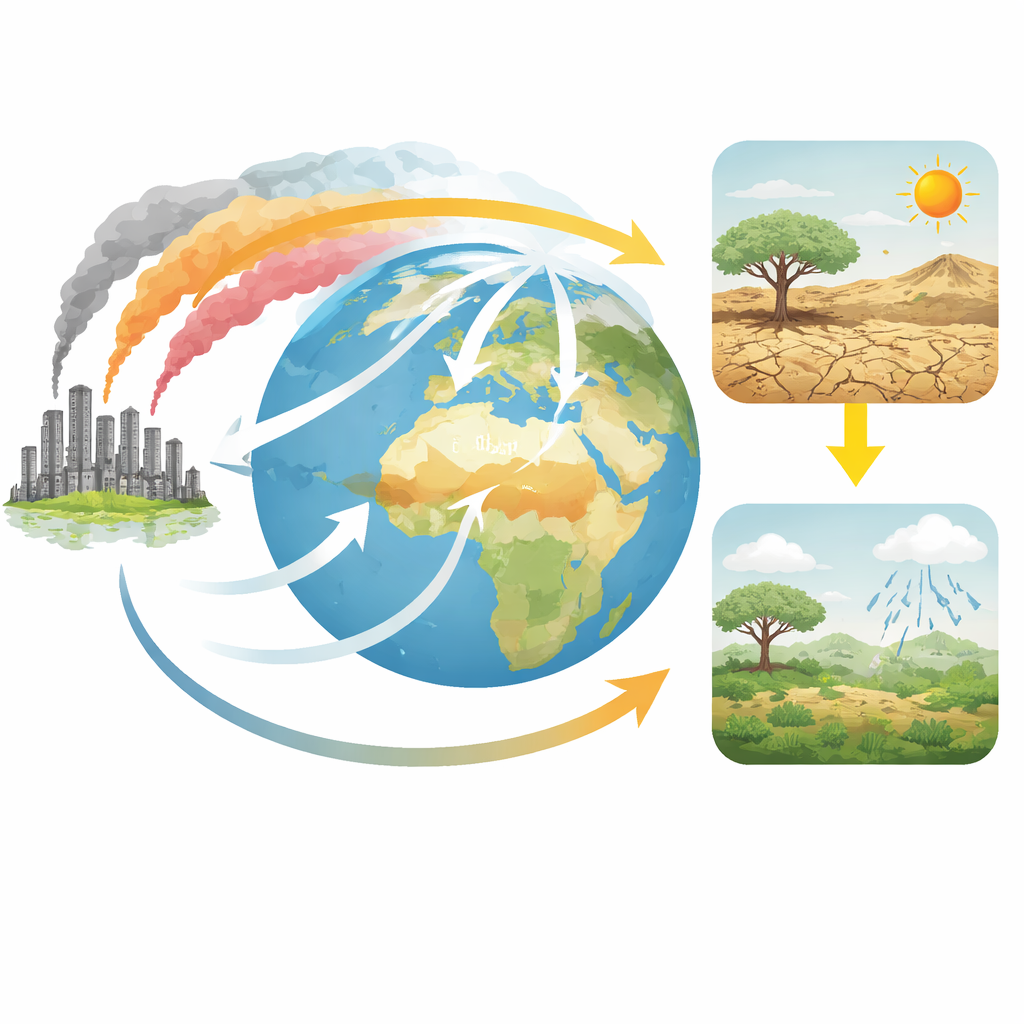
Weather records show that between 1970 and 1984 the Sahel experienced a sharp drop in summer rainfall, stretching from the Atlantic coast to the Horn of Africa. The land dried, crops failed, and societies were pushed to the brink. By the 2000s, however, the pattern had largely flipped: rainfall increased, and some areas saw a clear greening. Yet this recovery brought its own risks, including more frequent severe storms and destructive floods. Importantly, the authors note that these changes were not limited to the Sahel; other parts of the Northern Hemisphere tropics, such as South and East Asia, also saw shifts in monsoon rains over the same decades.
Following the fingerprints of human influence
To disentangle causes, the researchers turned to large collections of global climate model simulations from the most recent international comparison projects. They compared three types of experiments: ones including all known historical factors, ones with only greenhouse gases, and ones with only human-made aerosols—the tiny particles produced by burning coal, oil, and other fuels. By averaging many model runs, they minimized random weather noise and highlighted how the climate system responds to specific types of human influence. The combined "all forcings" experiments matched the observed shift from drought to wetter conditions, giving the team confidence that the models were capturing the key processes.
Air pollution beats greenhouse gases in the Sahel
When the authors separated out the effects, a striking pattern emerged. Changes driven by anthropogenic aerosols closely reproduced both the drying of the 1970s–1980s and the later rebound in Sahel rainfall, while the greenhouse-gas-only runs showed only a modest change. Quantitatively, the rainfall response to aerosols over the Sahel was about four to five times larger than the response to greenhouse gases during the key periods studied. As air-quality rules in Europe and North America cut sulfur emissions after the 1980s, the aerosol haze over the North Atlantic region thinned, and the models showed a corresponding shift toward stronger Sahel rains. In contrast, greenhouse gases mainly added warmth and slightly more moisture everywhere, without generating the observed sharp swings in regional rainfall.
How altered heating patterns move the monsoon
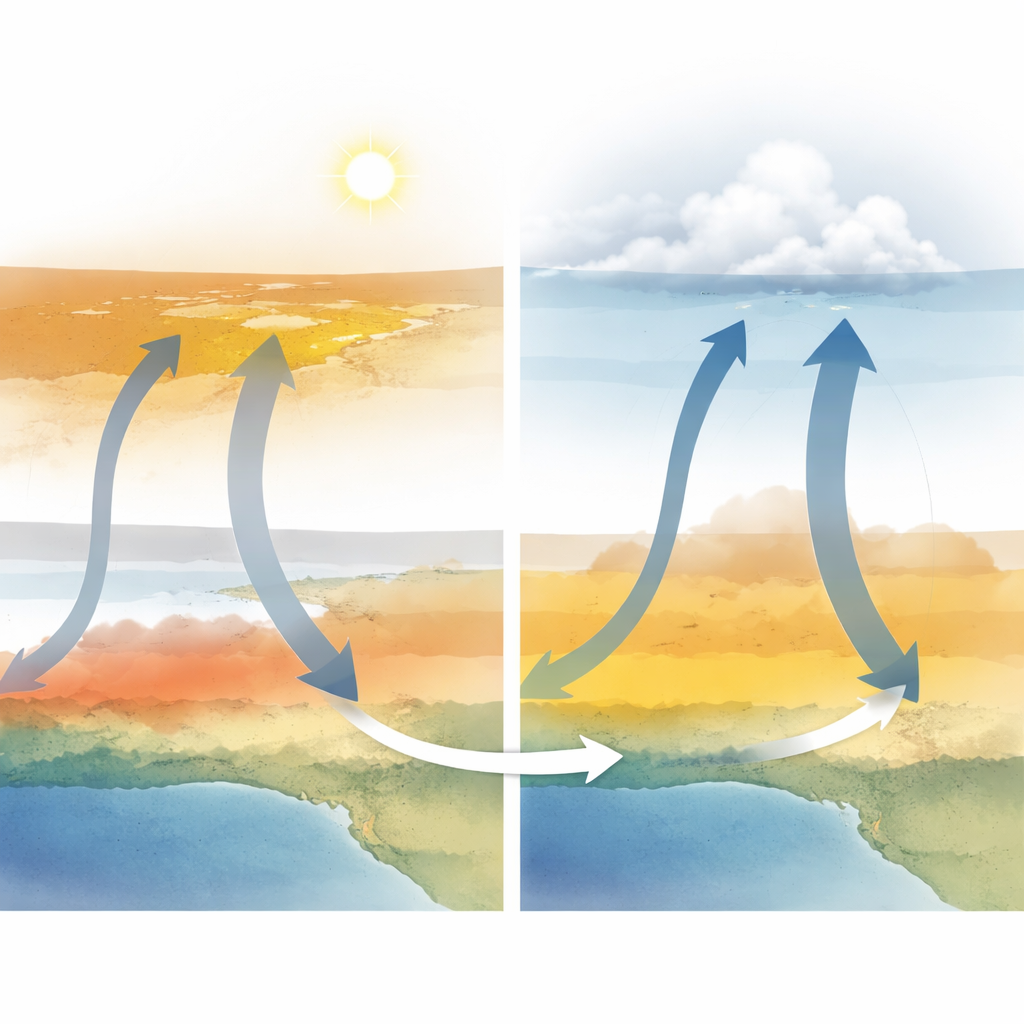
The core mechanism involves how uneven warming and cooling steer tropical air currents. In the drought decades, heavy aerosol pollution over industrial regions north of the Sahel reflected sunlight and cooled those areas, weakening the usual north–south contrast in surface heating between the Sahara and the wetter coast to the south. This dulled the strength of the West African monsoon circulation—part of the global Hadley Cell that moves air between equator and subtropics—reducing rising motion, cloud formation, and rainfall over the Sahel. At the land surface, drier soils and reduced vegetation further reinforced the dryness. When aerosol emissions later declined, the north–south heating contrast sharpened again, invigorating monsoon storms and increasing rainfall even though the region’s surface, on average, remained relatively cool in the models.
A new lens on regional climate risk
The study concludes that the recent history of Sahel rainfall cannot be explained primarily by greenhouse gases, natural variations, or land-use changes alone. Instead, shifting patterns of industrial air pollution—especially sulfate aerosols over the North Atlantic land regions—have been the main driver of both the Sahel’s severe drought and its partial recovery. Because aerosols are short-lived and concentrated near their sources, future changes in where and how much pollution is emitted could rapidly reshape regional climates. For the Sahel and other vulnerable regions, this means that accurate climate risk assessments must consider not just how much the planet warms, but also how evolving aerosol emissions redistribute heating and rainfall across the globe.
Citation: Nnamchi, H.C., Fiedler, S. Anthropogenic aerosols override greenhouse gases in Sahel climate change. Commun Earth Environ 7, 331 (2026). https://doi.org/10.1038/s43247-026-03474-3
Keywords: Sahel rainfall, anthropogenic aerosols, West African monsoon, climate change impacts, greenhouse gases