Clear Sky Science · en
Terrestrial organic matter input causes dual effects on methylmercury accumulation in coastal planktonic food webs
Why this study matters for seafood and coastal life
Mercury in seafood is a health concern worldwide, especially in its most toxic form, methylmercury, which can harm the human nervous system. This study asks a deceptively simple question with big implications: as climate change and land use send more brown, leaf‑derived organic matter from land into coastal seas, will the seafood chain end up with more or less methylmercury? By recreating miniature coastal ecosystems in large tanks, the researchers show that these terrestrial inputs can both boost and suppress methylmercury buildup in plankton, the tiny drifters that form the foundation of marine food webs. Understanding this tug‑of‑war is crucial for predicting future risks to fish, wildlife, and people who depend on the ocean for food.
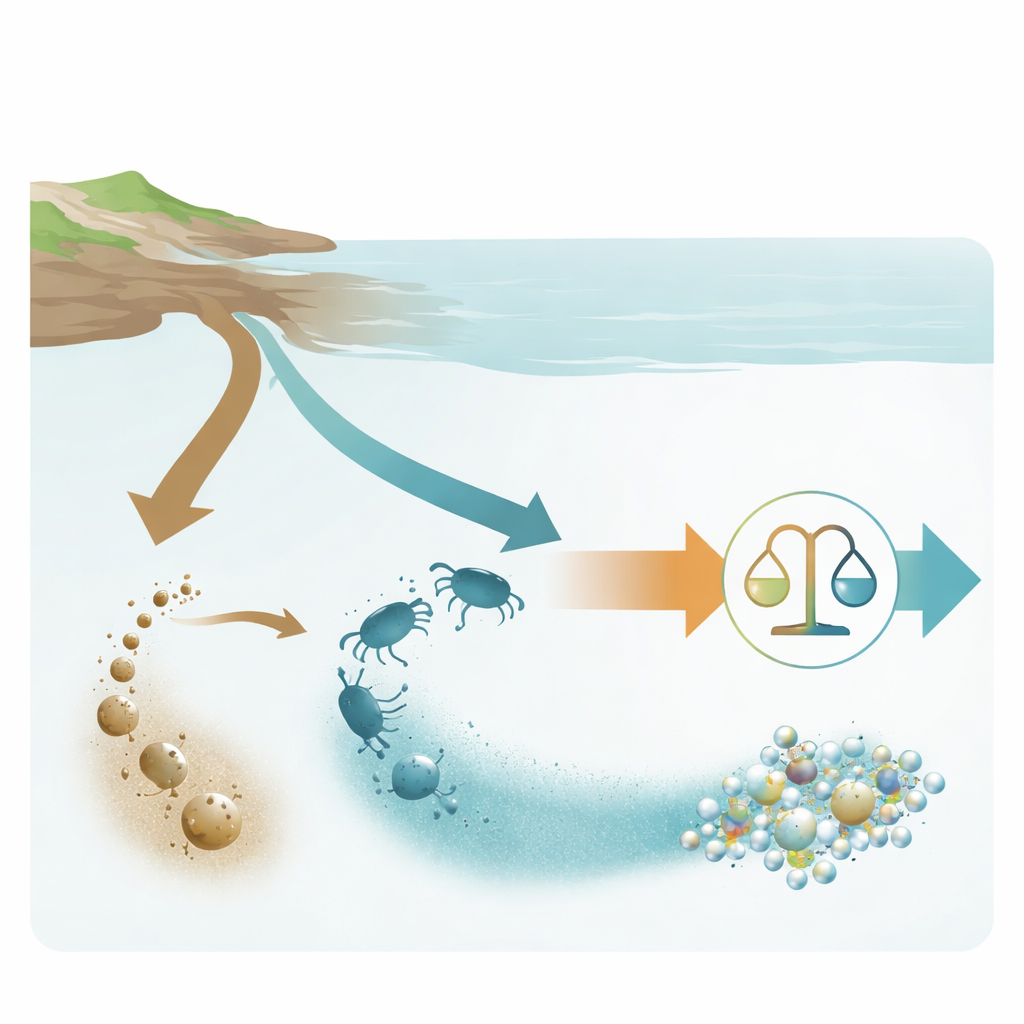
Brown water flowing from land to sea
Rivers and runoff carry huge amounts of dissolved organic matter from soils and forests into coastal waters. This “brown water” shades the sea, changes nutrient supply, and alters the chemistry of metals like mercury. In the northern Baltic Sea, such inputs are already increasing and are expected to grow as climate change intensifies rainfall and river discharge. The team set up twelve tall indoor tanks filled with estuarine water and added different amounts of terrestrial organic matter to create four conditions, from today’s typical levels to those expected in more heavily browned future coastal waters. They also added carefully measured isotopes of inorganic mercury and methylmercury, allowing them to track how the metal moved through the water and into plankton.
Miniature seas and busy microbial worlds
Over five weeks, the tanks developed distinct but all strongly “bacteria‑driven” food webs. As more terrestrial material was added, the water became darker, light for photosynthetic algae decreased, and bacterial production rose to dominate the base of the food web. Tiny heterotrophic organisms such as flagellates and ciliates under 20 micrometers grew more abundant, forming a multi‑step chain from bacteria to protozoa to zooplankton. In such complex, heterotrophic webs, methylmercury can biomagnify efficiently as it passes from one feeding level to the next, potentially raising concentrations in zooplankton that are later eaten by fish.
Sticky sulfur compounds that lock up mercury
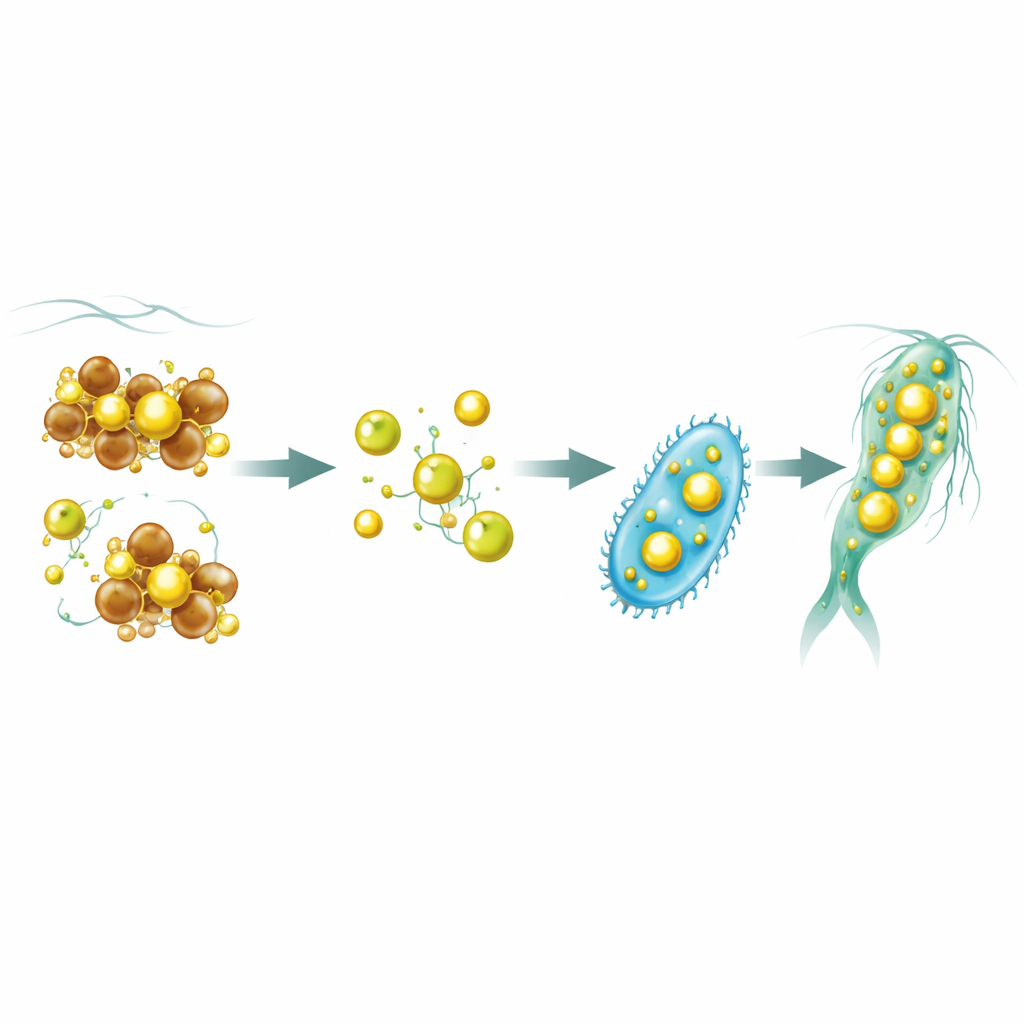
At the same time, the added terrestrial matter brought with it more dissolved sulfur‑containing groups known as thiols, which sit on organic molecules in the water. These thiols bind strongly to methylmercury, forming complexes that are much harder for plankton cells to take up. The researchers estimated thiol levels from dissolved carbon measurements and earlier field data, showing that thiol concentrations rose disproportionately as terrestrial inputs increased. As a result, although there was actually more dissolved methylmercury in the water at higher terrestrial inputs, its “free” and accessible portion declined. This chemical effect counteracts the biological boost from longer, more heterotrophic food chains.
Tracking methylmercury through the plankton
To see how these opposing forces balanced out, the team collected plankton in several size classes at the end of the experiment and calculated bioaccumulation factors, a measure of how much methylmercury builds up in organisms relative to the surrounding water. Across all treatments, these factors were high, reflecting the efficiency of the bacteria‑based webs. Yet within this experiment alone, average bioaccumulation actually decreased as terrestrial organic matter and thiol levels increased, despite higher bacterial dominance. When the authors combined their data with an earlier mesocosm study that covered a lower range of bacterial activity and thiol concentrations, a clear pattern emerged: methylmercury buildup in plankton increases with the share of production carried by bacteria, but decreases with thiol concentration in dissolved organic matter. A simple two‑factor statistical model explained about 90 percent of the variation in bioaccumulation across all treatments.
What this means for coasts, lakes, and our plates
For a non‑specialist, the key message is that more brown water from land does not automatically mean more or less mercury in seafood—it activates two competing mechanisms. Extra terrestrial organic matter pushes food webs toward longer, bacteria‑based pathways that amplify methylmercury up the chain, but it also carries sulfur groups that lock methylmercury into dissolved complexes and make it harder for plankton to absorb. The net result depends on the balance between these processes. Coastal areas with very active bacterial food webs but only moderate levels of thiol‑rich organic matter—conditions similar to the reference tanks in this study—may face the highest methylmercury buildup and deserve special monitoring. As climate change darkens many northern coastal waters, incorporating both food web structure and organic matter chemistry into environmental assessments will be essential for anticipating future risks to fish and the people who eat them.
Citation: Skrobonja, A., Brugel, S., Soerensen, A.L. et al. Terrestrial organic matter input causes dual effects on methylmercury accumulation in coastal planktonic food webs. Commun Earth Environ 7, 314 (2026). https://doi.org/10.1038/s43247-026-03470-7
Keywords: methylmercury, coastal food webs, terrestrial organic matter, dissolved organic carbon, marine pollution