Clear Sky Science · en
Seasonal freezing increases High Arctic erosion and landscape response to climate extremes
Why frozen rivers matter for our future
The High Arctic might seem like a timeless, frozen world, but its landscapes are changing quickly as the climate warms and extreme weather becomes more common. This study asks a simple but surprising question: do icy riverbeds slow erosion down, or can freezing and thawing actually make the ground wash away faster? The answer turns out to challenge long‑held assumptions and reveals that cold-region rivers may respond to climate extremes even more rapidly than rivers in warmer places. 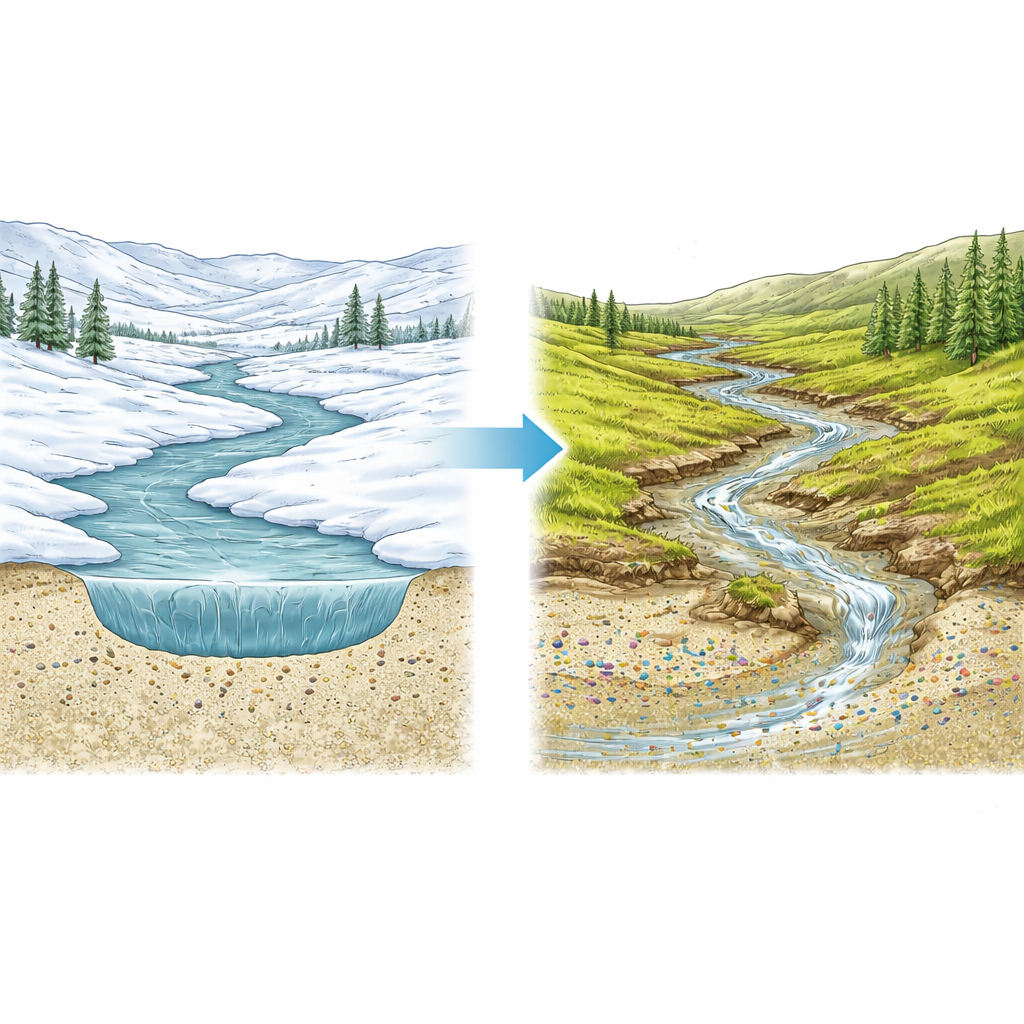
Old ideas about slow-changing frozen ground
For decades, scientists thought that ice locked into soil and riverbed sediment acted like glue. In winter, water in the pores between grains freezes, stiffening the ground and making it hard for flowing water to pick up and move particles. In this view, most erosion should happen late in the short Arctic summer, once the ice has melted and the bed behaves like that of any temperate river. Because thawing was treated as a slow, even process controlled mainly by heat diffusing downward, erosion in cold regions was expected to be modest and gradual over the course of each thaw season.
Laboratory rivers that break the rules
To test these assumptions, the researchers built a narrow, clear-walled flume—a kind of laboratory river—filled with glass beads that mimic sediment. They ran two sets of experiments: one with unfrozen beds and one where the same beds were fully frozen and then allowed to thaw from the top down while water flowed over them. Using cameras and dyes to track particles and water paths, they measured how many grains left the bed over time. Surprisingly, the frozen-and-thawing beds shed grains about ten times faster, on average, than the identical but never-frozen beds. Rather than being protected by ice, the riverbed became more erodible for most of the thaw season.
How hidden flows under the surface speed erosion
The key lies in what happens just beneath the riverbed surface as thaw progresses. Early in the season, the flowing water above drives narrow jets down into tiny depressions in the partially thawed layer. Because there is still solid ice deeper down, this thaw front behaves like a hard, impermeable barrier. The jets hit it and turn sideways, setting up swirling motions that stir warm water through the shallow thawed zone. This concentrated motion both melts ice faster in some spots and pushes on the grains from below, loosening them so they can be swept away. Over time, this uneven melting carves gentle waves into the thaw front and creates small steps in the bed surface. Later in the season, even after the stirring weakens and heat spreads more evenly, these steps and undulations continue to focus subsurface flow and pore pressure, keeping erosion rates higher than in an unfrozen bed. 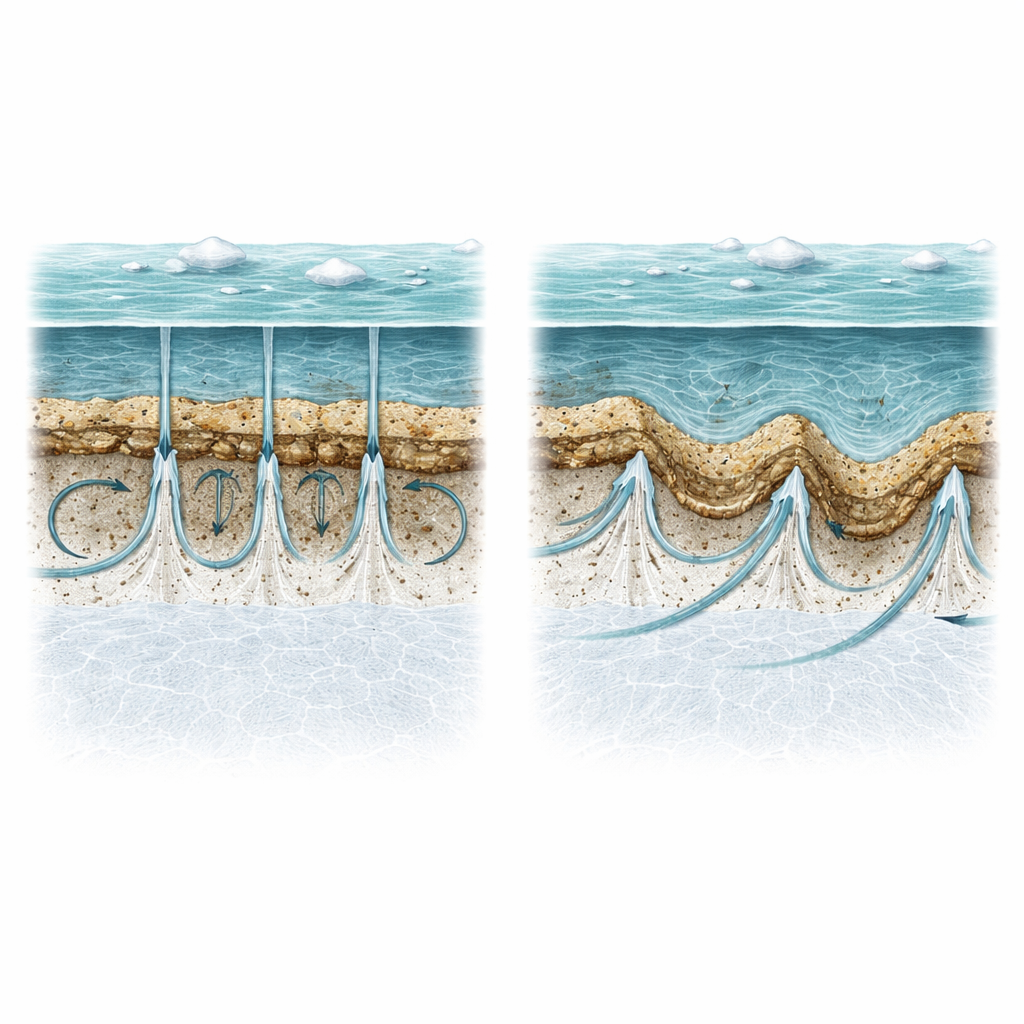
From tiny bedforms to broken-up river networks
The authors link these grain-scale processes to real Arctic landscapes in Canada’s High Arctic. There, small valleys show short, steep channel segments separated by flatter, ponded zones and wetlands—so-called discontinuous channel networks. Field measurements reveal undulating thaw fronts beneath channels and steps, similar in shape to those produced in the flume. The study proposes that repeated seasons of “coupled thaw-entrainment”—where thawing and particle pickup reinforce each other—leave a kind of memory in the ground: steps and pools formed one year shape where and how water seeps and thaws the next. Over many years, this feedback helps build the patchwork of eroding channels and depositional wetlands seen across periglacial landscapes.
Climate extremes as powerful landscape shapers
Using a new theoretical “regime space” that compares how strongly erosion is spread out versus focused, and whether thaw-front undulations grow or smooth out, the team explores how different weather events play out over a season. Cold snaps that briefly refreeze the ground tend to reset conditions and spread erosion more evenly, slowing step growth. In contrast, early-season heatwaves deepen the thaw layer and make erosion more focused, promoting rapid step and channel development even if total erosion is not dramatically larger. Intense rainstorms act in two ways: during the storm they raise flows and stir more heat into the ground, and afterward the added warmth leaves the bed more deeply thawed, similar to a heatwave.
What this means for a warming Arctic
The study concludes that, contrary to traditional expectations, frozen ground can make Arctic riverbeds more—not less—vulnerable to erosion once thaw begins, and that the timing and intensity of extreme weather strongly shape how quickly landscapes adjust. As early-season heatwaves and heavy rains become more frequent in a warming climate, High Arctic channel networks are likely to grow and reorganize rapidly, forming broken-up chains of channels and wetlands. For a lay observer, the takeaway is that icy landscapes are not slowly awakening giants, but fast-moving, reactive systems that may transform far sooner than long-term average warming alone would suggest.
Citation: Eschenfelder, J.A., Chartrand, S.M., Jellinek, A.M. et al. Seasonal freezing increases High Arctic erosion and landscape response to climate extremes. Commun Earth Environ 7, 388 (2026). https://doi.org/10.1038/s43247-026-03468-1
Keywords: Arctic erosion, permafrost thaw, river channels, climate extremes, landscape change