Clear Sky Science · en
Strontium to calcium ratio and oxygen isotopic coral records can exaggerate past decadal tropical climate variability
Why coral skeletons matter for our future
To prepare for future climate change, we need to know how much temperatures have naturally swung in the past. Tropical oceans are especially important because they drive weather patterns worldwide, yet thermometer records there are short. This study looks at coral skeletons—natural archives that can be read like climate diaries—and asks a simple but crucial question: do these archives faithfully record past temperature ups and downs, or can they mislead us about how wild past climate really was?

Reading temperature in coral bones
Massive reef-building corals grow layer by layer, laying down a skeleton whose chemistry changes with the warmth of the surrounding seawater. Scientists often measure two markers in these skeletons: the ratio of strontium to calcium, and the composition of oxygen isotopes. Both respond to temperature and can be sampled at nearly monthly resolution, reaching centuries into the past. These coral records have been used to reconstruct sea-surface temperatures, track El Niño behavior, and study the climate impact of volcanic eruptions.
An unexpected mismatch with real-world measurements
When researchers compare coral-based temperature reconstructions to modern sea-surface temperature data from ships, buoys, and satellites, they find something puzzling. On the scale of the yearly cycle—summer to winter—the corals match local temperature swings quite well. But when the data are averaged year by year and examined over decades, the coral records show much larger ups and downs than the instrumental records do. This pattern appears in both major coral markers, suggesting that the problem does not simply come from changes in rainfall or seawater composition. The result has fueled debate: are climate models missing big natural swings, or are the coral records exaggerating how variable the past really was?
Separating real climate swings from coral “noise”
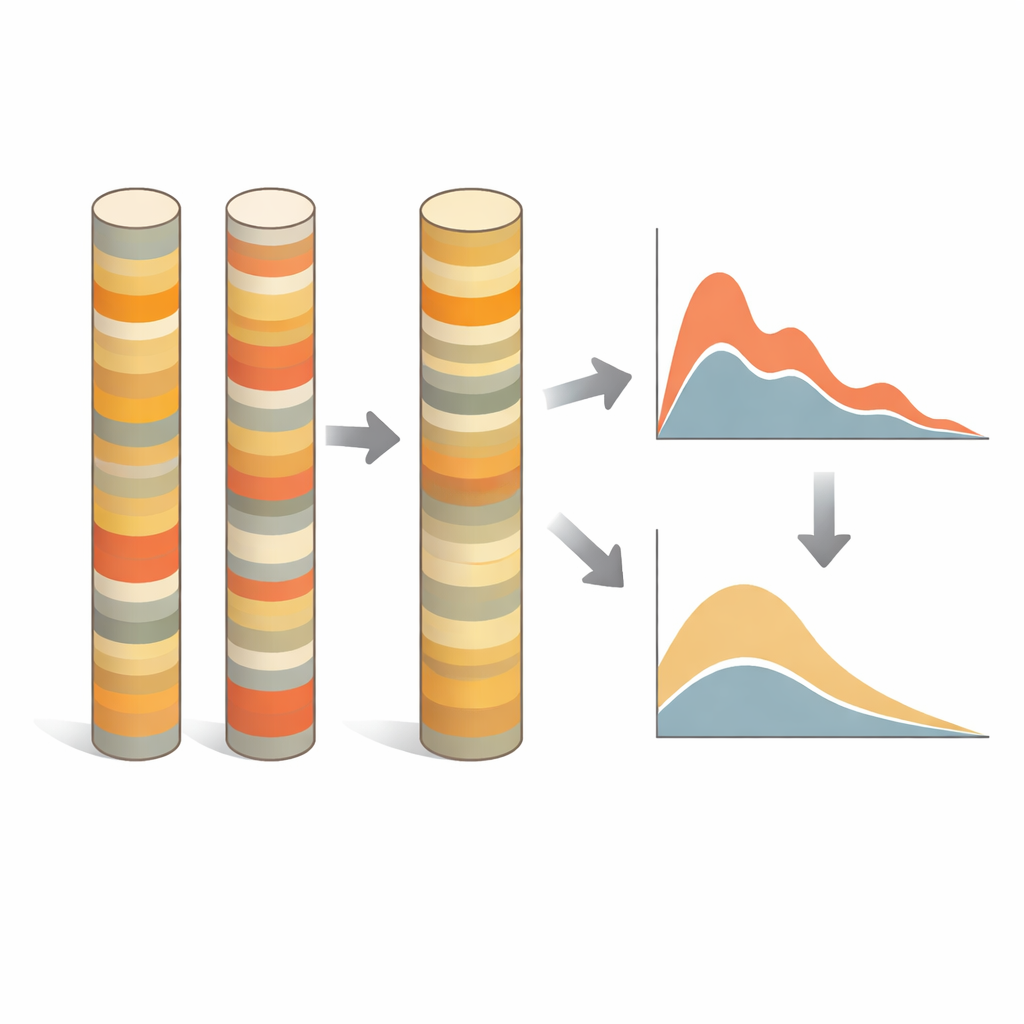
The authors tackle this question by focusing on places where two or more coral colonies grow close together, seeing almost exactly the same water temperatures. In principle, the climate signal should be nearly identical in each colony, while random, non-climate effects will differ from coral to coral. By comparing pairs of nearby records in the frequency domain—that is, across a range of timescales—they mathematically split each coral record into a shared climate component and a non-shared noise component. After converting the chemical signals into temperature units using well-established sensitivities, they compare these cleaned climate spectra to standard global sea-surface temperature datasets.
Hidden slow drifts in coral chemistry
The analysis reveals that individual coral records contain a large, slowly varying noise component that becomes stronger at longer timescales. Instead of random point-to-point scatter, the errors are “sticky”: they drift over years to decades in ways that can mimic real climate trends. Once this noise is removed, the remaining climate signal from corals closely matches the amplitude and timescale structure of observed sea-surface temperature variations. The study finds that, beyond the yearly cycle, the raw coral records exaggerate temperature variance by factors of about two to seven, meaning that reported decadal to centennial swings in past tropical temperatures have likely been overstated. The authors argue that these slow drifts may arise from biological processes within the coral, such as changes in growth rate, stress responses, or shifts in the coral’s microscopic algae, which change how trace elements are built into the skeleton.
Why working with many corals is key
There is a silver lining: although this long-memory noise is strong within any one coral, it appears largely uncorrelated between neighboring colonies. That means averaging several cores from the same site strongly boosts the true climate signal and damps the misleading drifts, much like combining multiple tree rings to reconstruct past rainfall. The authors show that stacks of just two replicate coral records are already enough to bring variability estimates into line with instrumental data, and they outline ways to quantify the remaining uncertainty across different timescales. They also highlight that many previous studies, which relied on single colonies, may have unintentionally amplified apparent mismatches between climate models and proxy data.
What this means for our view of past climate
For non-specialists, the take-home message is that corals remain one of our best windows into past tropical climate—but that window is a little foggier on long timescales than once thought. By carefully accounting for slow, internal quirks of coral growth and by prioritizing multiple cores from each site, scientists can obtain more realistic estimates of how much tropical temperatures have actually varied over decades and centuries. This refined picture suggests that earlier coral-based reconstructions likely overstated the size of natural swings, bringing them closer to what climate models and instrumental records already imply, and providing a more solid basis for judging today’s human-driven warming against the backdrop of Earth’s natural variability.
Citation: Dolman, A.M., McPartland, M.Y., Felis, T. et al. Strontium to calcium ratio and oxygen isotopic coral records can exaggerate past decadal tropical climate variability. Commun Earth Environ 7, 308 (2026). https://doi.org/10.1038/s43247-026-03465-4
Keywords: coral climate records, tropical sea surface temperature, paleoclimate variability, proxy noise and uncertainty, climate reconstruction methods