Clear Sky Science · en
Volcano-tectonic earthquake focal mechanisms reveal fluid-induced stress changes driving hydrothermal system development at Mount Ontake
Why hidden water inside volcanoes matters
Mount Ontake in central Japan looks peaceful most of the time, but in 2014 a sudden steam-driven blast killed dozens of hikers with almost no warning. That tragedy underscored how difficult it is to tell whether a restless volcano will actually erupt or simply simmer down. This study shows that tiny earthquakes beneath Ontake carry a detailed record of how hot fluids move and build pressure inside the mountain. By decoding those signals, scientists can better judge when a volcano’s internal plumbing is quietly adjusting — and when it might be edging toward another dangerous outburst.
Small quakes as underground messengers
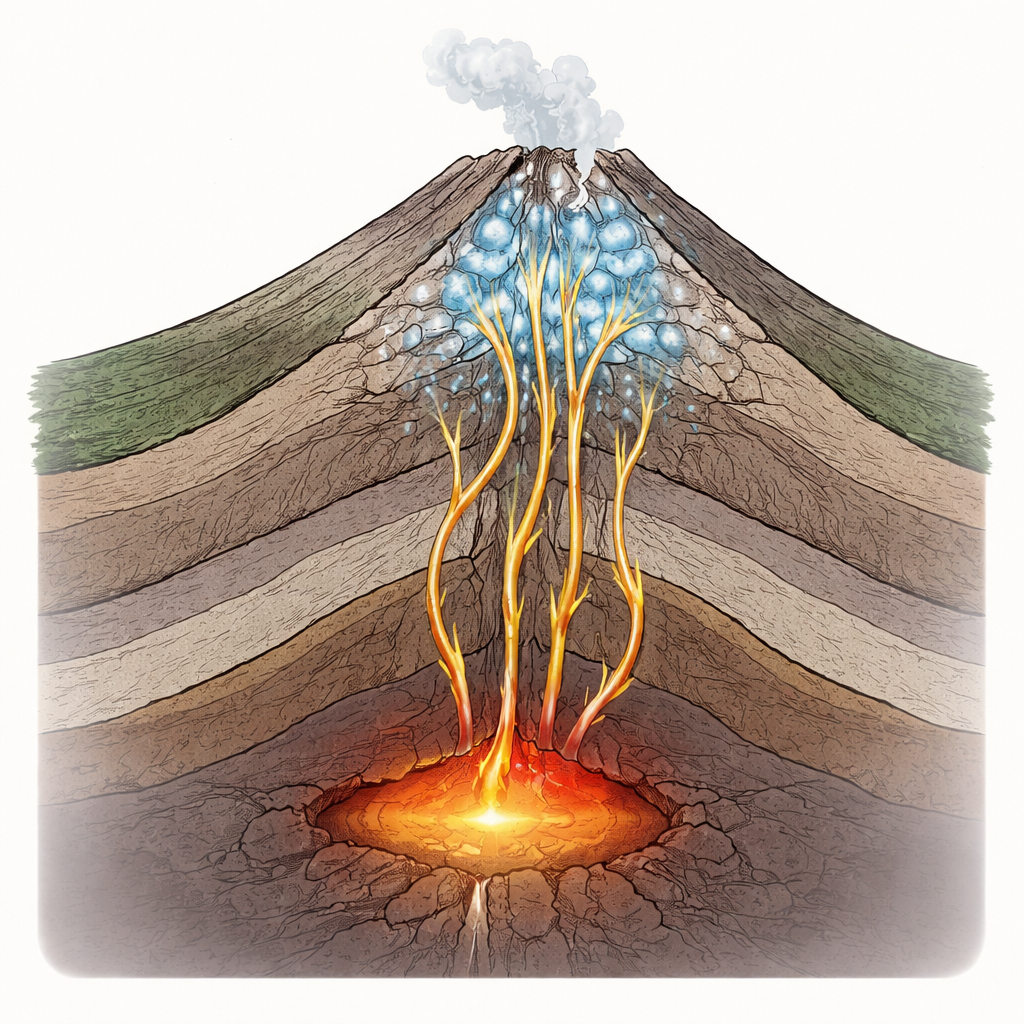
When rocks break under stress, they generate earthquakes whose shaking pattern reveals how the fault slipped. At volcanoes, many such “volcano‑tectonic” quakes occur a few kilometers below the surface as underground water and gas interact with the surrounding rock. The authors focused on an episode of unrest at Mount Ontake from late 2024 to early 2025. Thanks to a newly densified seismic network on the rugged summit, they recorded thousands of very small quakes and determined precise locations for 2,672 of them, most less than a kilometer or two below the summit. By analyzing the detailed source patterns of 316 of these events, they could infer how the local stress field — the push and pull acting on the rock — changed over time as fluids moved through the crust.
Tracing the shape of a growing fluid system
The earthquake locations showed that activity started near the boundary between the older volcanic edifice and deeper basement rock, then intensified without spreading much sideways. Over weeks, the cluster of quakes stretched out along near‑vertical planes that matched the direction of the region’s easiest paths for fluid flow. These “least‑resistance” planes are surfaces where the squeezing from the surrounding crust is weakest, so rising hot water and gas can most readily invade and pressurize them. The data indicated that, as fluids accumulated along these vertical pathways, the pattern of stress in nearby rock shifted: some areas became more prone to faults that slip downwards (normal faulting), others to compression‑dominated motion (reverse faulting), all without any magma necessarily reaching the surface.
How pressurized fluids twist the stress field
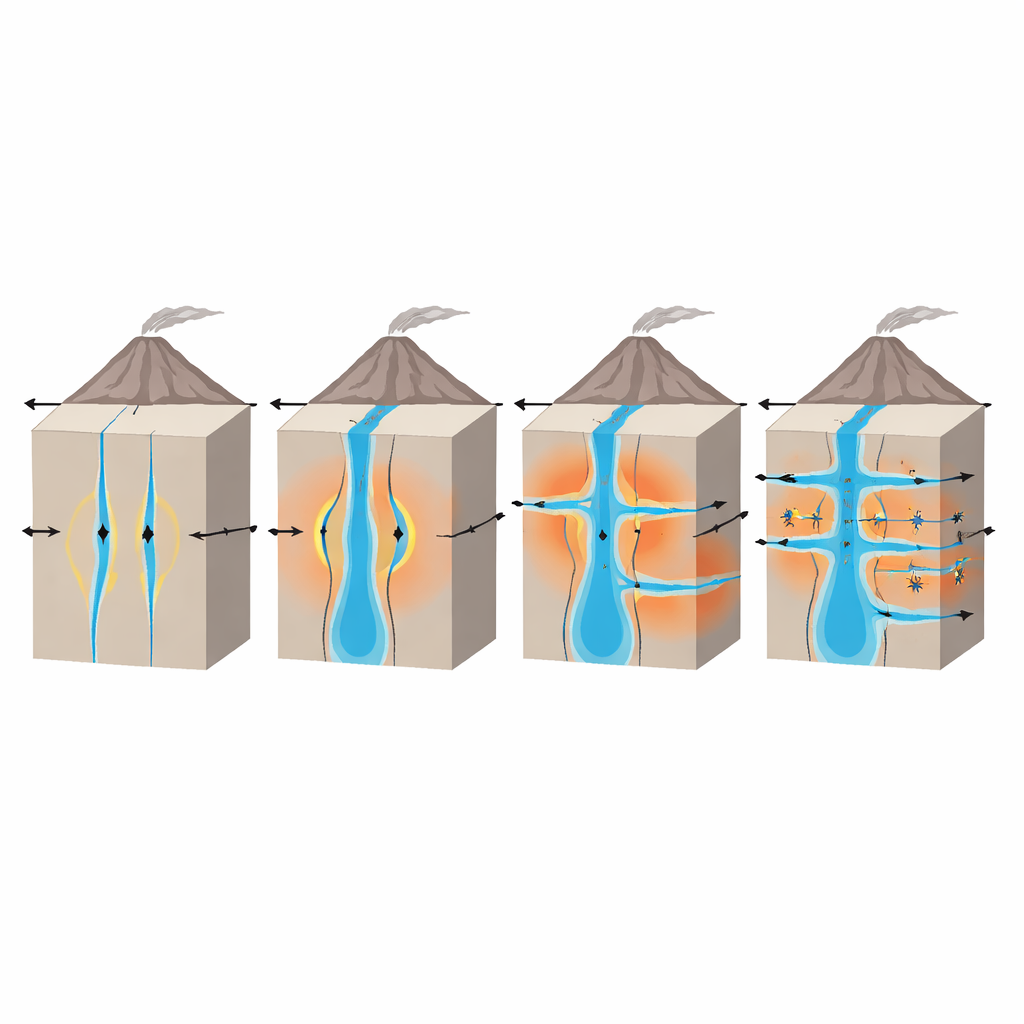
To explain the complex mix of quake types, the authors built a conceptual model of how fluids alter stresses. First, fluids intrude along vertical weak planes, pushing outward and increasing pressure in the direction that had previously been the least compressed. This makes it easier for nearby faults to slip in a way typical of normal faulting. Closer to the tips and edges of the fluid‑filled zones, however, pressure builds differently, rotating the direction of greatest and least compression by up to 90 degrees. As pressure continues to rise, the planes along which fluids can most easily spread flip from vertical to horizontal, allowing hot water and steam to invade flat fractures higher up. Throughout this process, earthquakes occur both on faults that fit the broader regional stress and on others that can only be explained by these local, fluid‑driven distortions.
Signals of a changing hydrothermal network
Just before a burst of volcanic tremor — a continuous vibration linked to moving fluids — the earthquakes that did not match the regional stress pattern released more energy than those that did. This timing suggests that fluid pressurization and intrusion were peaking, driving strong local stress changes. After the tremor, most quakes once again fit the broader regional stress, and overall seismic activity dropped sharply, as if the system had partially relieved its pressure. Yet an unusually large share of quakes still occurred on oddly oriented fractures. The authors interpret this as a sign that depressurization opened a wide variety of cracks and old weaknesses, letting fluids circulate through a more complex network rather than just a few well‑aligned faults.
What this means for forecasting eruptions
The study concludes that patterns in small earthquake mechanisms can reveal when and where pressurized hydrothermal fluids are reshaping the internal fracture network of a volcano. At Mount Ontake, these changes helped explain both the 2014 deadly eruption and the later unrest that did not erupt. By tying quake behavior to the build‑up of different kinds of stored elastic energy in the crust, the approach offers a physically grounded way to distinguish simple pressure adjustments from more dangerous conditions. In the long run, carefully tracking how fluids twist and redirect stress beneath active volcanoes could improve eruption forecasts and help authorities better judge when to close, or safely reopen, mountains that millions of people live near and visit.
Citation: Terakawa, T., Maeda, Y. & Horikawa, S. Volcano-tectonic earthquake focal mechanisms reveal fluid-induced stress changes driving hydrothermal system development at Mount Ontake. Commun Earth Environ 7, 370 (2026). https://doi.org/10.1038/s43247-026-03463-6
Keywords: volcano unrest, hydrothermal fluids, Mount Ontake, volcanic earthquakes, eruption forecasting