Clear Sky Science · en
Global hotspots of compound extreme heat-pollution linked to local surface and atmospheric conditions
Why heat and dirty air are a dangerous mix
Across the world, people are facing more days that are not only unbearably hot but also choked with fine particles in the air. This study looks at where such double trouble days happen most often and what weather patterns make them more likely, helping communities understand and prepare for a growing climate and health threat.
Where the double threat strikes most often
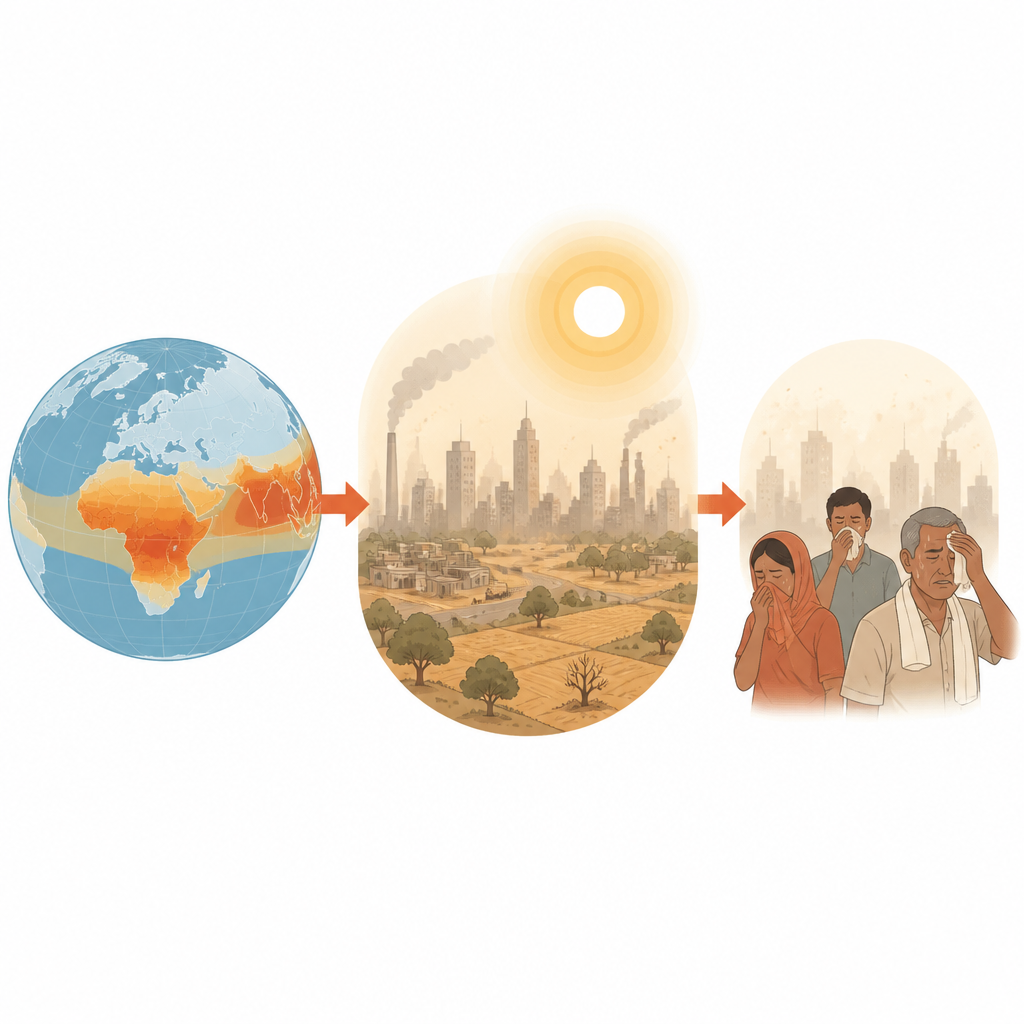
Using satellite based and ground based data at a fine one kilometer scale, the researchers mapped three kinds of days from 2003 to 2020 worldwide: very hot days, very polluted days, and days when both occur together. They found that extreme heat alone tends to peak in northern Africa, western Asia, and northwestern Australia, while dirty air alone is most common in central Africa, northern India, and parts of China. The most striking result appears for days when heat and pollution coincide, which cluster over large parts of Africa, South Asia, Southeast Asia, and parts of the United States and China.
Two global hotspots stand out
Among all regions, Sub Saharan Africa and the Indus River Valley stretching across parts of Pakistan and India stand out as true hotspots. On average, each of these regions suffers around three months per year of days that are both very hot and heavily polluted, and these events are also more intense and longer lasting than elsewhere. The two landscapes differ: Sub Saharan Africa includes broad plateaus near the southern Sahara, whereas the Indus River Valley is a low lying plain bordered by high mountains. Yet both settings foster conditions where heat and dirty air build up together and linger.
What happens at the surface
The team examined how key surface conditions change on different types of extreme days, focusing on temperature, rainfall, humidity, cloud cover, and incoming and outgoing radiation. In Sub Saharan Africa, hot only days bring higher temperatures, less rain and humidity, fewer clouds, and stronger sunshine, all of which reinforce each other to dry and heat the land. Pollution only days there look almost opposite, with cooler, wetter, cloudier conditions that help trap particles and allow them to grow. When heat and pollution coincide, the region still experiences strong warming, but the drops in rainfall and humidity are somewhat softened by the presence of particles and cloud changes that alter how sunlight is absorbed and reflected.
How air flows shape the risk
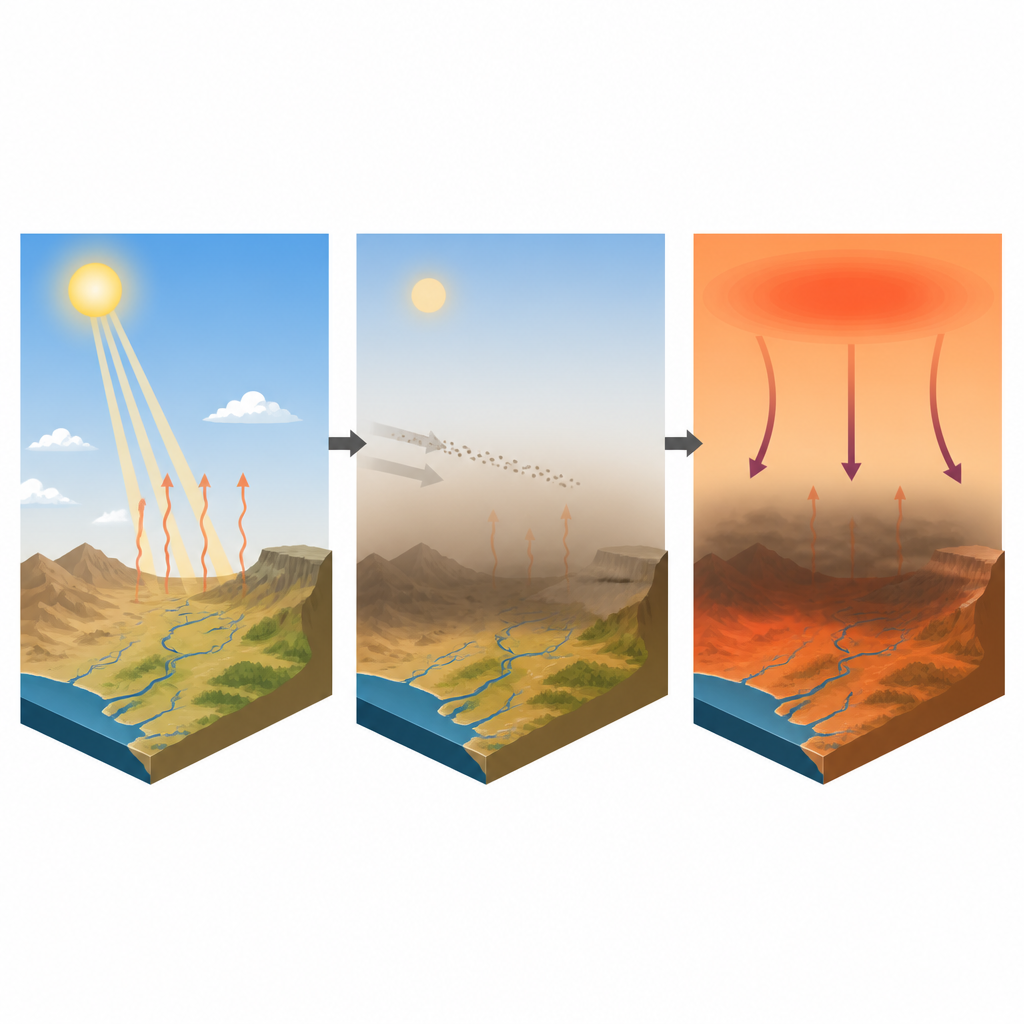
Higher up in the atmosphere, the air flow patterns that accompany these events differ between the two hotspots. Over Sub Saharan Africa, compound events feature sinking air in the middle and upper levels that suppresses cloud formation and helps warm the surface while slowing the escape of locally produced pollution. Over the Indus River Valley, a strong high pressure system extends from near the ground up through the upper troposphere. This pattern encourages widespread sinking, clear skies, and heat build up, while also steering dust from surrounding deserts and man made emissions from nearby regions into the valley, where surrounding mountains limit ventilation and let heat and pollution accumulate.
The chain reaction between land, air, and people
During compound heat pollution events in both hotspots, the land and air enter a self reinforcing cycle. High temperatures dry out soils and increase the demand for water, reducing the ability of rain to cleanse the air. With fewer clouds and stronger sunshine, the ground warms further, plants and other sources release more gases that can form new particles, and some components of existing particles absorb sunlight and warm the air just above the surface. At the same time, the stable, warm layer near the ground and the large scale circulation patterns limit vertical mixing, so dirty air remains trapped where people live.
What this means for everyday life
This study shows that some of the world’s most vulnerable regions are already experiencing frequent days when deadly heat and unhealthy air arrive together, driven by a combination of local land conditions and large scale weather patterns. For people on the ground, these findings underscore the need for warning systems that track heat and air quality at the same time, and for city and regional planning that cools neighborhoods while cutting emissions. By revealing where and how these compound extremes form, the work provides a scientific basis for designing practical steps to reduce health risks in a warming, more polluted world.
Citation: Huang, Z., Luo, M., Wu, S. et al. Global hotspots of compound extreme heat-pollution linked to local surface and atmospheric conditions. Commun Earth Environ 7, 457 (2026). https://doi.org/10.1038/s43247-026-03460-9
Keywords: extreme heat, air pollution, PM2.5, Sub Saharan Africa, Indus River Valley