Clear Sky Science · en
Crustose coralline algae biomineral-bound nitrogen isotopes provide a baseline to reconstruct coral trophic strategies
Why tiny reef crusts matter for coral survival
Coral reefs face growing stress from warming seas and changing ocean chemistry, yet some corals cope better than others. A key difference is how they get their food, sharing energy with resident algae or catching prey for themselves. This study shows that a humble group of pink, rock-hard seaweeds called crustose coralline algae can store a chemical record that helps scientists read how flexible coral feeding has been across oceans and through time.
Reading the ocean’s pantry with coral reef crusts
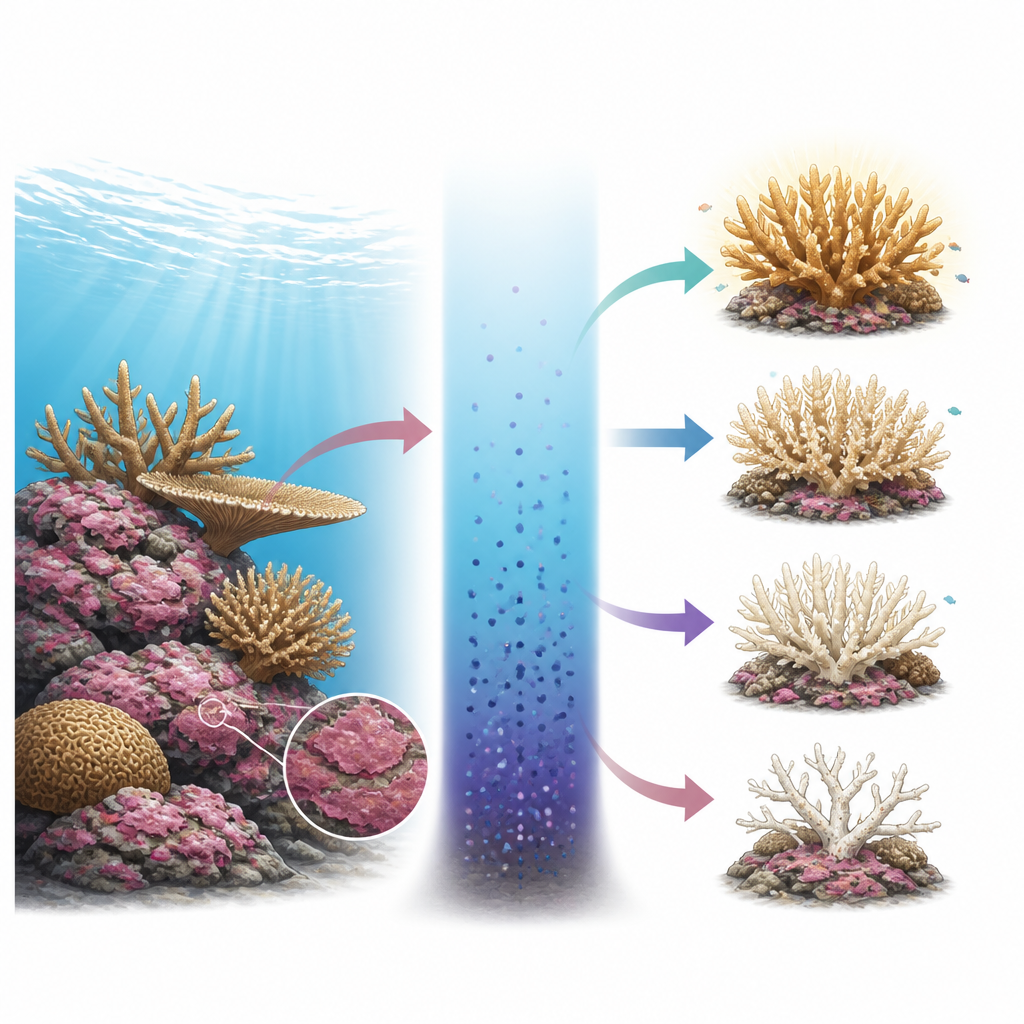
Crustose coralline algae form thin, pinkish crusts that glue reefs together and help baby corals settle. Because they depend entirely on sunlight and dissolved nutrients, they soak up nitrogen from surrounding seawater without the extra processing that happens in animals. The nitrogen they take in becomes locked inside their hard skeleton. By measuring the natural nitrogen isotope signature in this trapped organic material, the authors show that these algae closely track the nitrogen supplied to surface waters from below, creating a long-lived local “baseline” of nutrient conditions.
Matching algae signals to coral lifestyles
The team sampled algae and corals from 30 tropical reef sites across the Indo-Pacific, Atlantic, Red Sea, and Caribbean. In 17 locations they could collect triplets: algae, corals with internal algae partners, and corals that live without such partners. Across sites, the nitrogen signal in crustose coralline algae matched the nearby subsurface nitrate very well, even where conditions ranged from nutrient-poor blue water to regions influenced by powerful upwelling or low-oxygen zones. Symbiotic corals showed nitrogen values similar to the algae, while non-symbiotic, fully feeding corals were consistently enriched by a few parts per thousand, reflecting the waste they excrete as they digest prey.
From chemical fingerprints to feeding balance
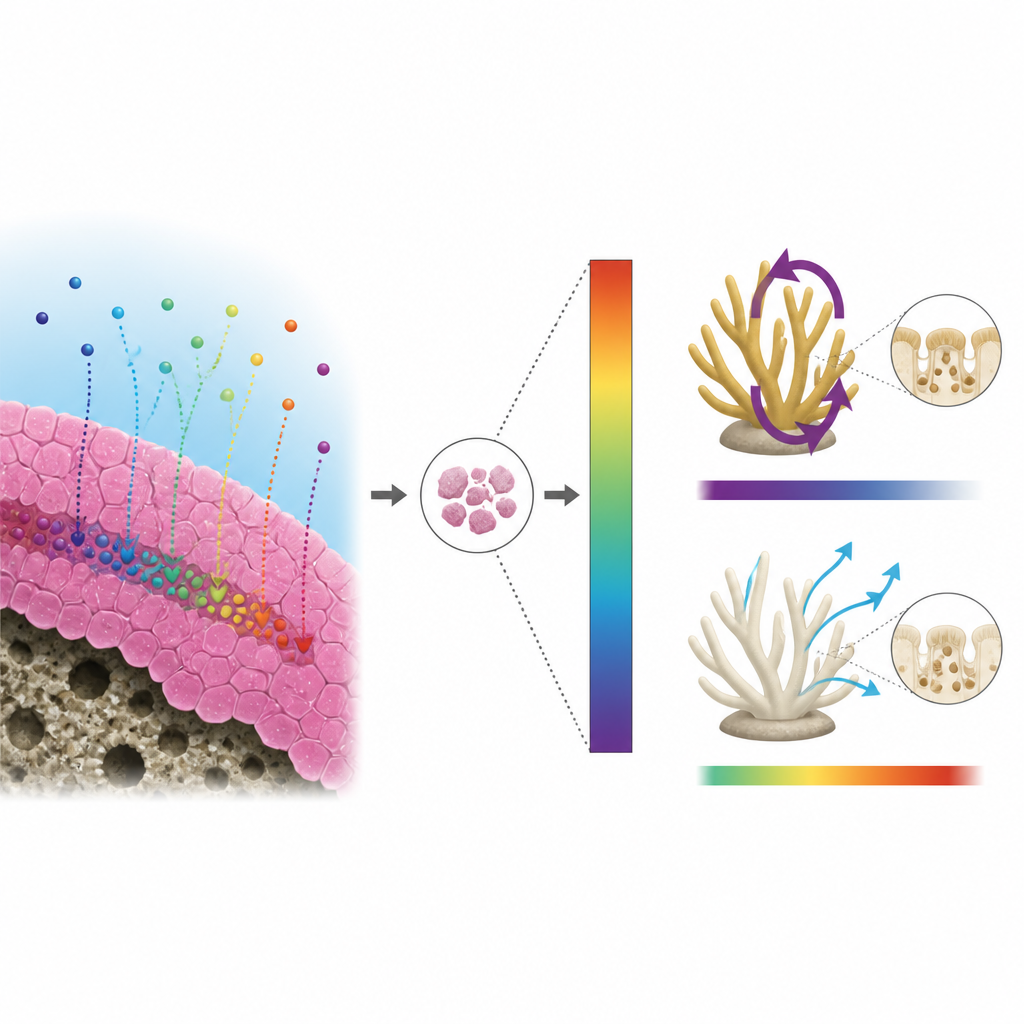
Because crustose coralline algae mark the local baseline, the difference between their nitrogen signal and that of nearby corals reveals how much corals rely on internal recycling versus external feeding. The authors use these offsets to define a “trophic enrichment factor” for purely feeding corals, then place symbiotic species on a scale between two end points: one dominated by recycling of nitrogen inside the coral–algae partnership, the other dominated by loss of nitrogen as waste. From this, they build a Reliance on Symbionts Index, which estimates the share of a coral’s energy that effectively comes from its photosynthetic partners, independent of local nutrient background.
Different corals, different ways to cope
Applying this index to many species from Jamaica and American Samoa, and then to several coral genera across the globe, reveals a wide spread in feeding strategies. Some corals, such as certain branching and mound-forming species, show consistently high reliance on internal algae, with little sign of nitrogen loss. Others lean more heavily on catching food or can shift along the scale depending on local conditions. These differences line up with long-term changes seen on reefs. In Jamaica, for example, highly symbiont-dependent corals have declined over recent decades, while more flexible types have become more common, suggesting that the ability to adjust feeding style can help corals weather repeated disturbances.
Looking back in time to guide coral futures
Because the nitrogen trapped in both crustose coralline algae and coral skeletons can survive for millions of years, this approach opens a window into the feeding strategies of ancient reefs. By comparing isotope values from algae, symbiotic corals, and non-symbiotic corals where fossils co-occur, scientists can infer how strongly past coral communities depended on internal algae and how that balance shifted during major environmental upheavals. The study concludes that these reef crusts provide a powerful baseline for reconstructing coral diets and resilience, helping us place today’s reef crisis in a much deeper historical context.
Citation: Jung, J., Wald, T., Foreman, A.D. et al. Crustose coralline algae biomineral-bound nitrogen isotopes provide a baseline to reconstruct coral trophic strategies. Commun Earth Environ 7, 438 (2026). https://doi.org/10.1038/s43247-026-03459-2
Keywords: coral reefs, crustose coralline algae, nitrogen isotopes, mixotrophy, photosymbiosis