Clear Sky Science · en
Microbial dormancy under freeze–thaw cycling regulates alpine soil responses to warming
Why frozen mountain soils matter
High mountain grasslands on the Qinghai–Tibetan Plateau store vast amounts of carbon in their frozen soils. As these regions warm at almost twice the global average rate, scientists worry that once-stable carbon could escape to the atmosphere as carbon dioxide, further fueling climate change. This study asks a deceptively simple question: what are the tiny soil microbes doing during long, cold winters and brief thaws, and how does their hidden lifestyle shape future greenhouse gas emissions?
The hidden life of soil microbes
Soil microbes drive the breakdown of dead plant material and the release of carbon dioxide, but in cold regions they live with extreme swings between frozen and thawed conditions. For much of the year, most microbes shut down into a dormant state to survive the cold, while a small minority keeps working even below freezing. When the soil thaws, conditions suddenly improve and many microbes wake up, producing enzymes that chew through organic matter and release pulses of carbon. Yet most large-scale climate models treat these soils as if microbes responded smoothly to temperature, without this on–off behavior.
Building a new picture of freeze–thaw soils
To capture this reality, the researchers created a new computer model, called MEND-FT, that builds microbial dormancy and freeze–thaw cycles directly into soil carbon calculations. They combined it with a multi-year field experiment in an alpine meadow where the entire top meter of soil was warmed by 4 degrees Celsius. Using measured soil temperatures and moisture, they calculated how deep the soil froze and thawed through time, and then used this “active layer” to control when microbes went dormant or became active. The model also tracked microbial biomass, enzyme production, nitrogen cycling, and carbon dioxide release.
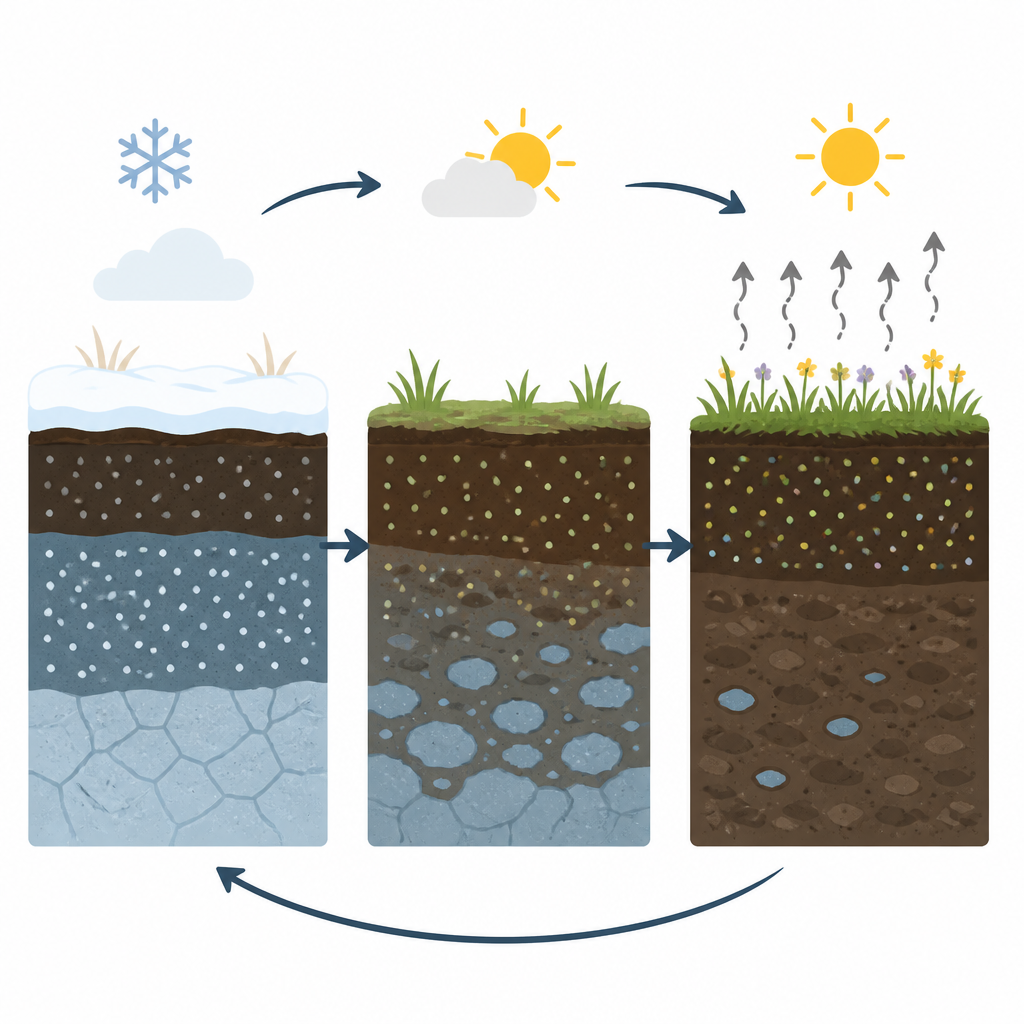
What warming does between seasons
The new model showed that warming reshapes the freeze–thaw pattern itself. Warmer soils froze less deeply, thawed about 38 days longer each year, and started freezing later in autumn while thawing earlier in spring. These shifts had outsized effects outside the growing season, when field measurements are often missing. Under warming, simulated carbon dioxide release rose much more in the non-growing season than in summer. Yet enzyme activity and a key microbial trait called carbon use efficiency changed only slightly. The model explained this apparent contradiction by showing that most microbes remained dormant for large parts of the year, and that warming mainly changed when they woke up rather than how fast each cell worked.
Microbial strategies, not just fuel supply
By comparing the new model with an earlier version that lacked freeze–thaw dormancy, the researchers found that including dormancy dramatically altered both short-term behavior and long-term projections. Over decades of repeated warming, total soil carbon fell modestly, by a bit more than 2 percent, even as microbial biomass increased and certain enzymes that attack tougher organic material became more active. At the same time, the relative amount of readily usable carbon available to microbes actually declined, meaning microbes were working harder on scarcer and more resistant material. This pattern suggests that the way microbes allocate their energy between growth, survival, and enzyme production under freeze–thaw stress is just as important as how much “fuel” is in the soil.
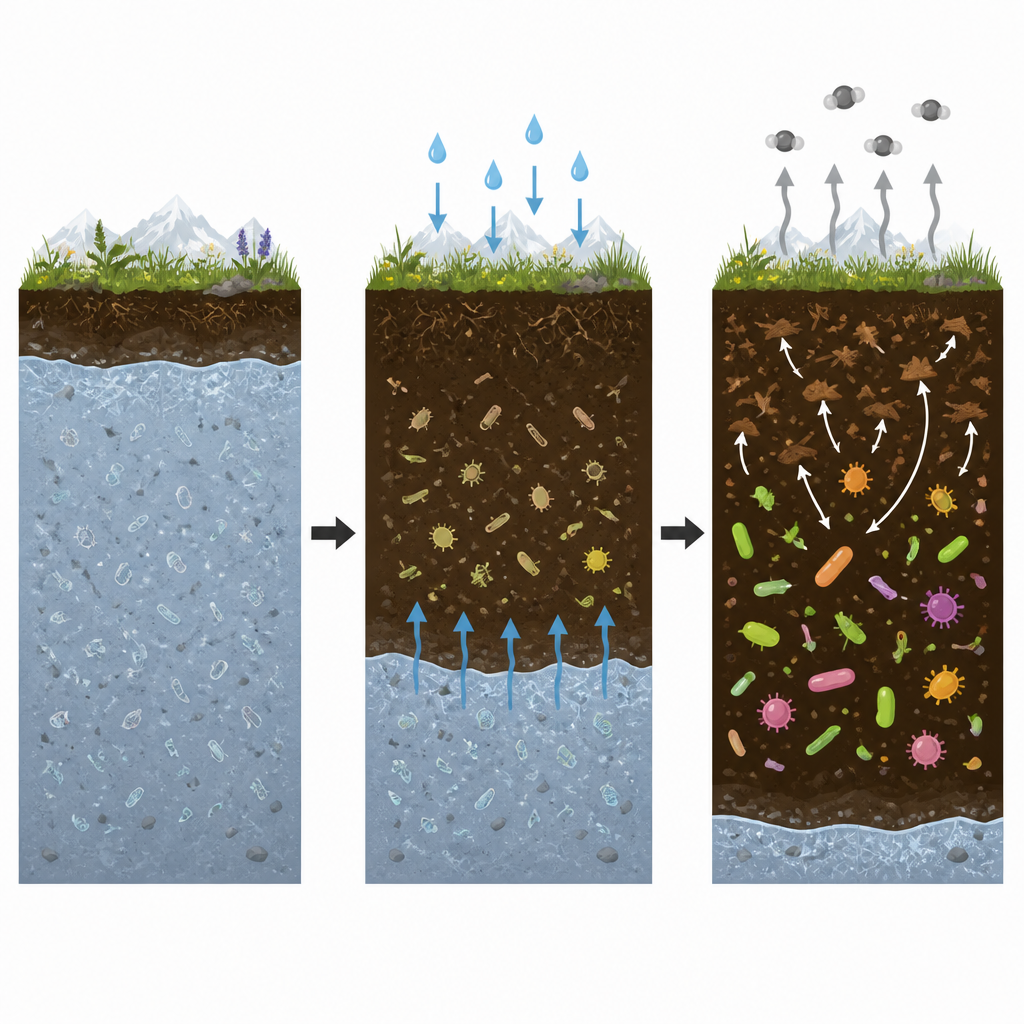
What this means for a warming world
To a lay reader, the takeaway is that frozen mountain soils are not passive carbon vaults that simply melt and empty as the planet warms. Instead, they are governed by microbial communities that shift in and out of dormancy with each freeze and thaw, subtly changing how and when carbon escapes to the air. The study shows that even a modest loss of soil carbon can come with bigger changes in microbial biomass and enzyme activity, and that non-growing seasons deserve much more attention. By putting microbial sleep–wake cycles into a model that can be used across regions, this work offers a more realistic way to predict how cold-soil carbon and greenhouse gas emissions will respond to ongoing climate change.
Citation: Qi, S., Wang, G., Zhou, S. et al. Microbial dormancy under freeze–thaw cycling regulates alpine soil responses to warming. Commun Earth Environ 7, 448 (2026). https://doi.org/10.1038/s43247-026-03451-w
Keywords: alpine soil carbon, microbial dormancy, freeze thaw cycles, Qinghai Tibetan Plateau, soil warming