Clear Sky Science · en
Component-specific shifts in soil respiration and its temperature sensitivity following natural forest conversion
Why changes beneath forests matter
When a forest is cleared or replanted, the most visible changes are the missing trees. Less obvious are shifts in the dark soil below, where roots and microbes constantly breathe out carbon dioxide. This hidden activity, called soil respiration, is a major part of the planet’s carbon cycle. Understanding how it reacts when natural forests are turned into farms, grasslands, or plantations helps us gauge how land use choices affect climate over decades.
Breathing soil and where the carbon comes from
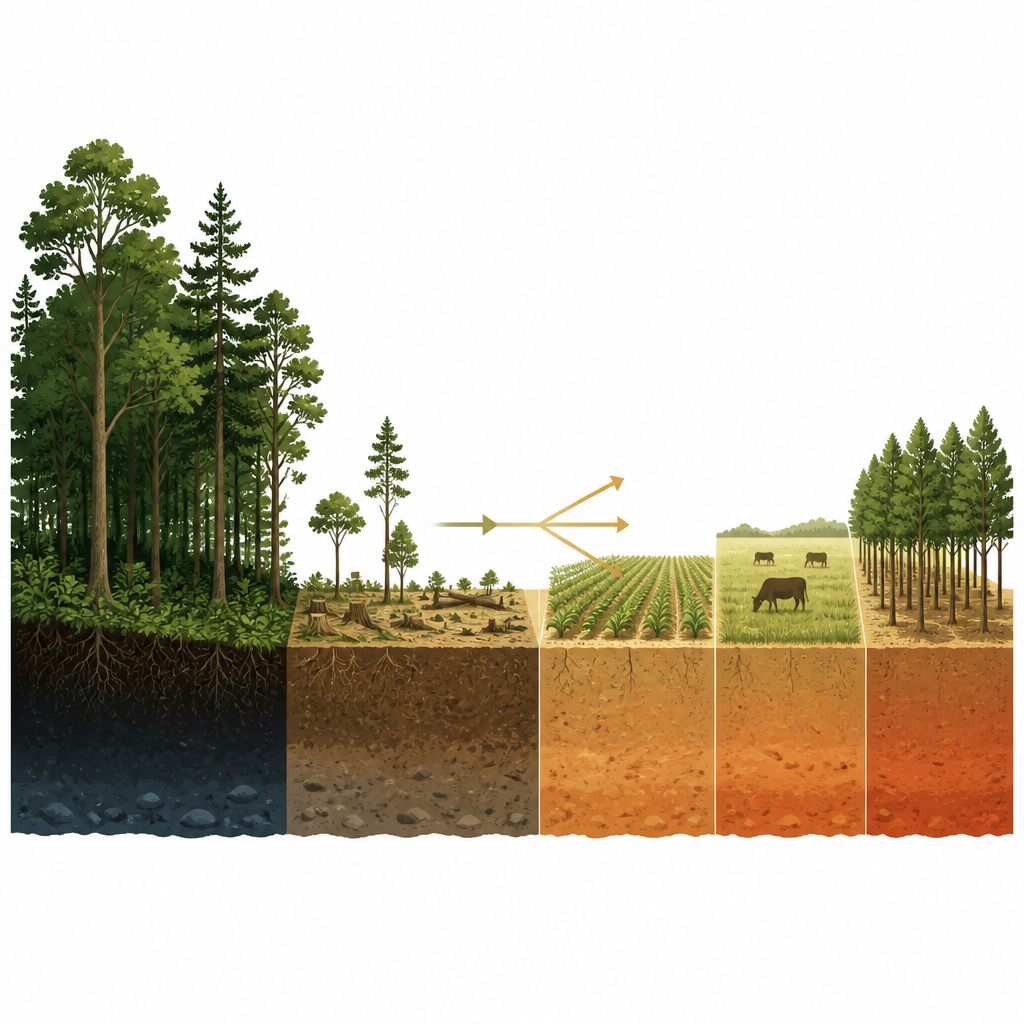
Soil releases carbon dioxide in two main ways. Plant roots use energy and oxygen and in doing so release carbon, while countless microbes break down dead leaves and organic matter, also producing carbon dioxide. The study collected results from 452 paired measurements across 164 field sites worldwide, always comparing natural forests with nearby converted land under similar climate. This allowed the authors to separate the root part of soil breathing from the microbial part and see how each responds when natural forests are replaced.
What happens when forests become fields or grass
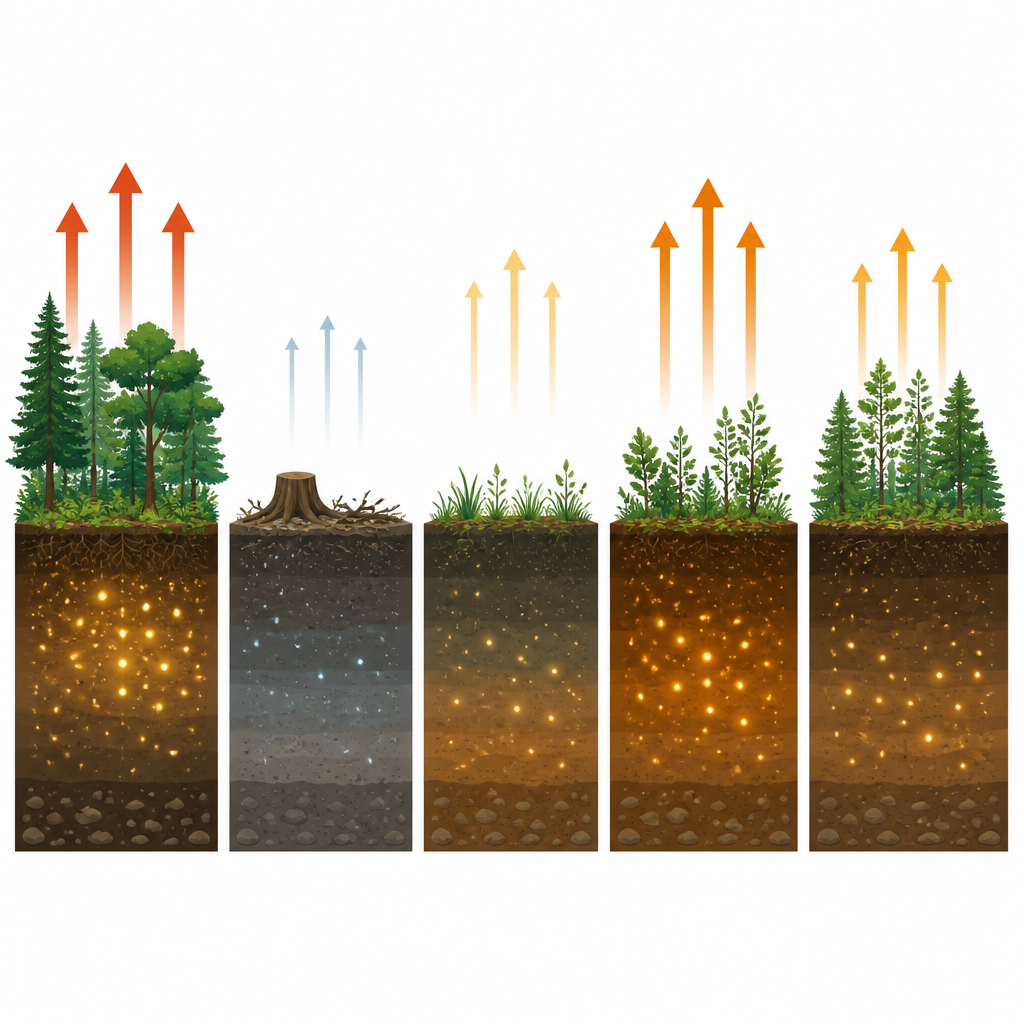
Across all sites, total soil respiration was about 7 percent lower after natural forest conversion. Most of this drop came from root activity, which fell by more than a quarter, reflecting the loss of living roots when trees are removed. Microbial respiration, by contrast, showed no consistent global change, although it dropped strongly in some croplands. The type of new land use mattered a lot. Converting forests to agriculture or grassland reduced soil respiration the most, while shifts to secondary forests or plantations tended to leave total soil breathing closer to that of intact forests.
How warmth changes soil breathing over time
Soil respiration becomes faster as temperatures rise, and scientists often describe this with a number that shows how much breathing increases for every 10 degree Celsius of warming. The study found that, overall, this temperature sensitivity did not change much when all conversion types were lumped together. But conversions to agriculture and grassland clearly stood out, showing higher temperature sensitivity, especially for microbial activity. In these systems, soil carbon inputs from plants are reduced and the remaining organic matter is harder to break down, so microbes respond more strongly to warming. At the same time, clearing forests usually warms the soil, partly offsetting the loss of carbon from reduced root activity.
Short term shocks and long term recovery
The changes after forest conversion were not permanent. Right after conversion, soil respiration dropped by around one tenth, while its temperature sensitivity rose, meaning the soil’s breathing became more responsive to warming. These shifts lasted for roughly 30 years. After that, soil respiration slowly recovered and became statistically similar to that of nearby forests by about 50 years, while temperature sensitivity returned to earlier levels after around 40 years. The recovery was mainly driven by the return of roots as vegetation re-established, whereas microbial respiration seemed to be pulled in opposite directions by the loss of soil carbon and the warming of the soil.
Soil traits that shape the response
The authors used statistical models to test which environmental factors best explained the varied responses they observed. Loss of soil organic carbon and increases in soil temperature were the strongest drivers of changes in total soil respiration. Temperature sensitivity, however, depended more on the soil’s starting properties. Soils with less clay and higher pH showed larger increases in temperature sensitivity, likely because their organic matter is less physically protected and their microbial communities are more dominated by bacteria, which tend to react more strongly to warming.
What this means for climate thinking
The study shows that turning natural forests into other land uses has complex but predictable effects on how soils store and release carbon. In the first decades after conversion, soils usually breathe less overall but become more responsive to temperature, especially in croplands and grasslands. Over time, soil respiration and its sensitivity to warming move back toward forest-like levels, particularly as vegetation returns. Because these patterns depend on land use type and local soil conditions, the authors argue that climate models should treat soil respiration and its temperature response as flexible and component-specific rather than fixed numbers. Doing so will give a clearer picture of how land use choices today shape carbon and climate in the future.
Citation: Fan, R., Li, X., Fang, C. et al. Component-specific shifts in soil respiration and its temperature sensitivity following natural forest conversion. Commun Earth Environ 7, 459 (2026). https://doi.org/10.1038/s43247-026-03449-4
Keywords: soil respiration, forest conversion, land use change, soil carbon, temperature sensitivity