Clear Sky Science · en
Plant diversity is key for microbial necromass carbon accrual in alpine grasslands
Why Grassland Roots Matter for Climate
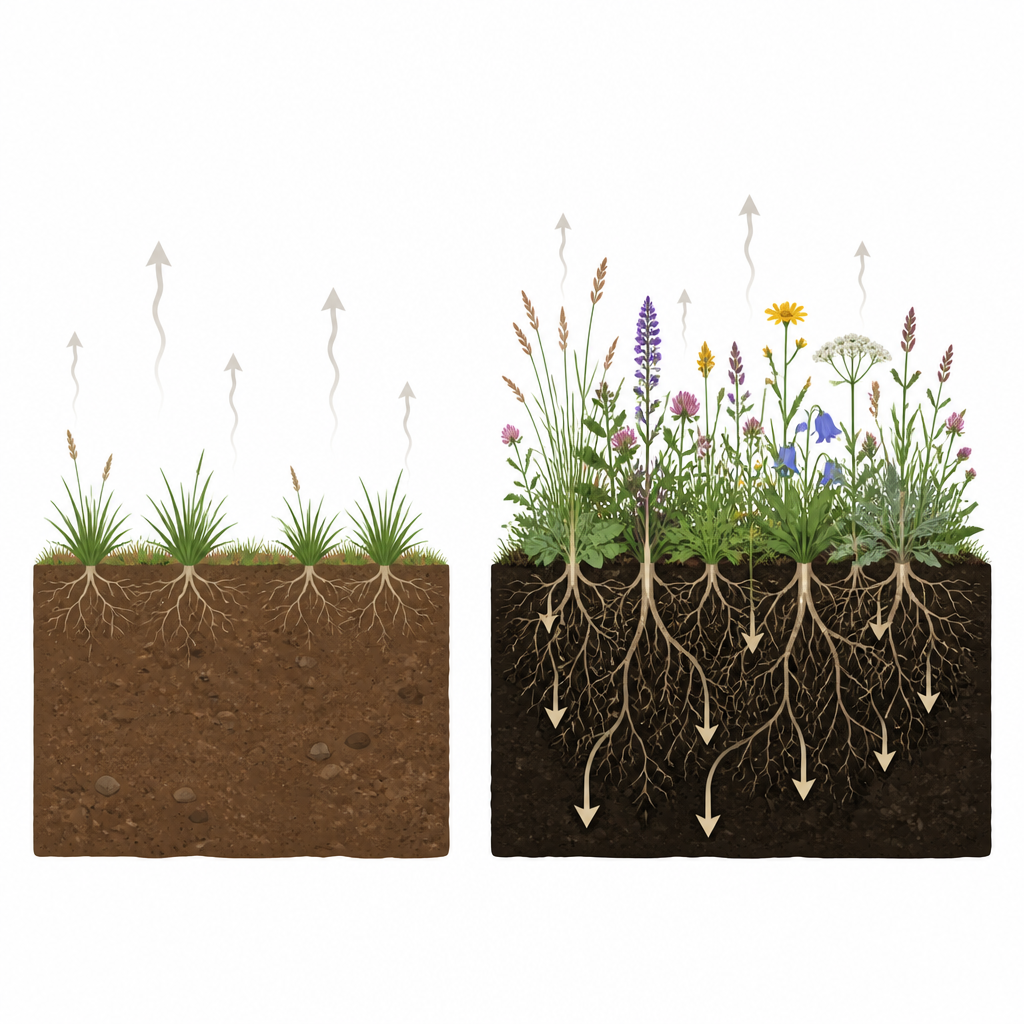
Most of us think of forests when we hear about storing carbon, but grasslands quietly hold a huge share of the planet’s carbon underground. This study looks at alpine grasslands on the Tibetan Plateau and asks a simple question with big implications: does having more kinds of plants help lock more carbon safely in the soil for the long term? The answer, it finds, lies not just in living roots and leaves, but in the tiny remains of dead microbes that build up and become a stable underground carbon bank.
Hidden Carbon from Tiny Soil Builders
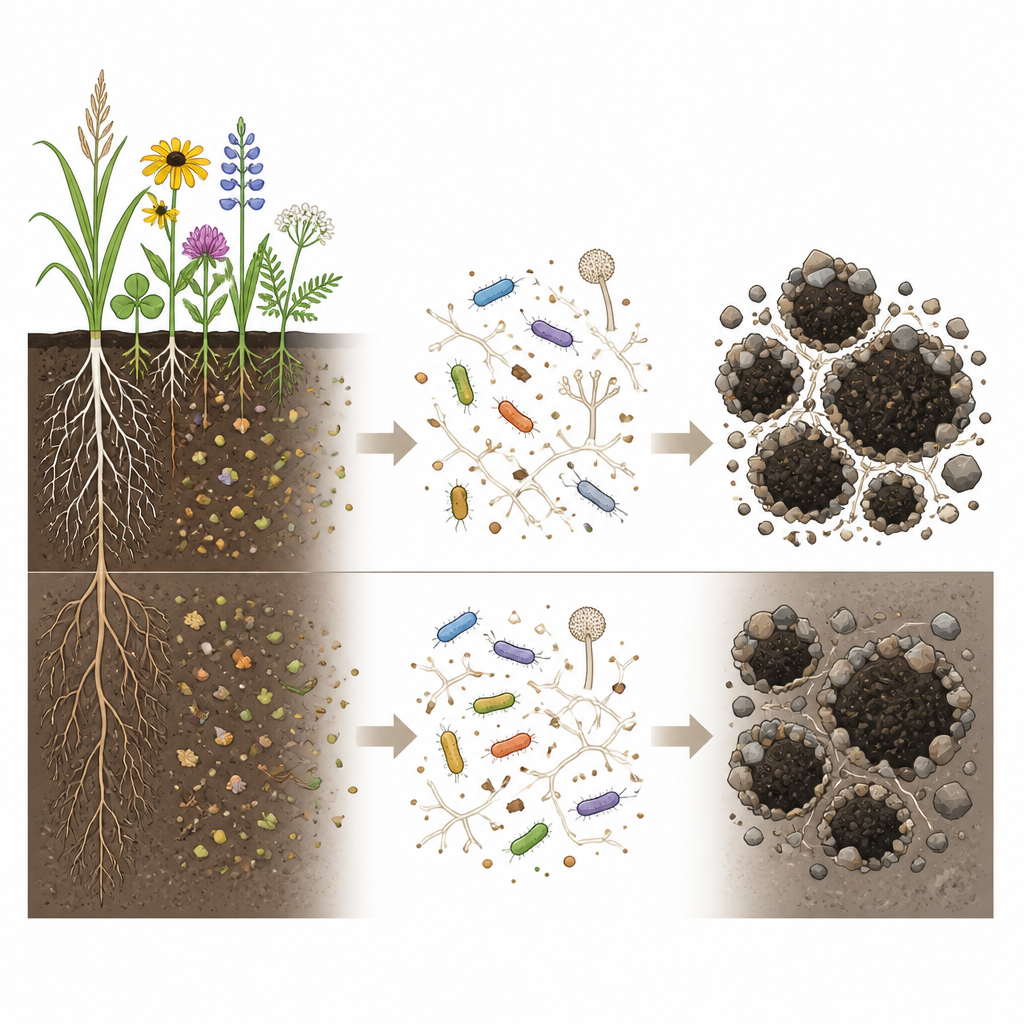
Beneath every patch of grass lives a bustling community of bacteria and fungi. When these microbes die, their cell walls and other remains can stick to soil particles and form what scientists call microbial necromass. This dead microbial material is surprisingly important because it can stay in the soil for a long time, storing carbon that would otherwise return to the air as carbon dioxide. In grasslands around the world, such microbial leftovers make up roughly 60 percent of all soil organic carbon, turning microscopic life into a major player in the climate system.
A 3,000 Kilometer Natural Experiment
To see how plant variety affects this hidden carbon, the researchers surveyed natural alpine grasslands along a 3,000 kilometer stretch of the Tibetan Plateau. They counted how many plant species grew in each plot, measured plant growth above and below ground, and took soil samples from shallow topsoil and deeper subsoil. In these soils they measured microbial necromass from bacteria and from fungi, along with many other features such as nitrogen levels, soil acidity, texture, and how strongly carbon was bound to minerals. This broad survey covered cold, dry highlands as well as somewhat warmer and wetter sites, capturing the main types of grassland in the region.
More Plant Species, More Lasting Soil Carbon
Across this vast region, plots with more plant species had more microbial necromass in both the topsoil and the subsoil. Both bacterial and fungal remains increased, but fungal material rose more steeply, especially near the surface. The best explanation for this pattern was not climate or basic soil chemistry, but how much carbon plants were feeding into the ground through roots and fallen leaves. Diverse plant communities were more productive and sent more carbon into the soil, fueling larger and more active microbial communities. As these microbes grew and died, their remains accumulated, particularly where plant inputs were strongest in the top layer of soil.
Soil Conditions that Help Carbon Stay Put
The study also found that richer plant communities tended to coincide with soils that were slightly more acidic, higher in total nitrogen, and better at protecting carbon on mineral surfaces. More nitrogen likely helped microbes build the tough molecules that form their cell walls, which then became part of the stable carbon pool. Slightly acidic conditions and strong bonding of carbon to clay and metal particles made it harder for microbes to break down this necromass once it formed. Together, these shifts in soil chemistry and mineral protection meant that higher plant diversity worked in two ways at once: it boosted the production of microbial remains and also helped preserve them.
What This Means for Climate and Land Care
In clear terms, this work shows that keeping many different plant species in alpine grasslands helps soil act as a more reliable carbon vault. Diverse grasslands do not just grow more; they also feed soil microbes in ways that leave behind long lasting carbon deep in the ground. Because microbial necromass makes up a large fraction of stable soil carbon, protecting and restoring plant diversity can strengthen the ability of grasslands to store carbon and support climate change mitigation. For land managers and policymakers, this suggests that conserving a rich mix of native plants is a natural, low tech tool for building and maintaining soil carbon stocks over time.
Citation: Yan, Y., Hautier, Y., Chen, X. et al. Plant diversity is key for microbial necromass carbon accrual in alpine grasslands. Commun Earth Environ 7, 441 (2026). https://doi.org/10.1038/s43247-026-03447-6
Keywords: soil carbon, plant diversity, grasslands, microbial necromass, climate change