Clear Sky Science · en
Cropland biophysical impacts on land surface temperature show diurnal differences across tropical Africa
Why farm fields can change the feel of the air
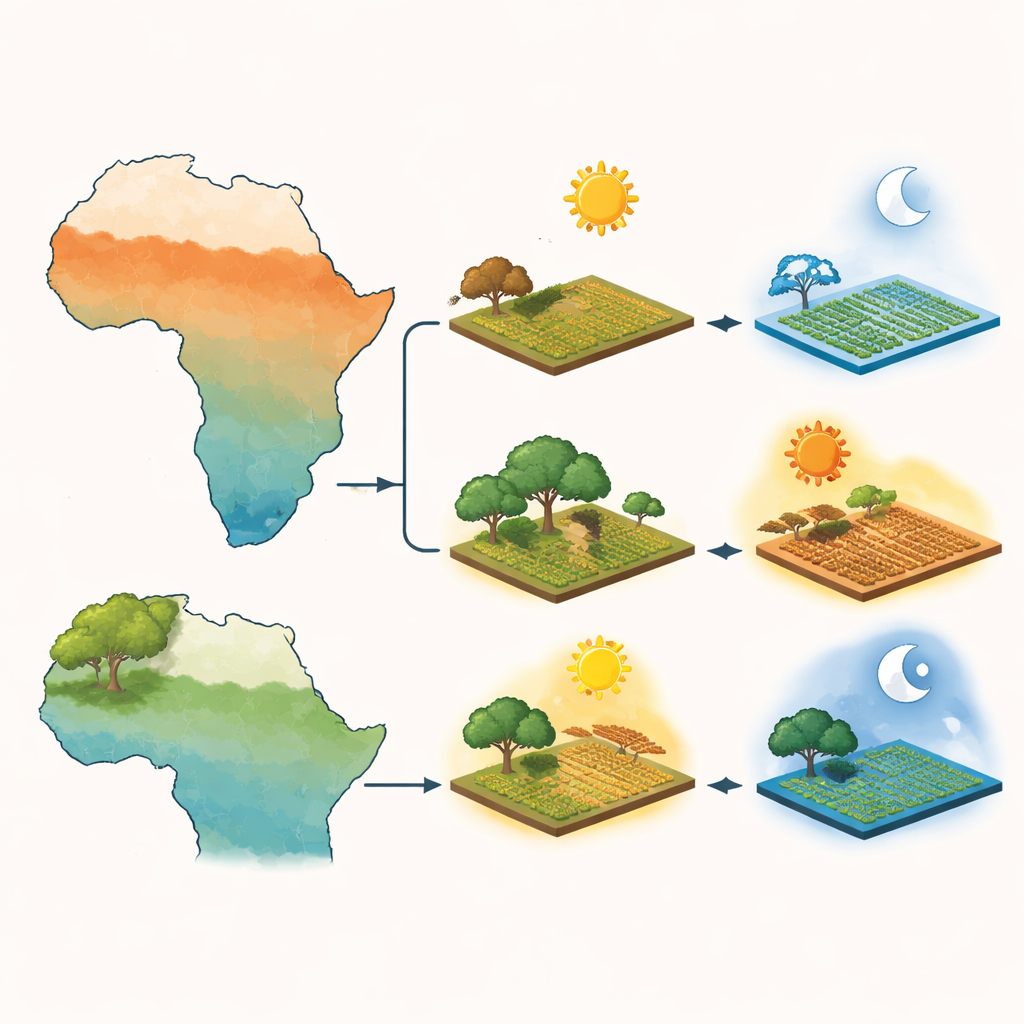
Across tropical Africa, grasslands are rapidly being turned into croplands to feed growing populations. Beyond food, this quiet land transformation also nudges local climate, subtly changing how hot the ground gets by day and by night. This study asks a simple but important question: when we replace natural grasslands with crop fields, does the land surface become warmer or cooler, and does that answer depend on how dry or humid the region is?
Watching temperatures from space, hour by hour
The researchers used 17 years of observations from European weather satellites that sit over the same part of the Earth all day long. These satellites measure how hot the land surface is every hour, along with how bright it is, how much sunlight and heat it receives, and how much energy leaves the surface as warmth or evaporation. The team focused on tropical Africa, where cropland has expanded faster than almost anywhere else, and where much of that expansion has replaced grasslands. By comparing nearby patches of long‑standing cropland and grassland under the same weather, they could tease out how the land-cover difference alone affects surface temperature.
Different stories in dry and humid regions
The key discovery is that the impact of croplands on surface temperature flips depending on how dry the climate is and what time of day it is. At night, croplands are slightly cooler than neighboring grasslands almost everywhere, regardless of whether the climate is dry or humid. In contrast, daytime tells a more mixed story. In drier parts of tropical Africa, croplands tend to cool the surface compared with grasslands, with the strongest cooling around midday. But in more humid regions, croplands actually make the surface warmer during the day, even though they still cool it at night. A simple index that compares rainfall to evaporative demand cleanly separates these two regimes, showing that the switch from daytime cooling to daytime warming occurs around the boundary between more arid and less arid climates.
Energy flows rather than sunlight alone
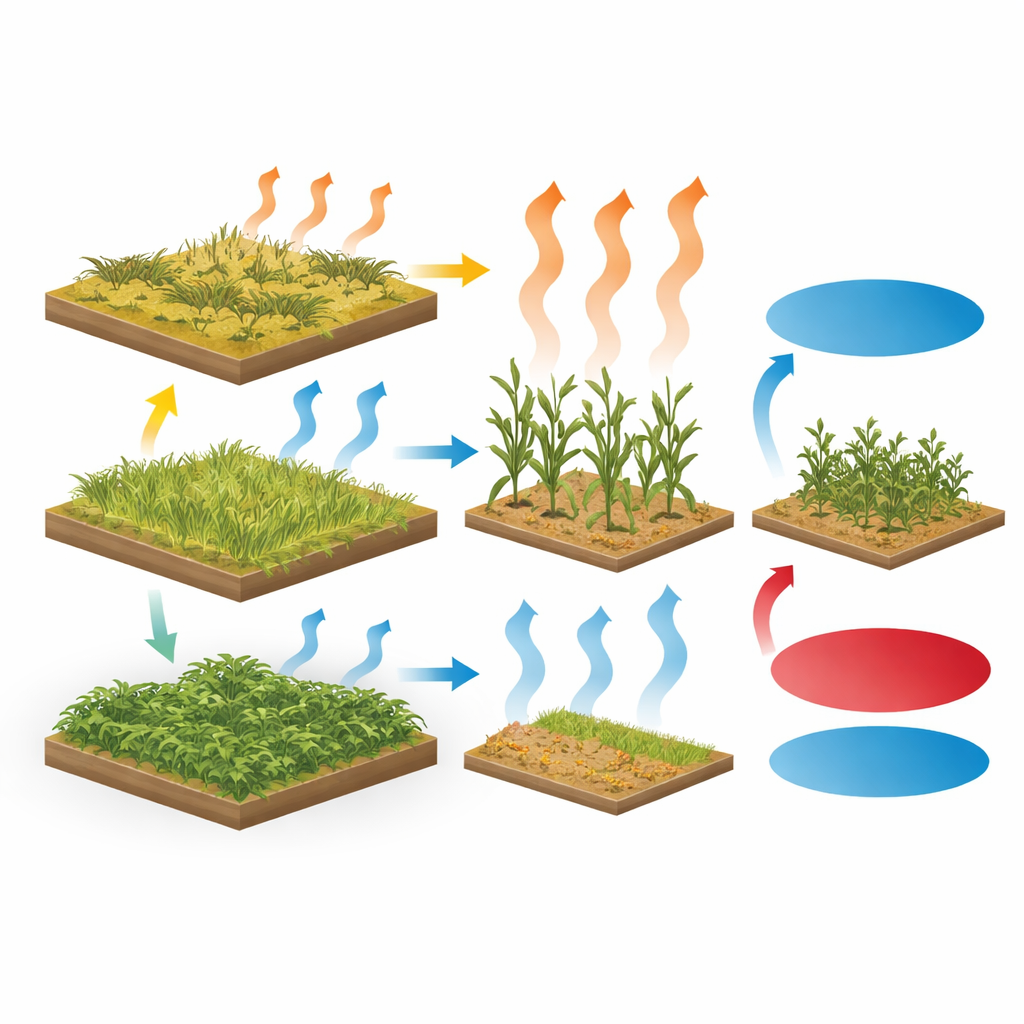
To understand why these contrasts appear, the authors broke down the temperature differences into contributions from various surface properties. They found that changes in how the land reflects sunlight play a secondary, buffering role. The main driver is how croplands alter the turbulent flows of energy between the land and the air: the sensible heat that directly warms the air and the latent heat tied to evaporation from soil and leaves. In drier regions, croplands generally have denser vegetation than the surrounding grasslands, often because irrigation and management keep crops greener. This greater leafiness allows more water to evaporate, shifting more energy into evaporation and less into direct heating, and thus cooling the surface by day and night.
Leaves, water, and warmth
In the more humid regions, the picture changes. There, croplands tend to have fewer leaves than nearby grasslands. With less leaf area, they evaporate less water, and more of the incoming energy ends up as direct heating of the surface and the air above it. At the same time, these croplands are often slightly brighter than grasslands, which would normally promote cooling by reflecting more sunlight. However, the study’s statistical models show that this brightening is not strong enough to counter the warming caused by reduced evaporation. Overall, differences in leaf area between croplands and grasslands set off a chain reaction: they change evaporation and turbulent heat flows, which in turn control how much the land surface warms or cools through the day.
What this means for future farming and climate
For people living and farming in tropical Africa, these findings carry a clear message. Expanding cropland over grassland does not have a single, uniform climate outcome. In drier regions, well‑managed croplands can slightly cool the land surface, especially during the day, through enhanced evaporation from greener fields. But in less arid, more humid regions, converting grasslands to croplands tends to warm the surface during the hottest hours, even though nights remain a bit cooler. As Africa’s demand for food grows, the study warns that continued cropland expansion in humid zones could intensify daytime heat stress for people and crops. Understanding and managing how vegetation density and water use change with new croplands will be crucial to balancing food production with local climate comfort.
Citation: Luo, H., Quaas, J. Cropland biophysical impacts on land surface temperature show diurnal differences across tropical Africa. Commun Earth Environ 7, 309 (2026). https://doi.org/10.1038/s43247-026-03445-8
Keywords: tropical Africa croplands, land surface temperature, grassland conversion, evaporation and heat flux, local climate impacts