Clear Sky Science · en
Synergistic reductions in fine particles and fossil fuel carbon dioxide revealed by tree-ring radiocarbon analysis
Why city trees can tell a story about cleaner air
Urban residents often wonder whether air quality and climate policies are really working in the long run. This study offers an unusual way to answer that question by reading the memories stored inside tree rings from Beijing and Xi’an. By combining these silent witnesses with modern pollution records, the researchers show how efforts to clean the air have also affected carbon emissions from fossil fuels.
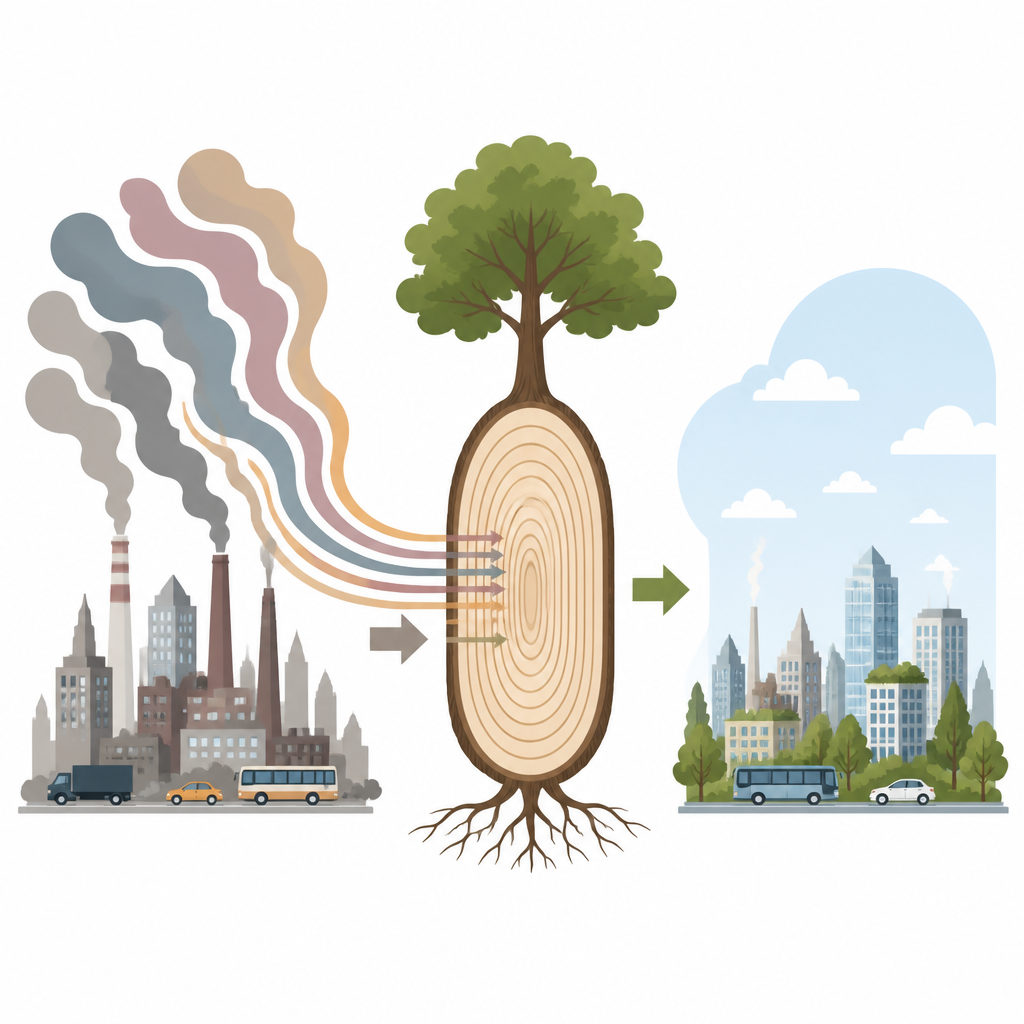
How trees become natural air history recorders
Trees take in carbon from the air as they grow, and each year they add a new ring of wood. That ring locks in the chemical signature of the air at the time, including a rare form of carbon called radiocarbon. Fossil fuels have lost all of their radiocarbon over millions of years, while recent plant material still contains it. By measuring radiocarbon in the annual rings of city trees, scientists can work out how much of the local carbon dioxide came from burning coal, oil, and gas each year over two decades.
Rising smoke and then a turning point
The team used tree rings to reconstruct yearly fossil fuel carbon dioxide in Beijing and Xi’an from 2000 to 2021 and compared these records with fine particle pollution, black carbon, and carbon monoxide. In both cities, fossil fuel carbon dioxide and fine particles climbed together during the early 2000s, reflecting fast industrial growth and booming traffic. In Beijing, fossil carbon dioxide peaked around 2010 and then leveled off, while in Xi’an the peak came later and declined more slowly. Fine particles, however, dropped sharply in both cities after national clean air action plans began in 2013, with Beijing seeing especially large reductions.
Pollution controls reshape the link between smoke and carbon
To make sense of these shifts, the researchers divided the years into three periods that line up with major policy changes. During the first period of rapid growth, fossil carbon dioxide and fine particles rose in lockstep, showing that the same sources drove both. In the second period, stronger air pollution rules in Beijing cut fine particles even while fossil carbon dioxide stayed roughly flat, signaling that filters, fuel switching, and other measures were capturing more soot without yet cutting total fuel use. In the third period, the two pollutants began to fall together again, especially in Beijing, suggesting that cleaner industry, vehicles, and energy choices started to reduce both smoke and carbon.
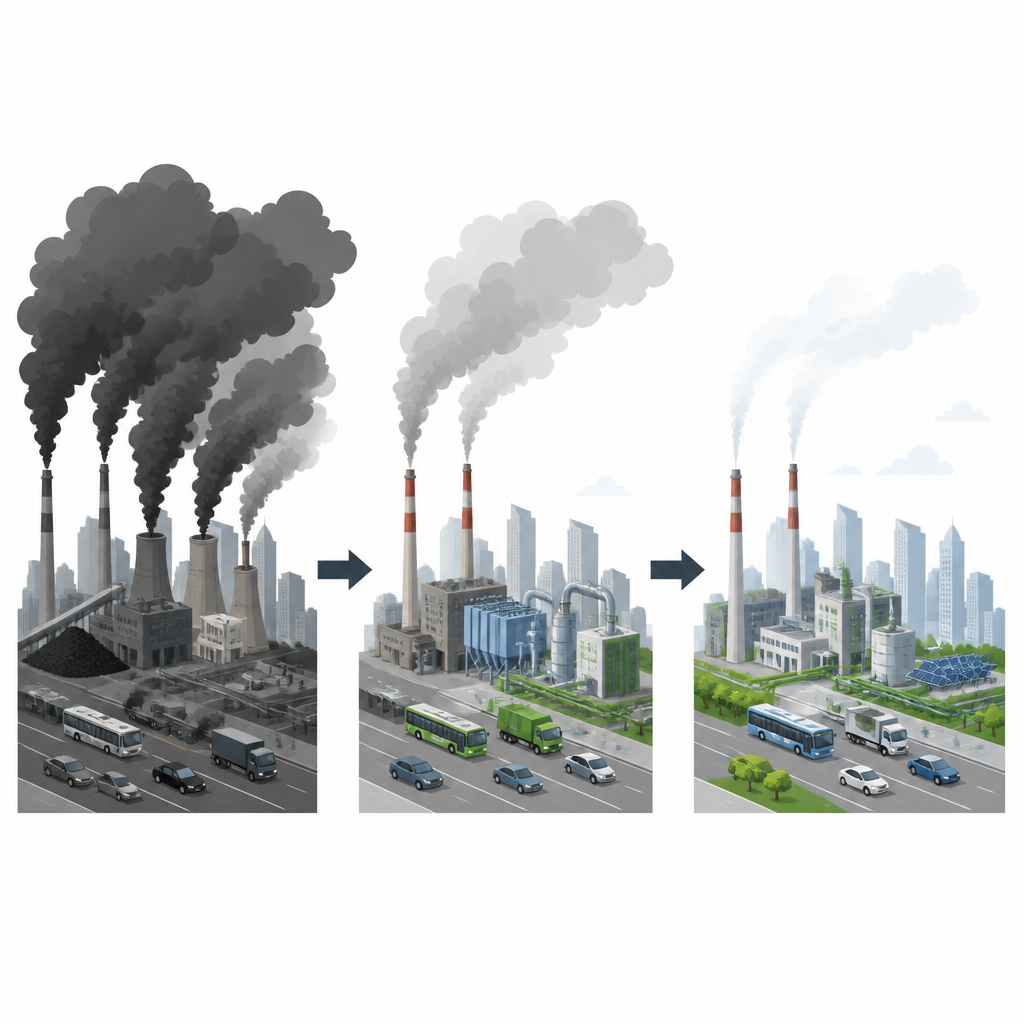
Simple ratios reveal cleaner burning
The study also looked at how much fine particle pollution, black carbon, and carbon monoxide were released for each unit of fossil carbon dioxide, treating these ratios as indicators of how dirty or clean combustion had become. Over the 22-year record, all three ratios declined in both cities. That means each unit of fossil fuel burned produced less soot and less incomplete combustion byproducts than before, reflecting better technology, stricter standards, and a gradual move toward fuels such as natural gas and electricity. Yet fossil carbon dioxide itself fell more slowly, especially in Xi’an, showing that total fuel demand and continued use of coal still keep climate emissions high.
What this means for cleaner air and a safer climate
For non-specialists, the key message is that air quality policies in Beijing and Xi’an have clearly delivered cleaner air, and trees provide independent evidence that supports this progress. At the same time, the slower drop in fossil fuel carbon dioxide reminds us that cutting smoke is easier than cutting the fuels that produce it. Tree-ring radiocarbon offers a powerful way to track how cities are doing on both fronts, helping decision makers see where air pollution control is working and where deeper changes in energy use are still needed to protect the climate.
Citation: Qu, Y., Niu, Z., Zhou, W. et al. Synergistic reductions in fine particles and fossil fuel carbon dioxide revealed by tree-ring radiocarbon analysis. Commun Earth Environ 7, 437 (2026). https://doi.org/10.1038/s43247-026-03439-6
Keywords: tree-ring radiocarbon, urban air pollution, fossil fuel CO2, China clean air policy, PM2.5 trends