Clear Sky Science · en
Mitigating atmospheric heavy metal pollution requires added efforts amid rapid clean-energy transitions in Chinese cities
Why city air and clean power matter to daily life
Many people now see clean energy as a cure for dirty air and climate change, but less is known about how it affects another hidden danger in city air: toxic metals such as lead, arsenic, and cadmium. These metals cling to tiny particles we breathe, can travel long distances, and build up in our bodies and ecosystems over time. This study looks at how the rapid shift toward cleaner energy in hundreds of Chinese cities is changing emissions of these metals today and how much extra progress is possible in the coming decades.
What the researchers set out to explore
China has been expanding wind, solar, hydropower, and nuclear power at a remarkable pace, while trying to cut a range of pollutants. Yet most statistics on clean energy use are reported only at national or provincial scales, and detailed data on heavy metal emissions are rare. To close this gap, the authors assembled a large city-level picture, covering 331 cities between 2005 and 2021. They built a new method to estimate how much clean energy each city actually consumes and combined it with a machine learning based map of four key airborne heavy metals. With these tools, they asked how much the energy shift has already cut metal pollution and how different choices about growth and technology might change future emissions through 2060.
How city energy use is changing across China
Over 16 years, total final energy use in Chinese cities more than doubled, but its makeup changed sharply. The shares of coal, oil, and conventional thermal power fell, while natural gas and clean energy grew more than sixfold. Solar and wind power posted the fastest gains, especially after 2015, and clean energy use in cities rose from about 57 to 358 million tons of coal equivalent. This shift did not look the same everywhere. Industrial cities, helped by strong national policies, showed particularly high clean energy shares, and some provinces in the northwest, southwest, and south had cities where more than 17 percent of final energy was clean. In contrast, many cities in northern and northeastern regions still relied heavily on fossil fuels, and the transport sector in almost all cities lagged far behind other sectors in clean energy use. 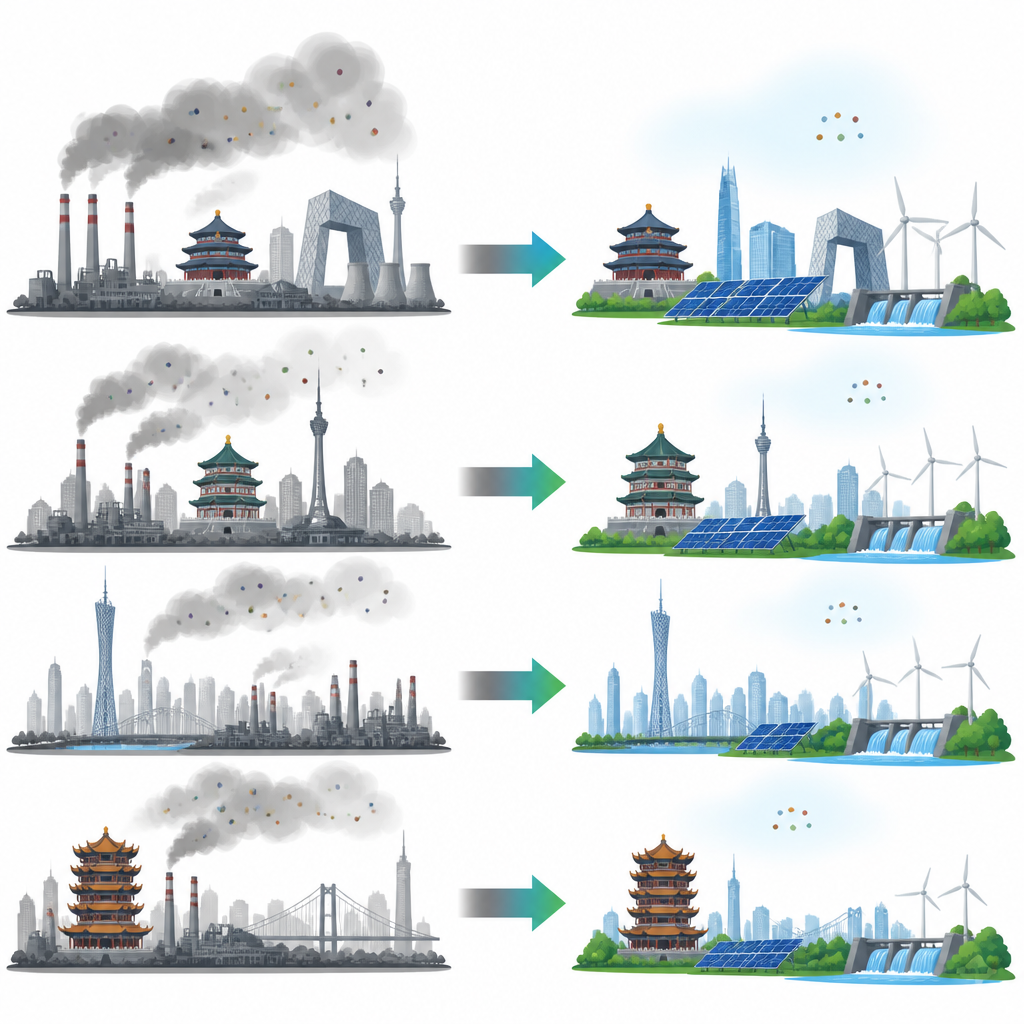
How much toxic metal pollution has been reduced so far
From 2015 to 2020, total emissions of the four heavy metals considered fell from about 9,806 to 5,776 tonnes across Chinese cities. When the authors separated the drivers of this change, they found that cleaner technologies at factories and power plants did the heavy lifting, accounting for more than 100 percent of the net reduction, because their gains had to offset increases from economic growth. Improvements in energy efficiency also helped. By comparison, the shift to clean energy cut only about 258 tonnes of metals, or 6.4 percent of the overall reduction. The benefits also varied widely by city type: non resource based cities and those with balanced industrial and service economies saw larger relative gains than service oriented or less balanced cities, and some places even experienced rises in certain metals despite using more clean energy.
What the future might look like under different choices
To explore what lies ahead, the study built dozens of scenarios that mix different speeds of clean energy rollout with different patterns of economic and social change. Across these futures, heavy metal emissions generally fall steeply by mid century, but the exact path depends more on how economies grow and improve their efficiency than on the clean energy shift alone. Under a business as usual path for the energy transition, the shift to clean power would cut about 520 tonnes of metals by 2060, roughly a tenth of total reductions. If cities push clean energy much faster and pair it with strong changes in technology, efficiency, and development patterns, that co benefit could rise to about 1,650 tonnes, or roughly 30 percent of cuts. The period from 2021 to 2040 emerges as a key window when most of these extra gains can still be captured. 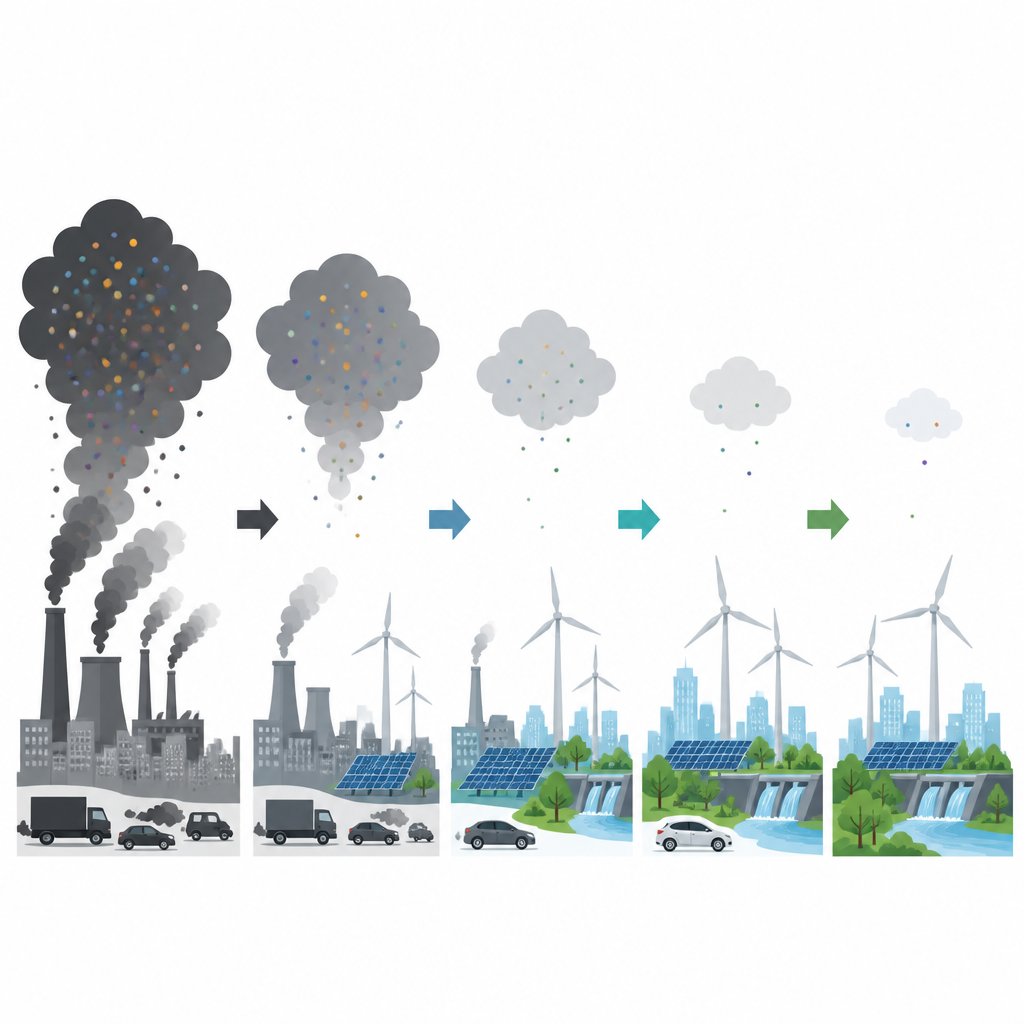
Why some cities matter more than others
The study shows that not all cities contribute equally to potential future reductions. Looking ahead to 2060 under the most ambitious path, cities in northern, eastern, and northeastern China are expected to deliver the largest drops in metal emissions, even though many of them have so far moved more slowly on clean energy than cities in the northwest and southwest. This mismatch suggests that sending more clean power toward these heavy emitting regions, while also boosting local solar and wind generation, could bring large health benefits. At the same time, service based and less balanced cities appear to need more targeted support, because their projected reductions remain modest even under strong national policies.
What this means for cleaner and safer city air
For a lay reader, the core message is that clean energy expansion helps reduce toxic metals in city air, but by itself it is not enough. Most of the progress so far has come from better pollution controls and more efficient energy use, while rising economic activity has pulled emissions upward. Looking forward, the clean energy transition can deliver much larger health gains if it moves faster than current plans and is combined with strong efforts to improve technology, cut energy waste, and steer growth toward less polluting activities. In short, cleaner power is a vital part of the solution, but deep cuts in heavy metal pollution will come only from a broader package of changes in how cities produce, move, and use energy.
Citation: Yang, G., Zhang, G., Cao, D. et al. Mitigating atmospheric heavy metal pollution requires added efforts amid rapid clean-energy transitions in Chinese cities. Commun Earth Environ 7, 422 (2026). https://doi.org/10.1038/s43247-026-03436-9
Keywords: clean energy transition, heavy metal air pollution, Chinese cities, renewable energy, urban environmental health