Clear Sky Science · en
Seismic detection using submarine cable polarization signals with machine learning
Listening to Quakes with Undersea Internet Cables
Most of the world’s earthquakes rumble beneath the oceans, far from traditional ground-based sensors. Yet nearly every continent is already linked by vast webs of fiber-optic cables that carry our internet traffic. This study asks a simple but powerful question: can those existing cables also serve as giant, ready-made ears for listening to earthquakes on the seafloor?
Why an Internet Cable Can Feel the Earth Move
Light racing through a fiber-optic cable does more than just ferry data; its internal properties subtly shift when the cable is bent, stretched or shaken. One such property is the state of polarization, a measure of how the light waves are oriented as they travel. When the seafloor moves during an earthquake, it can jostle a buried or resting cable, and in turn nudge the polarization of the light inside. The authors examined a major internet route in the Mediterranean Sea, the Med-Nautilus cable connecting Catania in Sicily to Tel Aviv, to find out whether real earthquakes leave a consistent fingerprint in these polarization signals. 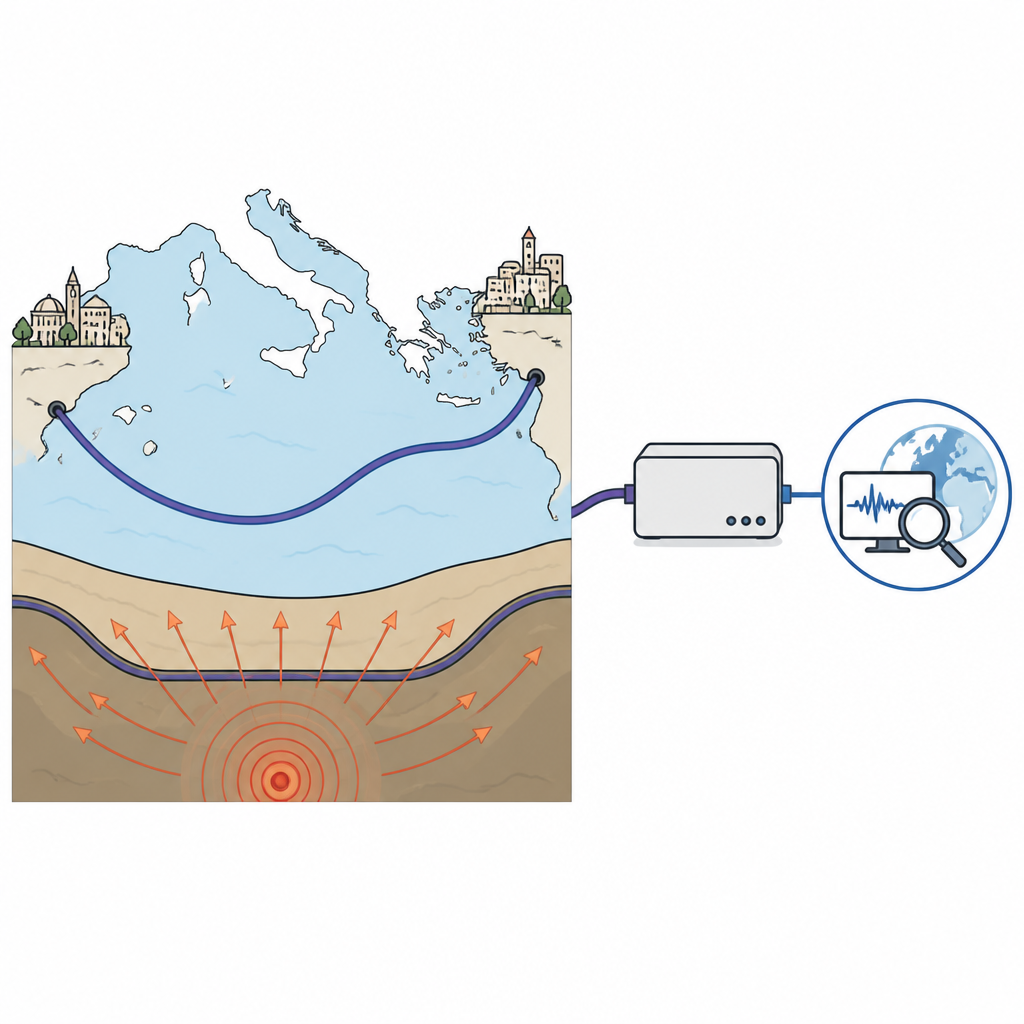
Turning Raw Cable Signals into Usable Clues
Between mid-2022 and late 2024, an Italian telecom operator supplied continuous records of polarization-related quantities from the cable, along with information about how the optical system was behaving. The researchers paired this with an independent earthquake catalog covering the Mediterranean, focusing on 60 events of magnitude 5 or larger. They estimated how far each quake was from the cable and when primary and secondary seismic waves should arrive, using standard Earth models. Then they cleaned and standardized the optical data, carving it into time windows around each event and into control periods without significant quakes. This careful preparation set the stage for testing both traditional detection methods and modern artificial intelligence on exactly the same data.
Simple Rules Fall Short, Learning Machines Do Better
The team first tried classic seismology-style tools that look for sudden jumps in signal strength or spectral energy, controlled by fixed thresholds. On the polarization data, these rule-based methods either raised too many false alarms or missed most actual events, sometimes performing no better than random guessing. By contrast, machine learning models that could weigh many subtle features at once did noticeably better. A technique called Extreme Gradient Boosting, which aggregates decisions from many small decision trees, reached about 60 percent accuracy, sensitivity and specificity when asked to distinguish quake-affected days from quieter ones. Analysis of the model’s behavior showed that it did not rely on a single smoking-gun feature, but on a blend of statistical measures that together captured small but meaningful changes in the polarization patterns. 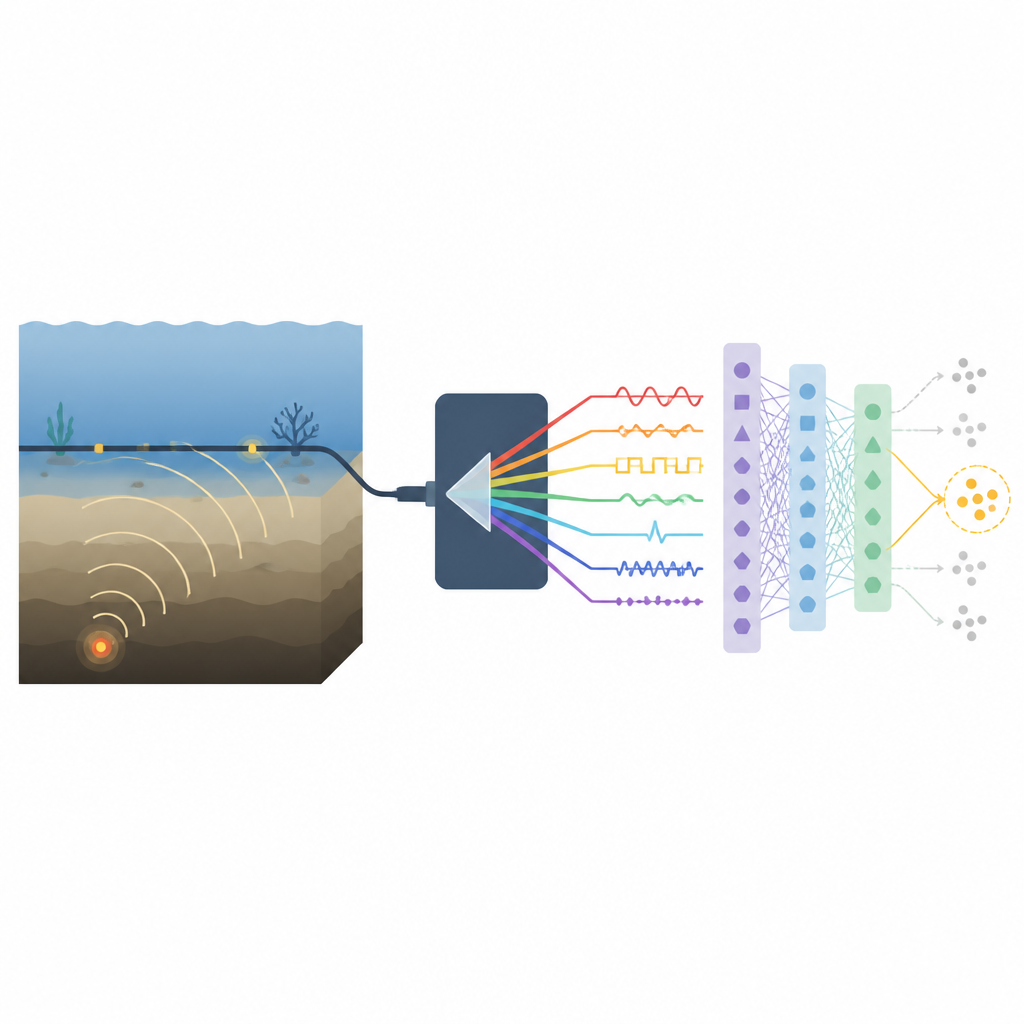
What the Cable Can and Cannot Hear
The authors then examined which quakes were most likely to be recognized by the learning algorithm. Surprisingly, straightforward factors like distance from the cable, depth of the quake or even magnitude did not show simple trends. Some moderately strong earthquakes produced clear, detectable polarizations changes, while others with similar characteristics went largely unnoticed. An additional deep learning approach, which learned what “normal” cable behavior looks like and flagged strong departures as anomalies, only clearly reacted to a few of the largest events. This suggests that how well a cable “hears” a quake depends on more than just the quake itself; details such as how tightly the cable is coupled to the seafloor, its burial and construction, and the surrounding environmental noise all play important roles.
The Big Picture for Future Ocean Monitoring
Despite modest detection rates and many missed events, the study provides an important proof of concept: even though the Med-Nautilus cable was never designed as a sensor, it still carries usable information about strong earthquakes through its light polarization. For the public, the key message is that our existing digital infrastructure could, in principle, double as a vast and inexpensive network of scientific instruments. If methods like these are refined, and combined with other sensing technologies, global submarine cable systems might help fill the current blind spots in oceanic seismic monitoring, offering coastal communities earlier and richer insight into what is happening beneath the waves.
Citation: Caruso, M., Morelli, M., Monaco, A. et al. Seismic detection using submarine cable polarization signals with machine learning. Commun Earth Environ 7, 421 (2026). https://doi.org/10.1038/s43247-026-03434-x
Keywords: submarine cables, earthquake detection, fiber optic sensing, machine learning, Mediterranean Sea