Clear Sky Science · en
Alkalinity-enhanced artificial substrates modulate local pH and increase survivorship of early-stage coral recruits
Helping Reefs Help Us
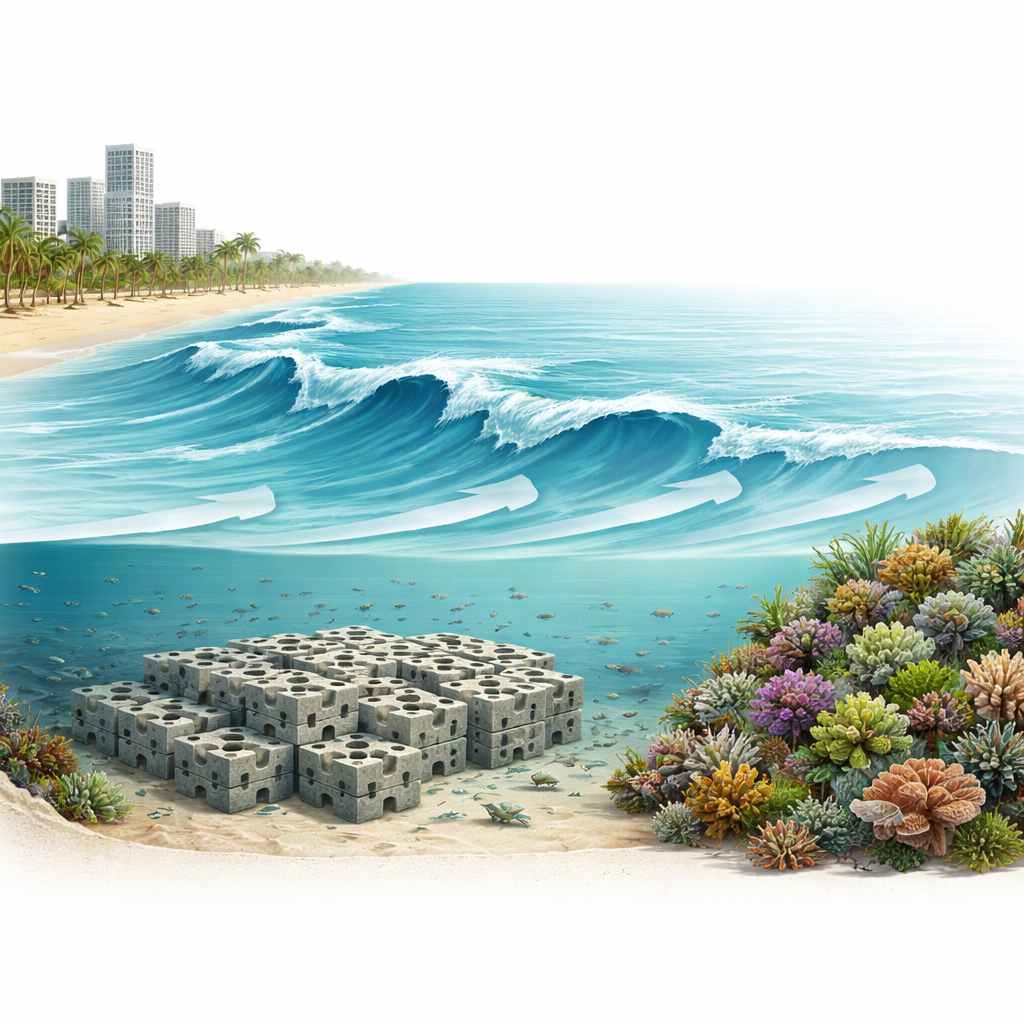
Coastal communities around the world rely on coral reefs as natural breakwaters that blunt storm waves, reduce flooding, and support fisheries and tourism. Yet these same reefs are rapidly disappearing. This study explores a practical, engineering-based idea: can we tweak the materials used to build artificial reef structures so that baby corals survive better in today’s harsher oceans, ultimately rebuilding living reefs that protect our shorelines?
Why Coral Babies Struggle
Coral reefs are in trouble: roughly 14% of global coral cover was lost between 2009 and 2018, driven by mass bleaching, pollution, storms, and disease. As reefs shrink, they produce fewer larvae, and those that do settle often die young. In the Caribbean, settlement rates are especially low, and slow-growing coral recruits stay vulnerable for longer, giving seaweed and other competitors time to crowd them out. On top of this, ocean acidification makes it harder for young corals to build their skeletons, forcing them to spend more energy just to grow. These bottlenecks—settlement, early survival, and early growth—are major barriers to successful reef restoration.
A New Kind of Building Block
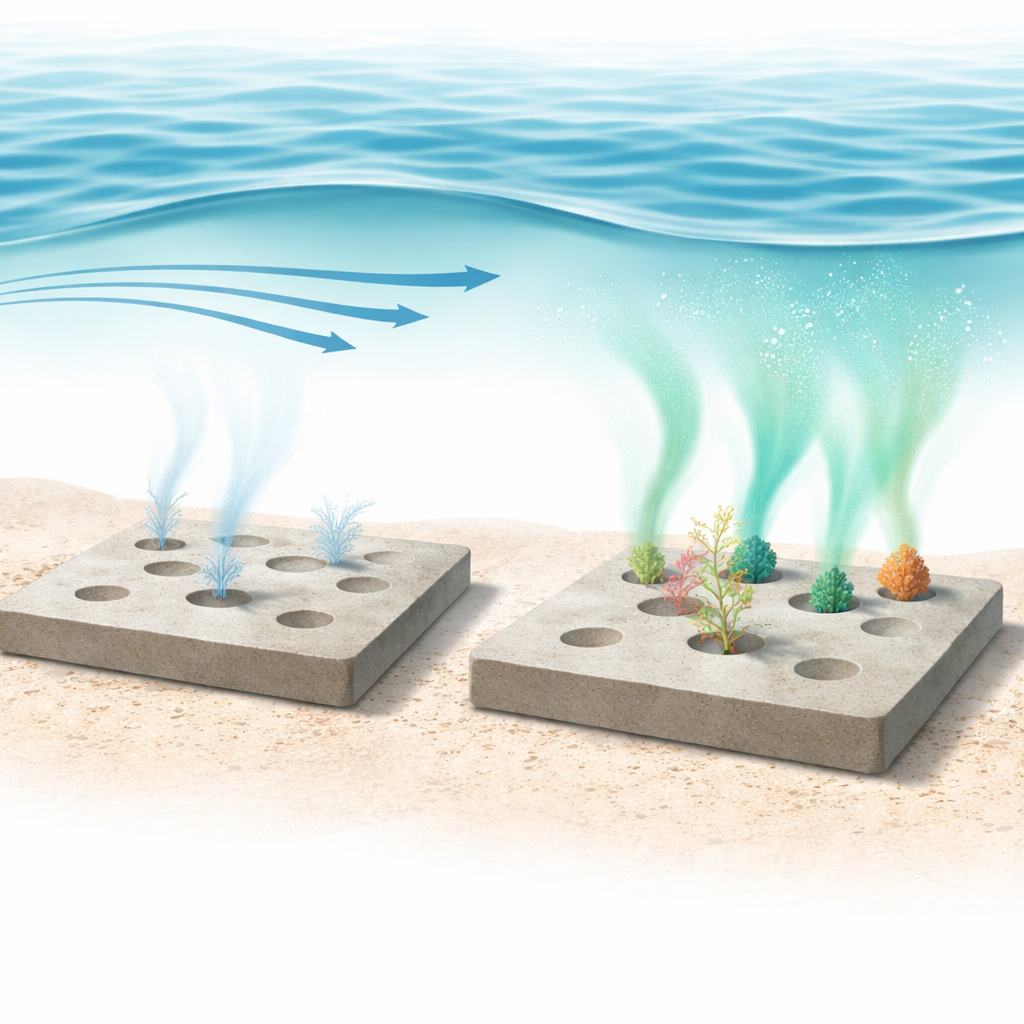
The researchers tested whether simple changes to cement tiles—the kind that could form the surface of artificial or “hybrid” reefs—could gently raise acidity-buffering capacity right where coral babies live. They mixed small amounts of common alkaline powders (sodium bicarbonate and sodium carbonate) into standard portland limestone cement, creating four tile “recipes,” and cast them either as smooth blocks or with a grid of shallow round depressions. In flume tanks that mimic gentle reef currents, they measured how each tile type altered the thin layer of water hugging its surface, where tiny corals sit and exchange gases, nutrients, and waste.
Shaping the Water Just Above the Surface
Chemically modified tiles released carbonate and bicarbonate ions into the nearby water, slightly raising pH in that boundary layer. Under still conditions, some mixes boosted pH by up to about half a unit; under flowing conditions, the enhancement was smaller but still detectable, roughly a tenth of a pH unit for the best-performing tiles. Importantly, this localized effect persisted for at least 12 weeks, long enough to matter for early coral life. Textured tiles created pockets inside their depressions where water moved more slowly and chemistry became even more elevated than over the flat surface, generating a patchy “chemical landscape” on scales of millimeters.
What the Corals Told the Scientists
Larvae of the threatened Caribbean coral Orbicella faveolata were allowed to settle on these tiles in the lab. They showed a clear preference for textured surfaces and especially for the shallow depressions, which act as small shelters and extra attachment area. Surprisingly, however, corals that started life in those tiny pits later had lower survival, likely because water there was too stagnant: waste products built up, fresh nutrients arrived slowly, and pH may have been pushed beyond an optimal range. Across all tiles, chemistry had little effect on where larvae chose to settle or how fast they grew in size, but it had a strong effect on whether they stayed alive. Tiles containing 1–2% carbonate additives boosted recruit survival by roughly 2.5–2.9 times compared with plain cement, even though average growth rates were similar.
From Lab Tiles to Living Coastal Shields
The study shows that modest tweaks to common construction materials can quietly reshape the micro-environment just above artificial reef surfaces in ways that matter to coral survival. By slightly buffering acidity where tiny recruits attach, these “alkalinity-enhanced” tiles improve the odds that more baby corals live through their most vulnerable months, without the impractical step of dosing whole reefs with chemicals. Although the work was done in controlled flumes, it points toward artificial and hybrid reef structures that not only break waves the day they are installed but also more reliably grow into robust living reefs over time. If field tests confirm these benefits, such smart substrates could become a scalable tool for restoring coral cover and strengthening natural coastal defenses in a warming, acidifying ocean.
Citation: Ruszczyk, M., Rodriguez, S., Tuen, M. et al. Alkalinity-enhanced artificial substrates modulate local pH and increase survivorship of early-stage coral recruits. Commun Earth Environ 7, 311 (2026). https://doi.org/10.1038/s43247-026-03414-1
Keywords: coral reef restoration, artificial reefs, ocean acidification, coastal protection, coral larvae