Clear Sky Science · en
Discrete element modeling reveals crustal strength control on fault architecture with global hydrocarbon distribution implications
Why Earth’s hidden cracks matter
Deep beneath our feet, the upper crust of the Earth slowly stretches and breaks, forming long rift valleys and offshore basins where thick piles of sediment build up. Many of the world’s oil and gas fields sit in these zones, yet scientists have lacked a simple rule that links the strength of the crust to the shapes of the faults that host these resources. This study uses computer experiments and a global survey of real rift basins to show how crustal strength steers the architecture of faults and helps explain where hydrocarbons are most likely to be trapped.
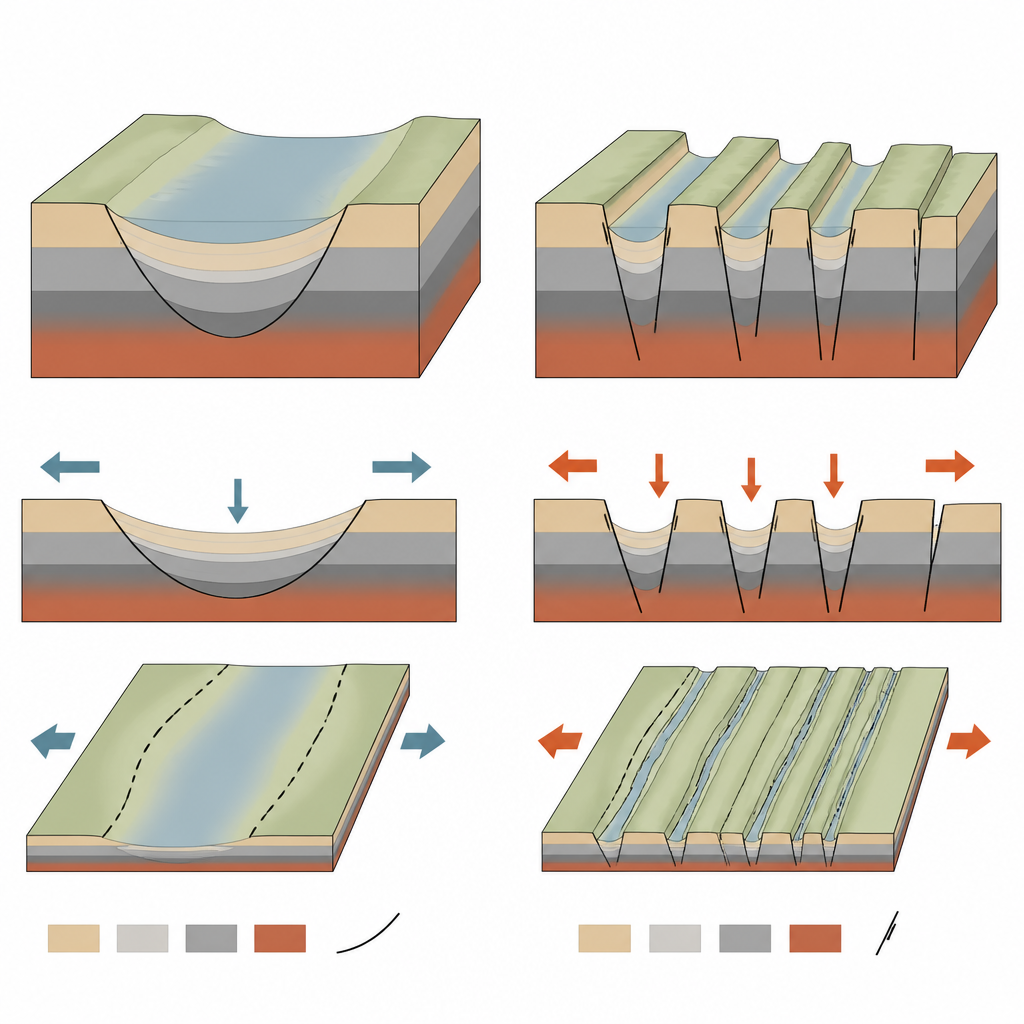
How stretching breaks the crust
When continents are pulled apart, the brittle upper crust does not tear smoothly. Instead, it breaks along faults, creating tilted blocks and deep basins that later fill with sediment. The authors explored this process with three dimensional models built from thousands of virtual grains that stick and break like real rocks. By systematically changing how strong these bonds were, while keeping the stretching conditions simple, they could watch how weak and strong crusts fracture in different ways as extension increases.
Two contrasting families of faults
The simulations revealed a clear split between two end member fault styles. In weak crust, deformation spreads out over broad areas and faults bend into low angles with depth, forming gently curving “listric” shapes. These faults rotate and flatten as stretching proceeds, creating a few wide, deep basins with long fault offsets but relatively small vertical throws. In strong crust, by contrast, strain focuses sharply into narrow zones of steep, almost planar faults. These high angle breaks slice the crust into many narrow blocks that tilt like a row of dominoes, building dense horst and graben patterns with large vertical offsets but shorter horizontal reach.
Linking models to real rift basins
To test whether this pattern occurs in nature, the team analyzed 261 extensional basins worldwide using published seismic profiles and a global map of P wave speeds in the upper crust, which serve as a proxy for rock strength. They classified each basin as dominated by listric or planar faults and compared this to its tectonic setting. Weak continental ocean transition zones, where continents thin toward new ocean basins, mostly showed low strength crust and listric fault systems. In contrast, stronger intra continental zones, far from active margins, were typically ruled by steep planar faults. A statistical test confirmed that this pairing of fault style and tectonic domain is unlikely to be random.
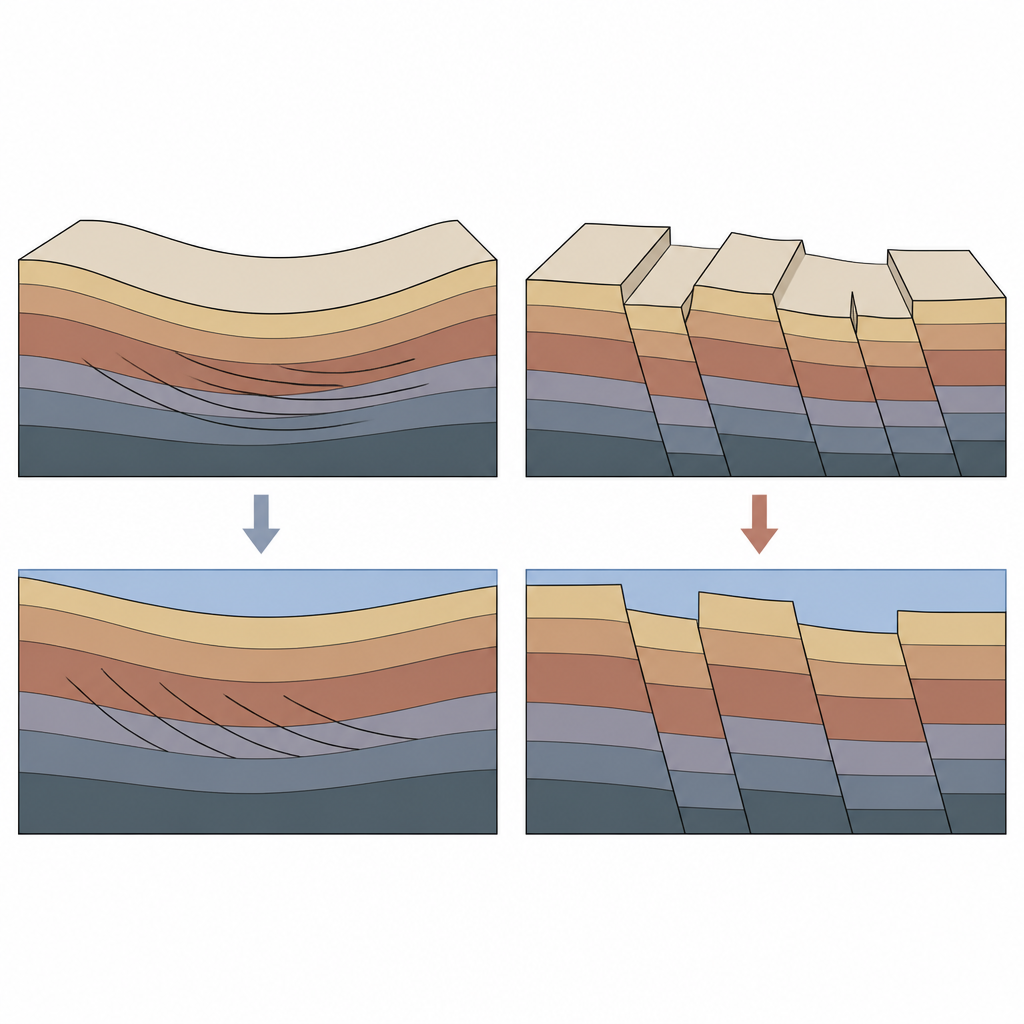
From crustal strength to resource potential
The geometry of these faults does more than shape the landscape. It also influences how well basins store hydrocarbons. In the models, strong crust not only formed steeper faults but also a larger number of fault bounded compartments, which can act as structural traps. When the authors compared this prediction with global petroleum endowment data for 56 basins, they found that those dominated by planar faults in strong intra continental crust hosted nearly three quarters of the total estimated oil and gas. Weak crustal basins with listric faults, common near continental margins, contained far less, likely because their diffuse deformation and frequent fault reactivation make it easier for hydrocarbons to leak away.
What this means for reading Earth’s rifts
Put simply, the study shows that how strong the upper crust is largely controls whether a rift basin develops a few broad, gently curved faults or many steep, block bounding breaks. This basic mechanical choice strongly influences how strain accumulates, how sedimentary basins evolve, and how well they can trap oil and gas over geologic time. By tying fault style to crustal strength estimated from seismic speeds, the work offers a practical way to interpret rift structures and to make first pass assessments of resource potential in poorly explored regions, without claiming to replace the detailed geological and geochemical studies that are still needed for full evaluations.
Citation: An, S., So, BD. Discrete element modeling reveals crustal strength control on fault architecture with global hydrocarbon distribution implications. Commun Earth Environ 7, 405 (2026). https://doi.org/10.1038/s43247-026-03411-4
Keywords: continental rifting, fault geometry, crustal strength, extensional basins, hydrocarbon traps