Clear Sky Science · en
BGC-Argo float reveals shifts in nitrogen-carbon cycling in an oxygen-deficient zone
Why hidden ocean zones matter
Far below the ocean surface lie vast layers of water that are almost devoid of oxygen. These oxygen-poor regions quietly control how much life-essential nitrogen and climate-warming carbon move through the sea and back to the atmosphere. This study follows a robotic float in the Eastern Tropical North Pacific for nearly three years, revealing that the chemistry in these hidden layers is far more changeable than scientists once thought. The work shows how pulses of marine life at the surface, swirling eddies, and microscopic microbes together reshape the ocean’s nitrogen and carbon balance over time.
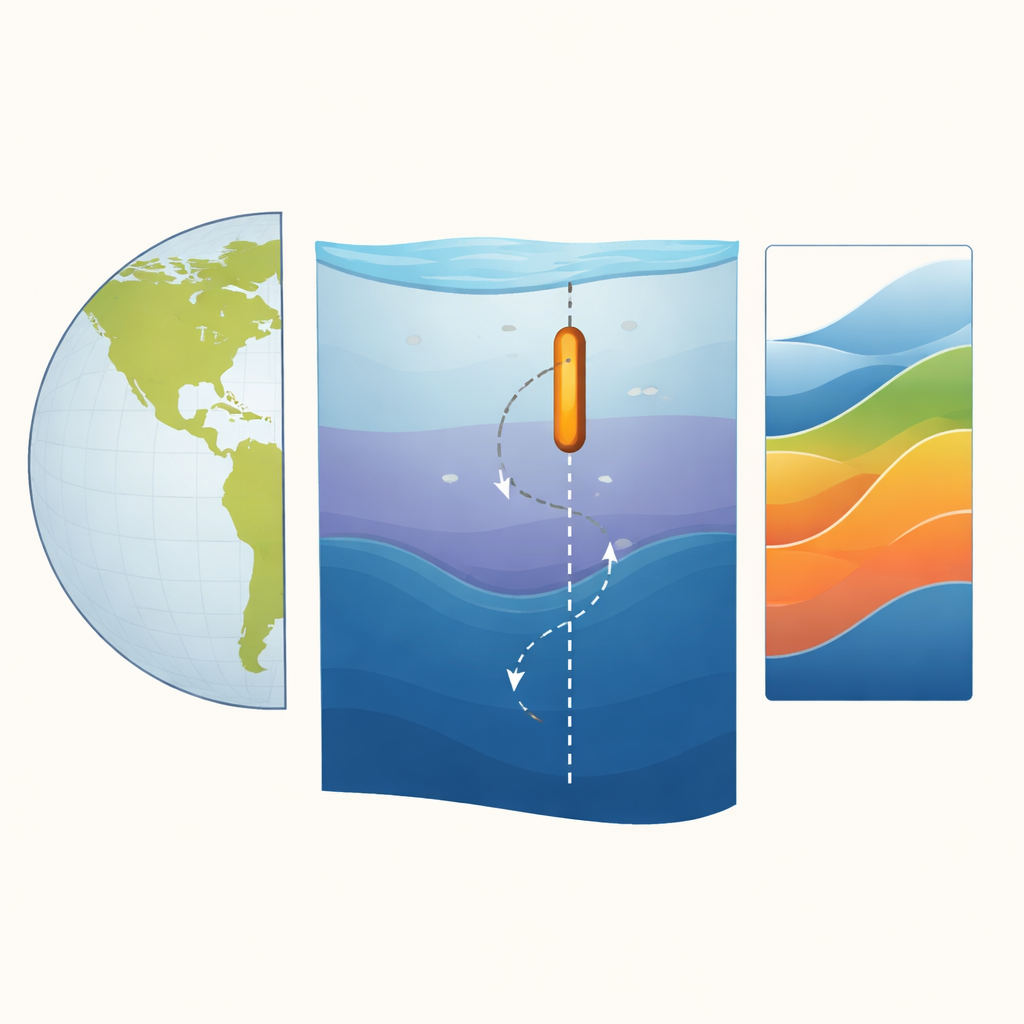
A robot drift in a low-oxygen sea
Researchers deployed an autonomous Biogeochemical Argo float in the Eastern Tropical North Pacific, a region famous for a thick oxygen-deficient zone. The float repeatedly dove and rose through the water column, recording oxygen, nitrate, nitrite, pH, and particles rich in organic carbon. Over almost three years, it experienced La Niña, neutral, and strong El Niño conditions. Throughout that time, a mid-depth band of water from about 100 to more than 800 meters stayed extremely low in oxygen, confirming that this region acts as a long-lived hotspot for nitrogen loss.
A fading chemical signal in the dark
Inside this low-oxygen band, the team focused on nitrite, a short-lived form of nitrogen that appears and disappears as microbes breathe nitrate and other compounds instead of oxygen. Early in the record, there was a pronounced layer where nitrite built up, a sign that microbes were actively turning nitrate into nitrite faster than it could be consumed. Over 2023 and 2024, however, nitrite levels steadily dropped, sometimes below the detection limit. At the same time, pH decreased and carbonate saturation horizons shifted, pointing to extra carbon dioxide being produced and to changing buffering capacity of the water. These changes occurred across a wide area, as a second nearby float saw the same nitrite decline, suggesting a regional shift rather than a local quirk.
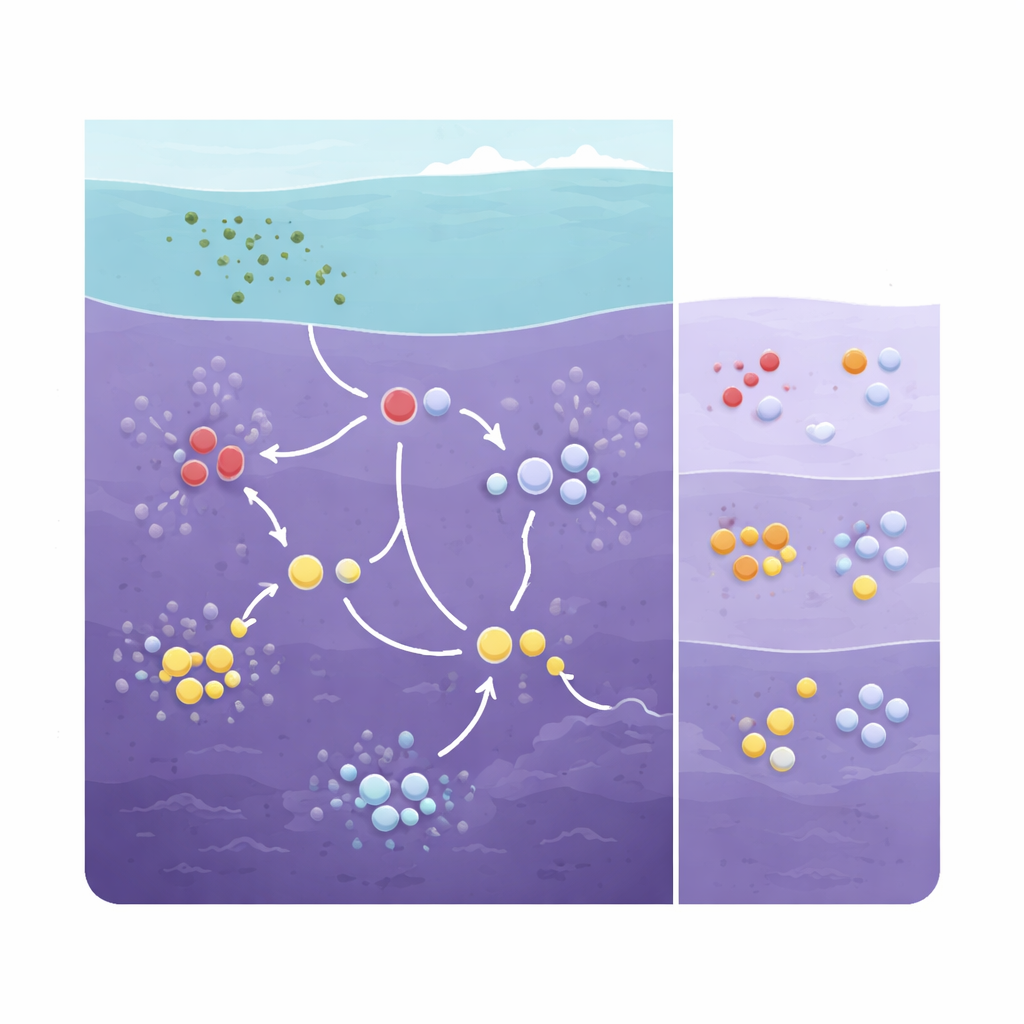
Surface blooms and swirling eddies
The float’s sensors also revealed strong swings in plant-like plankton and organic particles near the surface. Seasonal blooms and an especially productive stretch in late summer 2022 loaded the upper ocean with organic matter. Eddies—large rotating masses of water—periodically lifted nutrient-rich deeper water closer to sunlight, fueling these blooms and raising chlorophyll and particulate organic carbon. These events not only boosted life at the surface but also altered the chemical makeup of waters sinking into the oxygen-deficient zone, changing how much “food” was available to microbes that drive nitrogen loss and carbon release in the dark.
Microbial pathways reshuffle with time
To decode which microbial processes were most active, the researchers used a stoichiometric mass-balance model that links changes in nitrate, nitrite, carbon dioxide, and alkalinity. The analysis showed that one step—reducing nitrate to nitrite—dominated nitrogen transformations under all conditions. Yet other pathways shifted with depth and time. When nitrite was plentiful, nitrite oxidation and nitrate reduction were especially strong. During the high-organic-carbon episode, denitrification and anammox, which turn fixed nitrogen into inert nitrogen gas, were stimulated, while nitrite oxidation weakened. Under later, low-nitrite conditions, denitrification became more important, indicating more strongly reducing conditions that favor the complete removal of nitrogen from the system and the production of greenhouse gases such as nitrous oxide.
What this means for the changing ocean
This long, detailed record shows that oxygen-deficient zones are not quiet, steady “dead zones,” but dynamic environments where nitrogen and carbon pathways continually reorganize. Shifts in plankton productivity, organic matter supply, and physical stirring by eddies can tip the balance between keeping nitrogen available for marine life and losing it to the atmosphere, while also altering how much carbon dioxide these waters store or release. As low-oxygen regions are expected to expand with climate change, autonomous floats and similar tools will be essential for tracking these hidden transformations and for improving predictions of how the ocean’s chemistry, productivity, and greenhouse gas emissions may evolve.
Citation: Bif, M.B., Kelly, C., Altabet, M.A. et al. BGC-Argo float reveals shifts in nitrogen-carbon cycling in an oxygen-deficient zone. Commun Earth Environ 7, 294 (2026). https://doi.org/10.1038/s43247-026-03410-5
Keywords: oxygen-deficient zones, marine nitrogen cycle, biogeochemical Argo floats, ocean carbon cycling, Eastern Tropical North Pacific