Clear Sky Science · en
Pre-subduction of the Caroline Plateau intensifies lithospheric hydration in the southern Mariana Trench
Why a deep ocean trench matters to everyday life
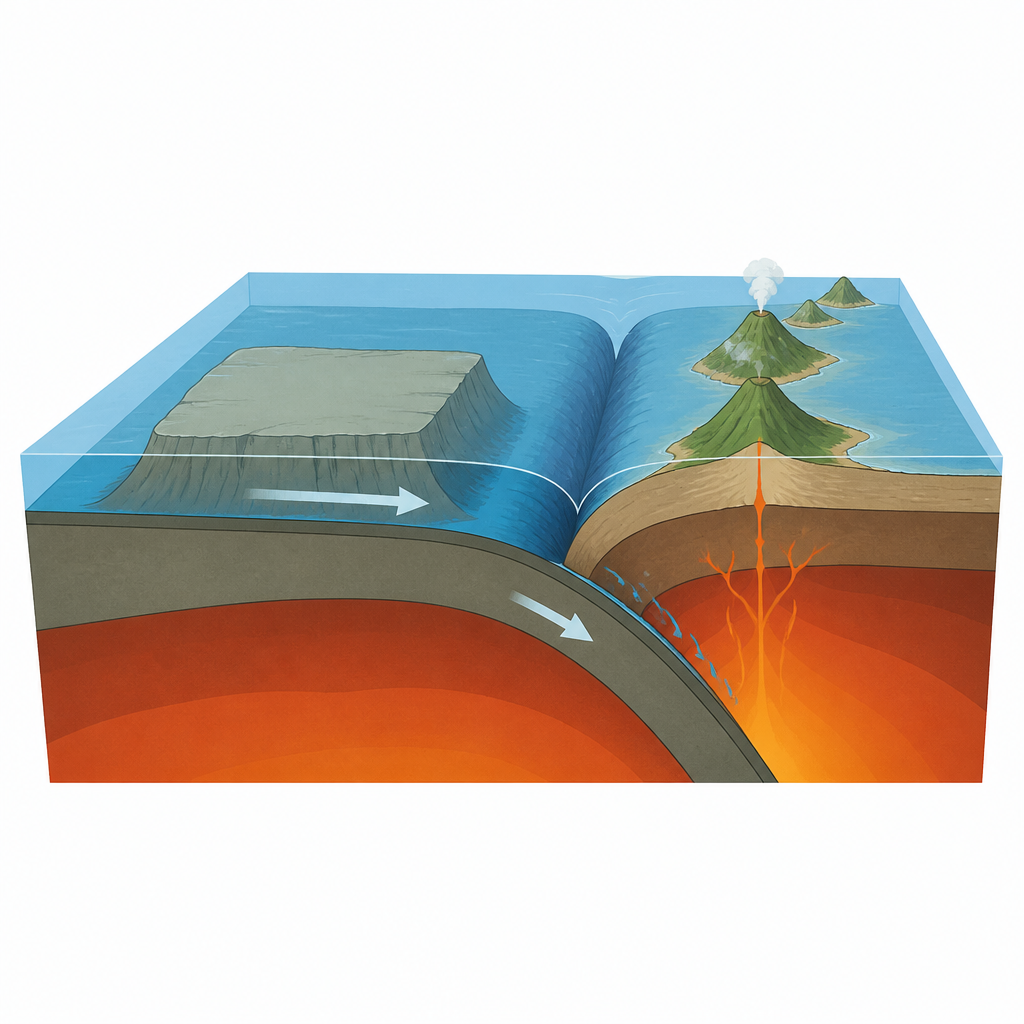
The southern Mariana Trench is the deepest place on Earth, but it is more than a record-breaking hole in the seafloor. It is part of a giant conveyor belt that carries water and rock from Earth’s surface into the deep interior, helping control volcanoes, earthquakes, and even the long-term balance of oceans and atmosphere. This study looks at what happens when a huge undersea plateau of thick crust creeps toward the trench and how that changes the way water seeps into the planet.
A hidden undersea highland on the move
Far to the west of the famous Challenger Deep lies the Caroline Plateau, a broad, elevated region of ocean floor built by ancient volcanic activity. Unlike normal, relatively thin ocean crust, this plateau has a much thicker, more buoyant base. As the Pacific Plate slowly slides toward the southern Mariana Trench, both the plateau and nearby normal crust are being dragged down together. The authors used ocean bottom seismometers and sound waves fired from a research ship to map the hidden structure of this incoming plate in great detail.
Listening to the crust with seismic sound
By timing how fast seismic waves traveled through the plate, the team could infer both thickness and rock condition. They found that the crust beneath the study line thickens from about 7.5 kilometers right at the trench to as much as 16 to 18 kilometers farther out where the Caroline Plateau sits. At the same time, seismic waves slowed down in certain zones between the edge of the plateau and the trench. Slower speeds here point to cracked and water-rich rock compared with the faster, dry mantle that usually lies beneath normal ocean crust.
How bending and breaking let water dive deep
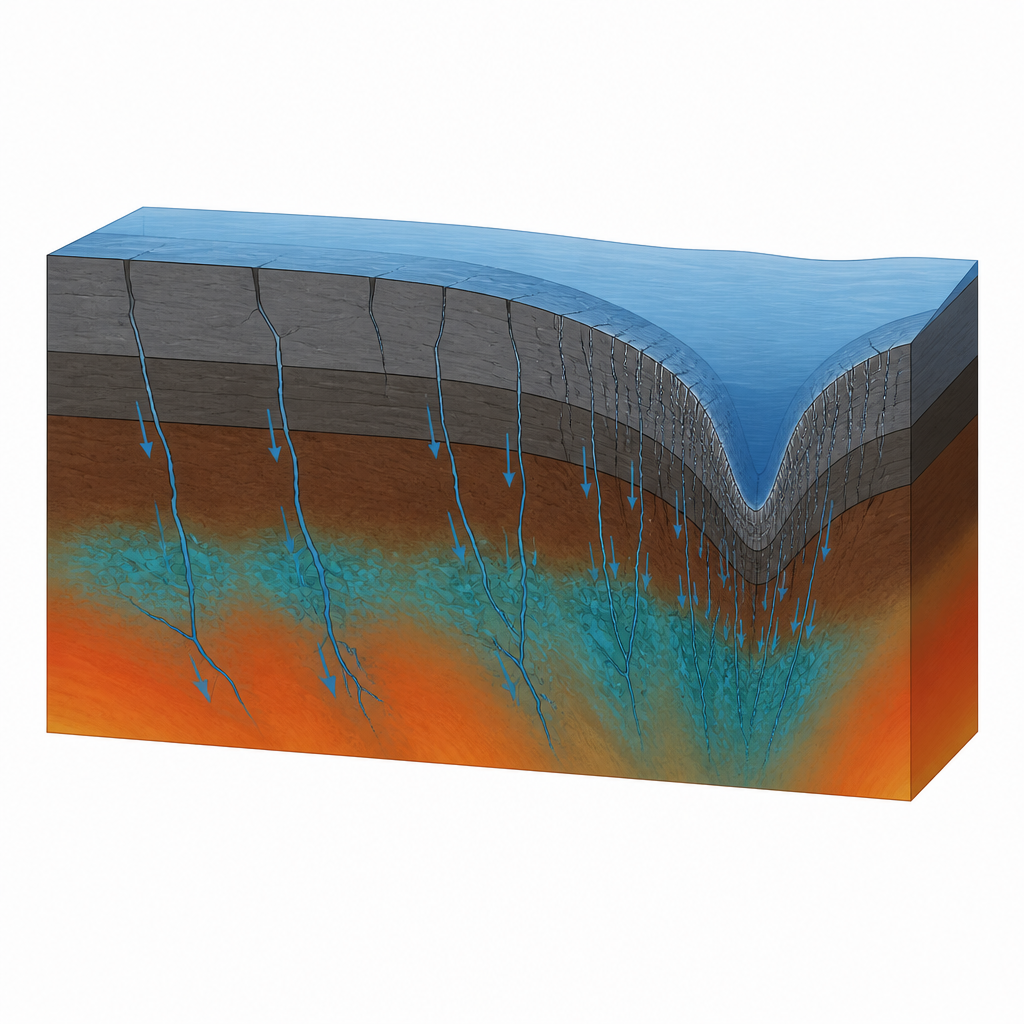
As the plate bends down into the trench, it does not flex evenly. The first small faults appear far from the trench, but they do little to change the deeper rock. Closer in, faults grow deeper, slicing through the entire crust and reaching the mantle below. These breaks act as pathways that let seawater plunge downward and react with hot rocks, turning them into a water-rich mineral mix. The study outlines three stages along the path to the trench: gentle shallow cracking, then deeper cuts that start to alter mantle rocks, and finally intense faulting near the trench where hydration is strongest.
A tug of war between plateau and normal crust
The thick Caroline Plateau does not behave like the thinner crust next to it. Normal crust ahead of the plateau develops many closely spaced, small faults and shows very large drops in seismic speed, a sign of heavy hydration. The plateau segment instead develops fewer but larger faults and shows smaller speed reductions, which points to weaker hydration inside the plateau itself. Yet just in front of the plateau, where its stiff leading edge meets the trench, bending becomes focused and the underlying mantle shows exceptionally low speeds. This reveals an especially intense pocket of water-rich rock compared with both nearby regions and other subduction zones around the world.
Shaping trenches, volcanoes, and the seafloor above
These differences at depth are mirrored by changes higher up. Where the plateau dives in, the inner wall of the trench arches upward and the back-arc region behind the trench remains mostly unbroken, with little sign of seafloor spreading. Where only normal crust sinks, the inner trench slope is broader and the back-arc is stretched and opening. The authors argue that the buoyant plateau shortens and flattens the sinking slab beneath it, while the longer segment of normal crust to the east rolls back more steeply, pulling the overlying plate apart. Over time, as the Caroline Plateau continues its journey, the intense, localized hydration now seen at its front edge may encourage later tearing and break-up of the slab deep within the Earth.
What this means for Earth’s water and hazards
For a non-specialist, the core message is that giant undersea plateaus act like stiff speed bumps on the conveyor belt that feeds Earth’s deep interior. By channeling and intensifying water flow into specific parts of the sinking plate, they help decide where rocks weaken, where slabs might eventually rip, and how the overlying ocean floor bends or breaks. This work shows that the shape and strength of the incoming seafloor strongly influence how Earth recycles water and how future earthquakes and volcanoes may be distributed along one of the planet’s most extreme plate boundaries.
Citation: He, E., Qiu, X., Li, Y. et al. Pre-subduction of the Caroline Plateau intensifies lithospheric hydration in the southern Mariana Trench. Commun Earth Environ 7, 409 (2026). https://doi.org/10.1038/s43247-026-03408-z
Keywords: Mariana Trench, Caroline Plateau, subduction, lithospheric hydration, oceanic plateau