Clear Sky Science · en
Cracked on-axis and pristine off-axis crust formed during forearc evolution at a nascent subduction zone
Why the Hidden Edges of Tectonic Plates Matter
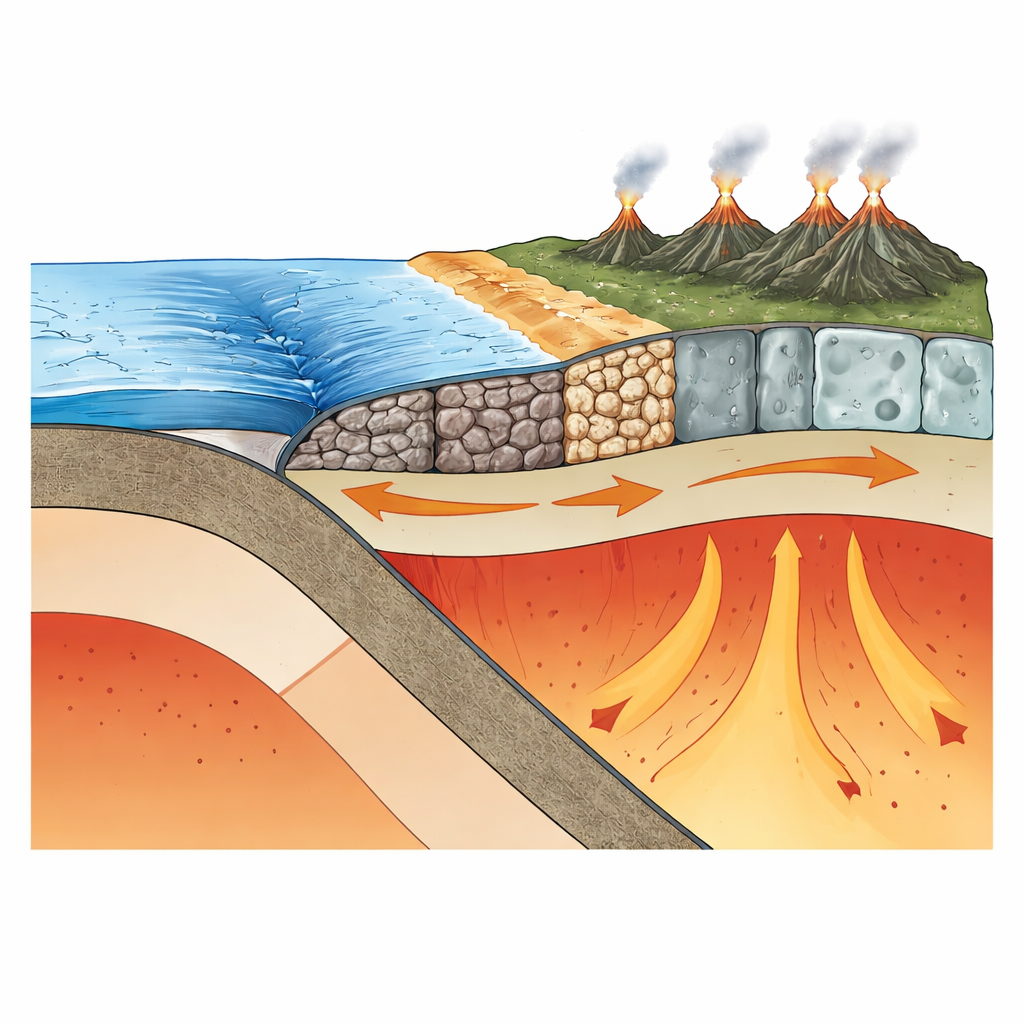
Far from shore, where one tectonic plate begins to dive beneath another, lies a little-known zone that quietly shapes the face of our planet. This "forearc" region records the birth of subduction zones—places where ocean floor sinks into the mantle, fueling earthquakes, volcanoes, and eventually even the growth of continents. Yet much of this early history is buried under kilometers of rock and water. This study uses deep-sea drill cores and geophysical measurements to decode how young ocean crust in the Izu–Bonin forearc formed, cracked, and changed during the earliest moments of a subduction zone’s life.
Young Crust at the Front Line of a New Subduction Zone
The researchers focused on the Izu–Bonin–Mariana arc south of Japan, one of the best natural laboratories for studying how subduction begins. Here, ocean drilling has recovered unusual volcanic rocks formed more than 50 million years ago, when an oceanic plate first began to sink into the mantle. Early eruptions produced forearc basalts, similar in composition to mid-ocean ridge lavas, followed by rare magmas called boninites. These rocks built a forearc crust between the ocean trench and the future volcanic arc. Because modern examples of such young forearcs are scarce and often overprinted by later events, this preserved system offers a rare snapshot of how primitive arc crust—and ultimately continental crust—first took shape.
Probing Rocks for Their Physical Fingerprints
From four deep drill holes in the outer forearc, the team collected dozens of small rock cubes for detailed laboratory tests. They measured how dense the rocks are, how many voids and pores they contain (their porosity), how fast sound waves travel through them, and how strongly they respond to a magnetic field. They also analyzed chemical compositions and inspected thin slices of rock under the microscope. The samples span several related rock types, from early forearc basalts and basaltic boninites to later, more silica-rich boninites erupted farther from the spreading center. By comparing physical properties with textures seen under the microscope, the scientists linked differences in the rocks’ internal structure to the volcanic and tectonic conditions under which they formed.
Cracked Versus Pristine: Two Styles of Early Crust
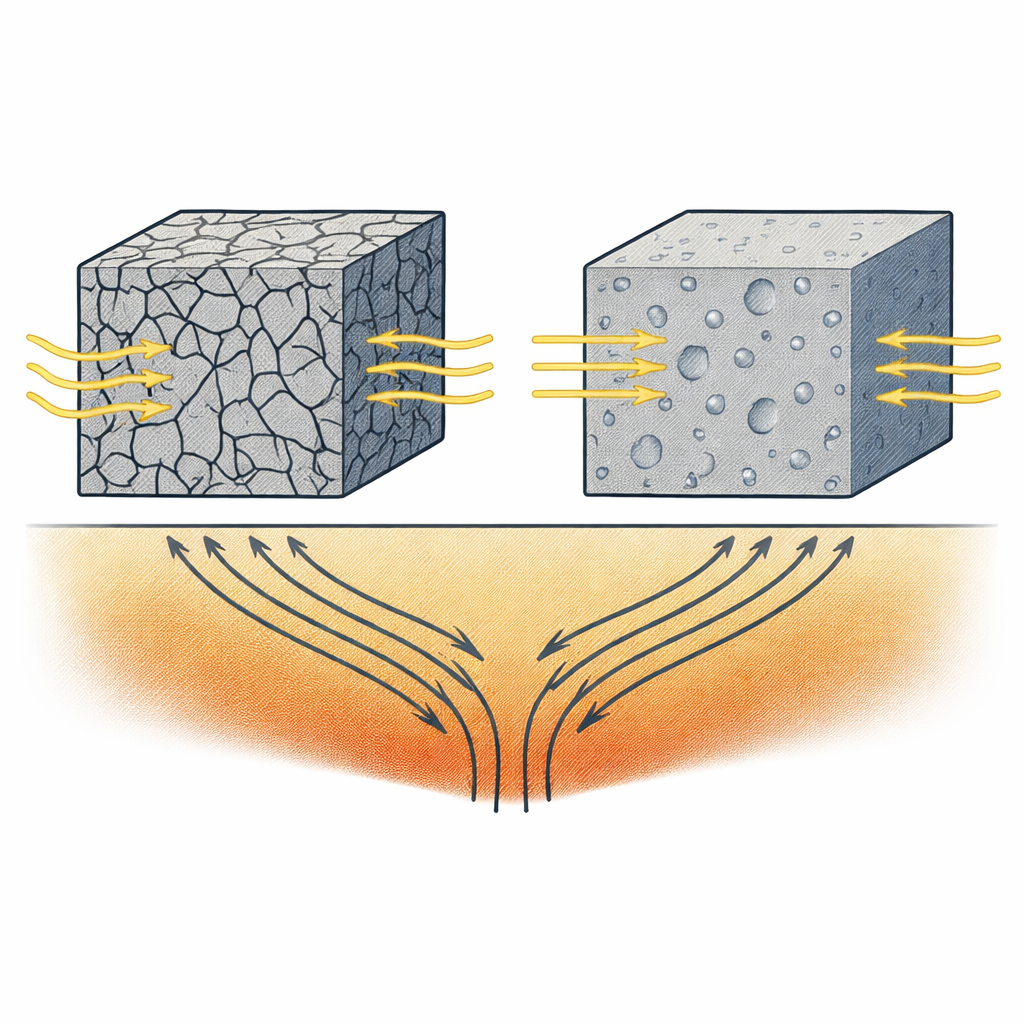
The tests revealed a striking split between early and later volcanic products. Rocks formed during the initial seafloor spreading stage are riddled with fine cracks that cut between and within mineral grains, and often contain clay minerals produced by circulating hot fluids. These heavily damaged rocks have relatively low sound speeds, because the cracks act like soft gaps that slow passing waves. In contrast, later off-axis lavas are more glassy, with rounded bubbles and far fewer cracks. They also host fewer magnetic minerals, likely because rapid cooling trapped iron and titanium in glass instead of letting magnetic crystals grow. Despite sometimes having similar overall porosity, these smoother, less fractured rocks transmit sound faster, showing that the shape and connectivity of voids—not just their volume—strongly controls physical behavior.
Reading Deep Structure from Surface Waves
Armed with these rock-scale insights, the authors revisited existing seismic surveys that image the forearc crust along long profiles. They found two recurring patterns: some parts of the crust show low sound speeds near the surface that rise sharply with depth, while other areas start faster and change more gradually. By comparing these trends to their lab results and theoretical models of how cracks close under pressure, they concluded that the steep-gradient profiles represent crust that began highly cracked—likely formed at the early spreading axis—while the gentler profiles mark more intact crust built by later off-axis eruptions. Their interpretation suggests that smoother, off-axis volcanic bodies intruded into and alongside earlier cracked crust in bands spaced tens of kilometers apart, implying that even during subduction’s infancy, magma supply varied along the margin in a patterned way.
What This Means for Earth’s Changing Crust
Taken together, the work shows that early forearc crust is not a uniform slab, but a patchwork of shattered and relatively pristine blocks created by different volcanic stages. This patchwork controls how fluids circulate, how heat escapes, and how seismic waves travel through the crust—processes that influence earthquake behavior and long-term chemical exchange between the ocean and the solid Earth. By tying lab measurements of drill cores to broad geophysical images, the study demonstrates how tiny cracks in ancient rocks can reveal the step-by-step construction of new subduction zones, offering a clearer view of how today’s continents may have begun as fractured crust at the leading edge of sinking plates.
Citation: Akamatsu, Y., Fujii, M., Harigane, Y. et al. Cracked on-axis and pristine off-axis crust formed during forearc evolution at a nascent subduction zone. Commun Earth Environ 7, 315 (2026). https://doi.org/10.1038/s43247-026-03400-7
Keywords: subduction initiation, forearc crust, Izu–Bonin arc, oceanic lithosphere, seismic properties