Clear Sky Science · en
Unique microbes released by retreating glaciers are rarely propagated to coastal ecosystems
Why shrinking glaciers matter for tiny life
As glaciers melt under a warming climate, they do not just release water and sediment; they also unleash vast numbers of microscopic organisms. These hidden passengers help drive the chemistry of rivers, soils, and seas. This study followed those microbes from Arctic glaciers in Svalbard, across newly exposed land, and into nearby fjords to ask a simple question with big implications: when glaciers retreat, do their unique microbial communities reshape coastal oceans, or do they mostly vanish along the way?
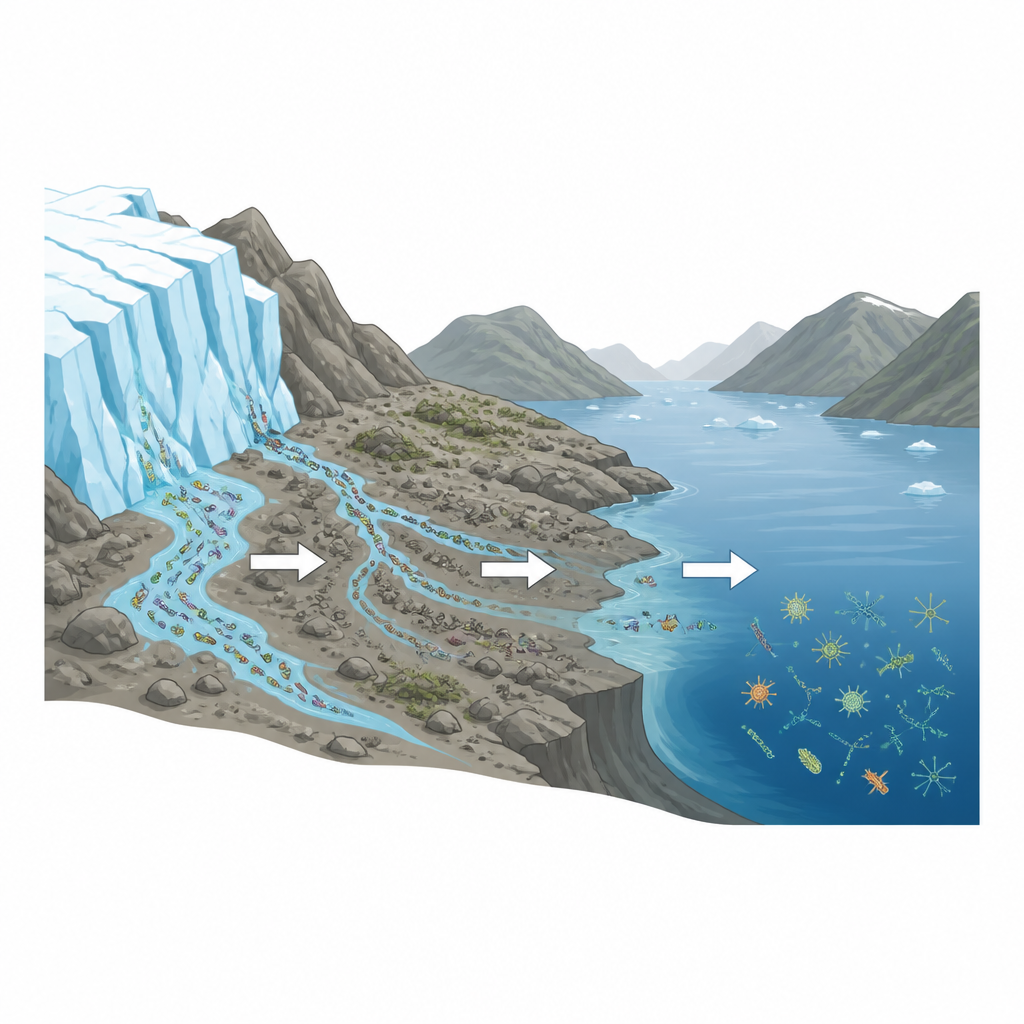
Following microbes from ice to ocean
The researchers sampled ice, meltwater streams and lakes, soils in front of glaciers, and seawater from an adjoining fjord in Svalbard. Using genome-resolved metagenomics, they reconstructed 309 microbial genomes, allowing them to track not just which microbes were present, but what they were capable of doing biochemically. This glacier-to-fjord route spans sharp changes in temperature, salt levels, and nutrients, creating a natural test of which microbes can survive the journey and establish themselves downstream.
Glaciers as seed banks for new land
The team found that glacier habitats, including ice and dark, debris-filled surface holes, were surprisingly diverse. Many bacterial groups thrived there, and a large fraction of glacier microbes were shared among different glaciers, suggesting a characteristic “glacial biome.” When meltwater carried these communities downslope, they became dominant in foreland soils, lakes, and streams. About three quarters of the microbial genomes detected on the foreland could be traced back to glacial sources, showing that glaciers act as powerful seed banks that populate the freshly exposed landscapes left behind as ice retreats.
A barrier at the shoreline
In contrast, very few glacial microbes successfully colonized the fjord. Only a small minority of genomes found in marine sediments or seawater could be linked to glacier origins, and most of those belonged to just a few hardy lineages. The fjord community was instead dominated by unique marine microbes that were largely absent upstream. Network analyses of how different species co-occur showed that these fjord specialists formed tight, self-contained clusters, with limited connections to glacier and foreland microbes. Steep shifts in salinity, nutrient stratification, and competition from well-adapted marine residents together created a strong environmental filter at the land–sea boundary.
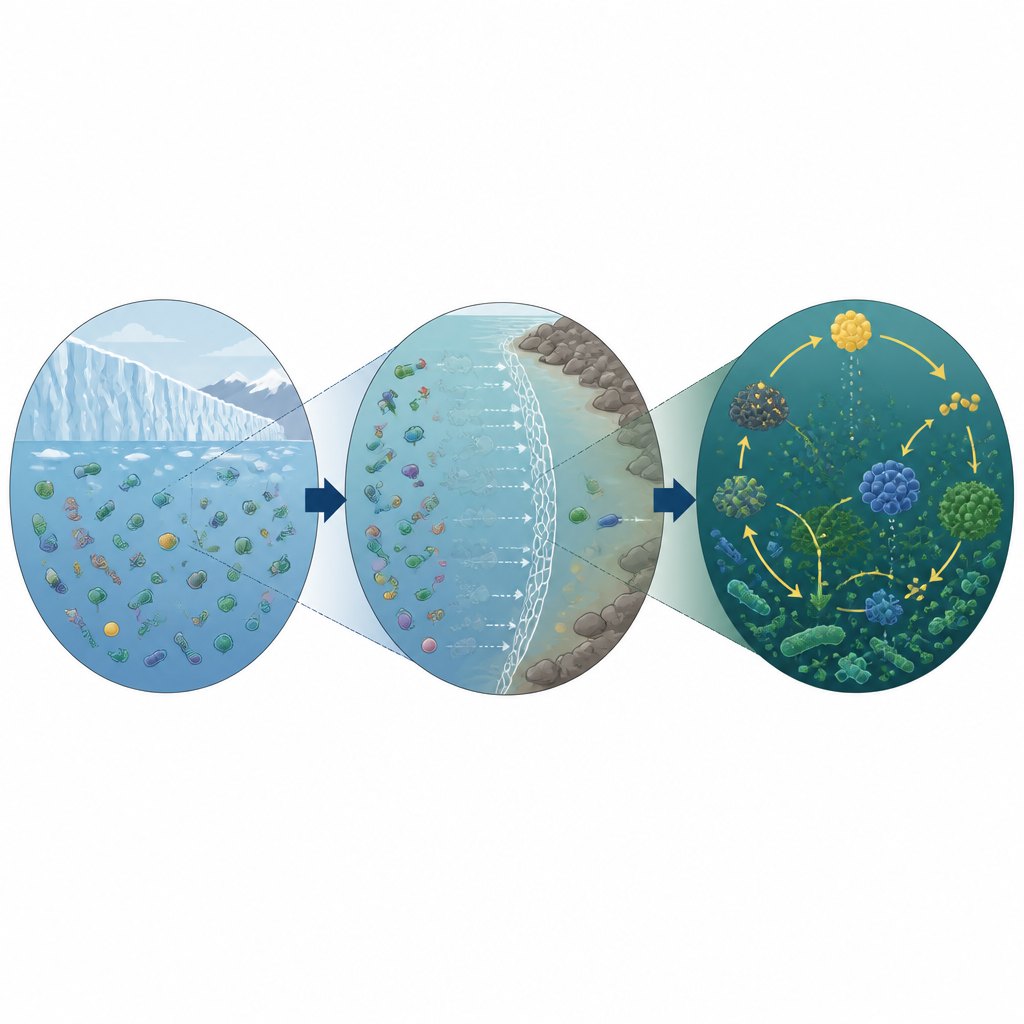
Different jobs along the journey
Looking at the genes each microbe carried revealed how their roles changed along the route from ice to ocean. Nearly all communities relied on eating organic carbon, but glaciers hosted many microbes that could also fix carbon from carbon dioxide, making new organic matter in an energy-poor environment. Glacial and foreland microbes were versatile in using different chemical energy sources and in driving nitrogen transformations, with the foreland acting as a hotspot for processes that convert nitrate to nitrogen gases. Fjord microbes, by contrast, leaned strongly on breaking down incoming organic matter and showed a striking emphasis on sulfur cycling, especially reactions that help remove certain greenhouse gases. These differences show how the same water flow supports very different chemical “jobs” in each habitat.
Special cold survivors and their uncertain future
Glacial microbes carried genes that help them cope with life in ice, including antifreeze proteins and flexible systems for handling sudden changes in salt levels as water freezes and thaws. They also invested heavily in enzymes that can chip away at tough, ancient organic material locked in ice and sediments. Downstream communities lacked many of these specialized traits, relying instead on more generic cold-adaptation tools that work across a range of chilly environments. This means that as glaciers shrink, we are not just losing frozen water, but also distinct microbial specialists and the unique chemical functions they perform on land. The study concludes that glacier loss is likely to disrupt microbial diversity and carbon processing on newly exposed terrain far more than it will alter established coastal marine ecosystems, with long-term consequences for how carbon and nutrients cycle in polar regions.
Citation: Liu, K., Liu, Y., Zhang, Z. et al. Unique microbes released by retreating glaciers are rarely propagated to coastal ecosystems. Commun Earth Environ 7, 413 (2026). https://doi.org/10.1038/s43247-026-03399-x
Keywords: glacier microbiome, Svalbard fjord, microbial dispersal, carbon cycling, climate-driven deglaciation