Clear Sky Science · en
Sediment transport pathways and organic carbon burial impacted by offshore wind farms in shelf seas
Why sea-floor mud matters for clean energy
Offshore wind farms are a cornerstone of the clean‑energy transition, especially in shallow shelf seas like the North Sea. Yet the same spinning turbines that deliver low‑carbon electricity also nudge winds, currents and seabed sediments in subtle ways. This study asks a deceptively simple question with big implications: as we build ever more turbines offshore, are we also rearranging the mud and buried carbon that help stabilize coasts and lock away greenhouse gases? 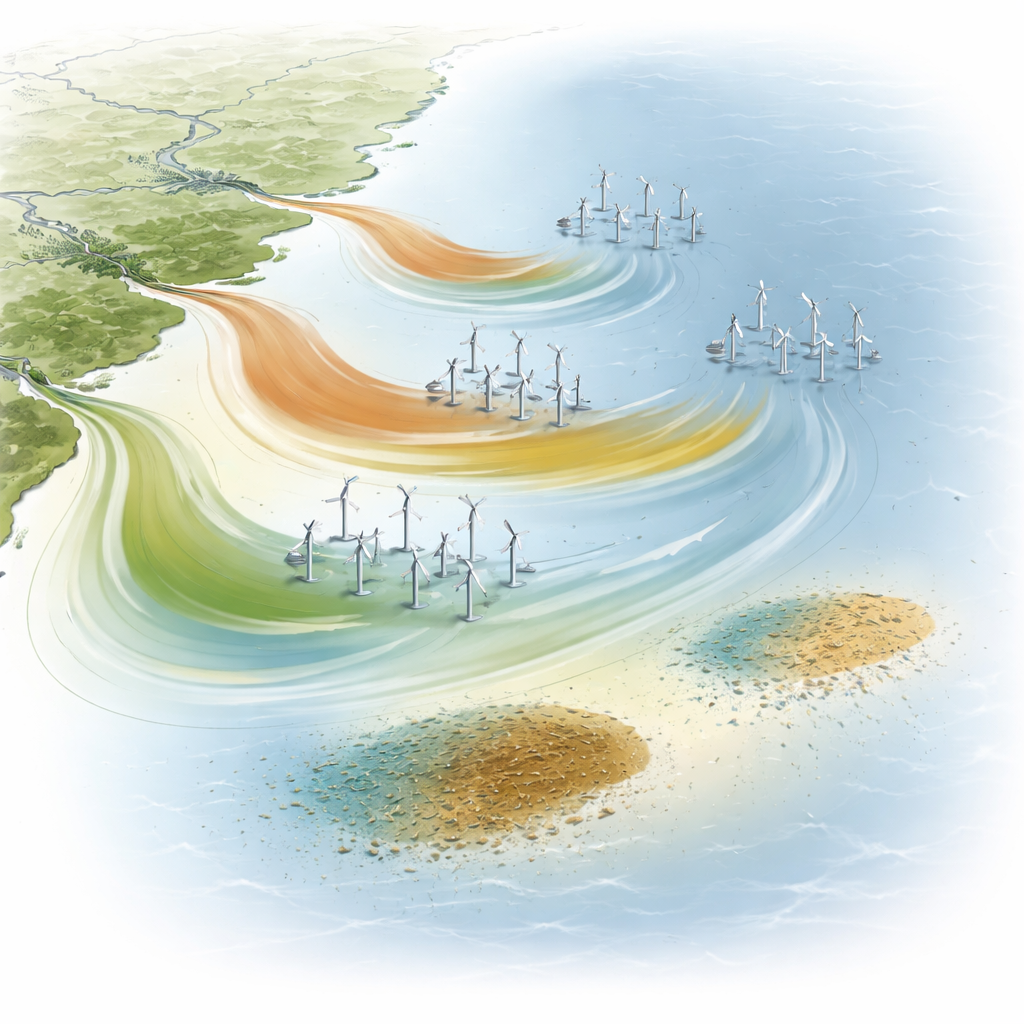
Hidden highways of mud and carbon
The North Sea seafloor is not uniform sand. Fine mud delivered by rivers and the open Atlantic is swept around by tides, storms and coastal currents until it settles in a few key “depocenters” – natural resting places where particles accumulate. These muddy hotspots are not only physical sinks for sediment; they also act as long‑term burial sites for organic carbon, much of it from land and plankton. The authors focus on how the growing clusters of offshore wind farms, mostly built on sandy shallows, might disturb these natural highways of mud and carbon as material moves between the open shelf, coastal waters and sensitive areas such as the Wadden Sea.
Simulating a crowded, windy sea
To tackle this, the team built a three‑dimensional computer model that couples ocean circulation, waves and sediment movement across the entire North Sea. Crucially, they did not treat wind farms as just a few rough spots on the bottom. Instead, they represented both atmospheric wakes – slower winds stretching tens of kilometers downstream of turbine clusters – and extra turbulence and drag generated by the turbine foundations in the water. They ran 15 versions of the model for two contrasting years, one with high river inputs and one with low, and systematically varied how easily mud and organic particles sink or are stirred up. By comparing simulations with and without wind farms, they isolated how the installations alone reshape transport and burial of fine sediment and particulate organic carbon at regional scale.
Shifting where mud and carbon come to rest
The results reveal that offshore wind farms do not simply stir up a little sand around their bases; they subtly redirect the larger‑scale flow of mud. Each year, about 10 million tonnes of fine sediment and 0.4 million tonnes of organic carbon enter the North Sea from rivers. The model suggests existing wind farms retain roughly 1.5% of this river‑borne sediment and carbon on the shelf, rather than letting it continue toward deeper depocenters in the Skagerrak and Norwegian Trench. Across the North Sea, wind farms drive a gross reshuffling of about 1.1 million tonnes of mud and 0.045 million tonnes of organic carbon annually, even though the net gain or loss averaged over the whole region remains small. Importantly, the pattern of where material goes changes: the primary Helgoland Mud Area accumulates less, while nearby regions such as the Paleo‑Elbe valley and Oyster Ground gain more, hinting at the slow weakening of old hotspots and emergence of new ones. 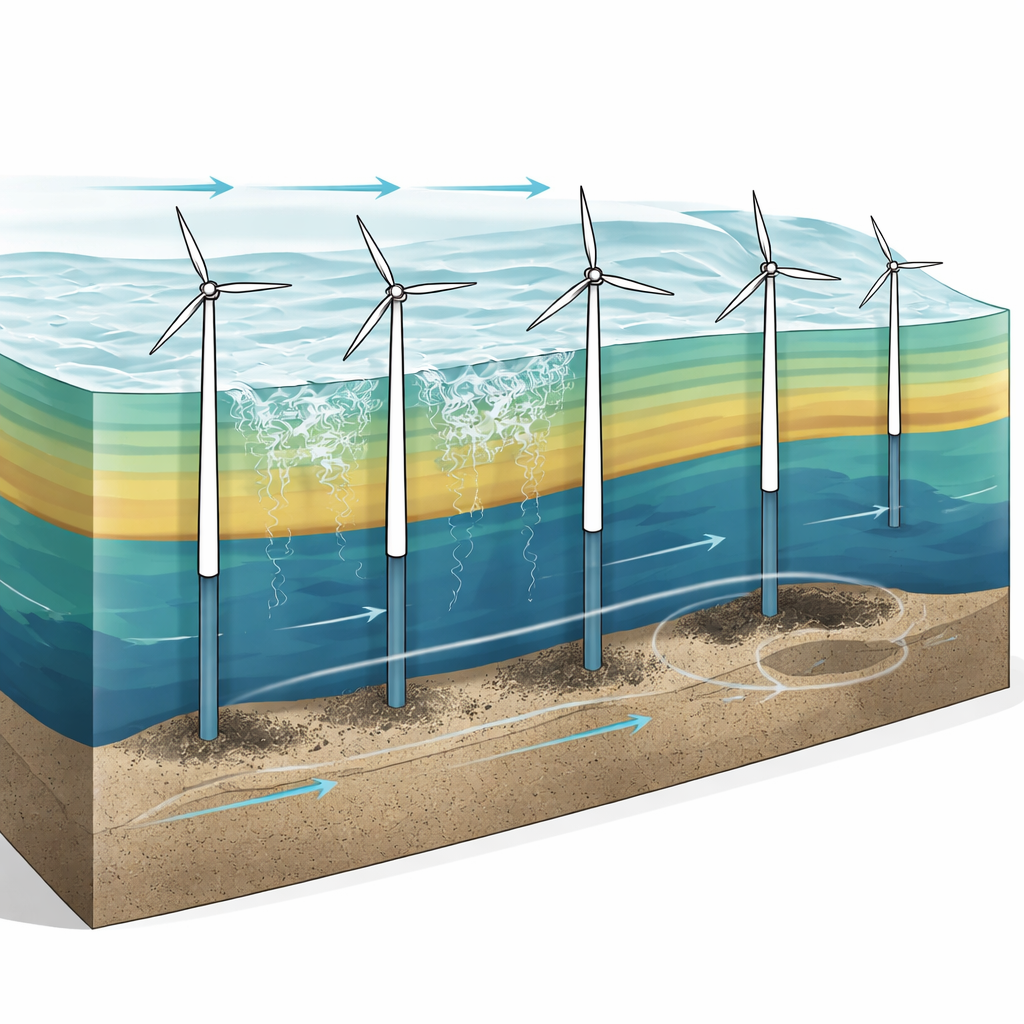
How turbines tug on currents and layers
These shifts arise from changes in bottom stress, mixing and water‑column layering caused by the farms. Within and downstream of turbine clusters, extra drag and wake turbulence alter how often currents are strong enough to resuspend mud from the seabed. In some zones, resuspension events become more frequent; in others, weaker bottom stress favors deposition. At the same time, reduced wind speeds in the atmospheric wakes lessen surface stirring over wider areas, particularly in summer. The model shows that, in places surrounded by wind farms, the water column becomes more strongly layered, or stratified, meaning less vertical mixing. This stronger layering encourages fine particles to settle and stay put. Seasonal effects matter: in winter, changes are more confined near the farms and along established transport routes; in summer, when river plumes and warm surface waters already promote stratification, wind‑farm‑induced changes in mixing can redirect sediment pathways and alter transport by up to about 30% locally.
Consequences for coasts, carbon and planning
Although the simulated year‑to‑year changes in mud and organic carbon content at any given spot are small—typically under one percent—their consistent direction implies that over decades, offshore wind farms could measurably reshape seabed landscapes. Less mud reaching long‑standing depocenters may erode their role as carbon burial “hotspots,” while greater accumulation around wind‑farm clusters creates new zones of storage. In regions such as the German Bight, this also affects how much sediment remains available to feed coastal systems like the Wadden Sea, which need a steady supply to keep pace with sea‑level rise. Because similar mud‑trapping mechanisms operate in other shelf seas where offshore wind is expanding, the study argues that planners should treat wind farms as active players in sediment and carbon cycles, not just passive structures. Integrating these subtle but persistent effects into marine spatial planning will be key to building out offshore wind in a way that protects both the climate and the seafloor ecosystems that quietly support it.
Citation: Chen, J., Christiansen, N., Porz, L. et al. Sediment transport pathways and organic carbon burial impacted by offshore wind farms in shelf seas. Commun Earth Environ 7, 262 (2026). https://doi.org/10.1038/s43247-026-03390-6
Keywords: offshore wind farms, North Sea sediments, organic carbon burial, shelf sea ecosystems, marine spatial planning