Clear Sky Science · en
Fluid-driven element mobility resets plagioclase rubidium strontium and barium clocks while potassium feldspar resists
Why this rock story matters
Deep beneath our feet, hot fluids move through the crust, quietly rewriting the chemical "clocks" geologists use to tell time and trace Earth’s history. This study shows that two very common minerals in continental rocks—plagioclase and potassium feldspar—do not respond to these fluids in the same way. That mismatch can either blur or sharpen our view of how continents evolve, how ores form, and when ancient events actually happened.
Two common minerals, two different memories
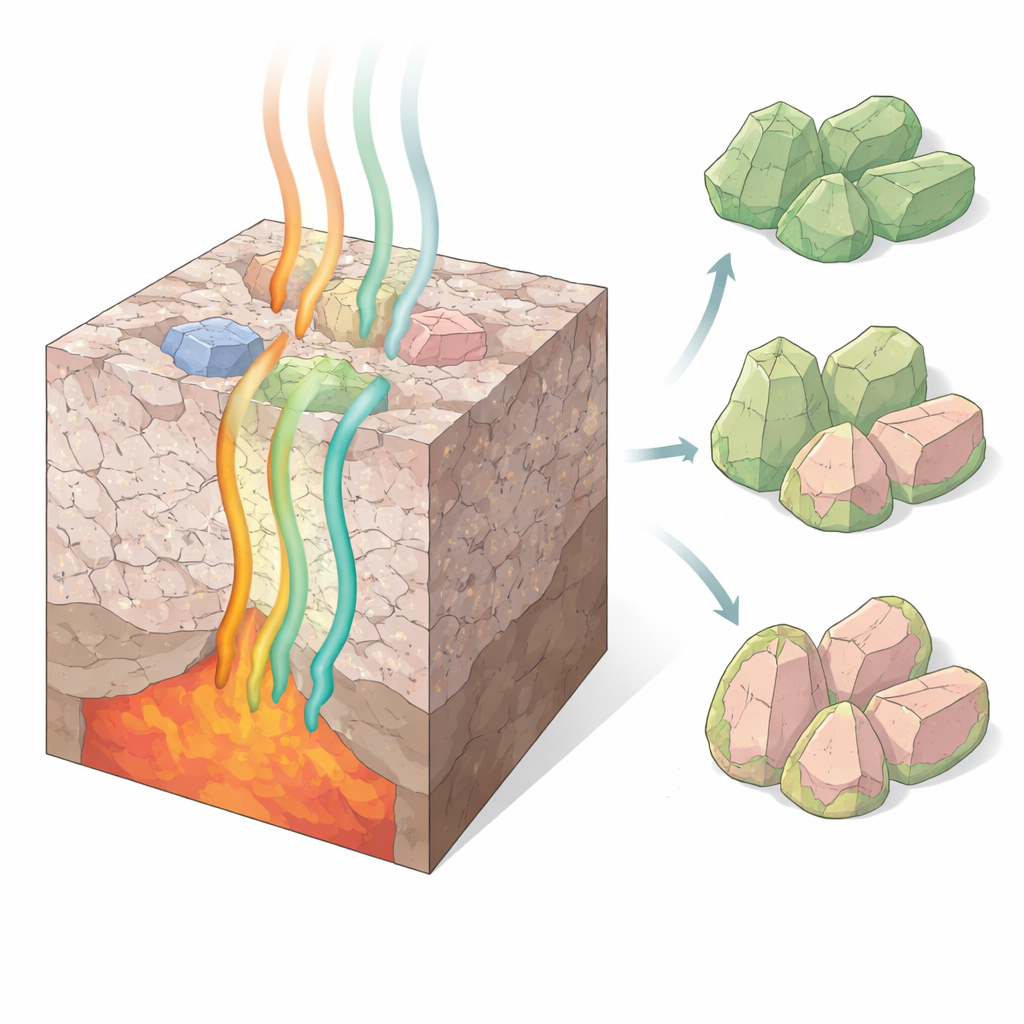
Plagioclase and potassium feldspar are the workhorses of the continental crust, dominating many granites and pegmatites. Both host large-ion lithophile elements such as rubidium, cesium, strontium, and barium that are widely used as tracers and dating tools. Yet scientists have long suspected that hot, salty fluids can move these elements around, scrambling the original magmatic signal. This paper tackles that problem directly by looking at individual mineral grains from ancient pegmatites in the North China Craton that were later flushed by much younger granitic fluids. Because the host rocks and invading fluids formed at very different times, their lead isotopes provide a sharp contrast, acting like a built‑in tracer for fluid–rock interaction.
Reading fluid paths in tiny rock textures
Under the microscope, the feldspars reveal a clear alteration sequence. Coarse, primary grains (called type‑I) preserve mostly magmatic textures and serve as a baseline. Finer-grained, overprinted feldspars (types II and III) are associated with quartz, epidote, and albite, and show textures typical of replacement by fluids: old crystals dissolving along fractures and defects while new feldspar precipitates in place. Plagioclase is cut by microfractures and twinning planes that act as fluid highways and tends to react strongly, often turning into albite and epidote-rich assemblages. Potassium feldspar, with a more rigid framework, shows more patchy, incomplete alteration, leaving relict cores that still look and behave like the original magmatic mineral.
Lead fingerprints and moving elements
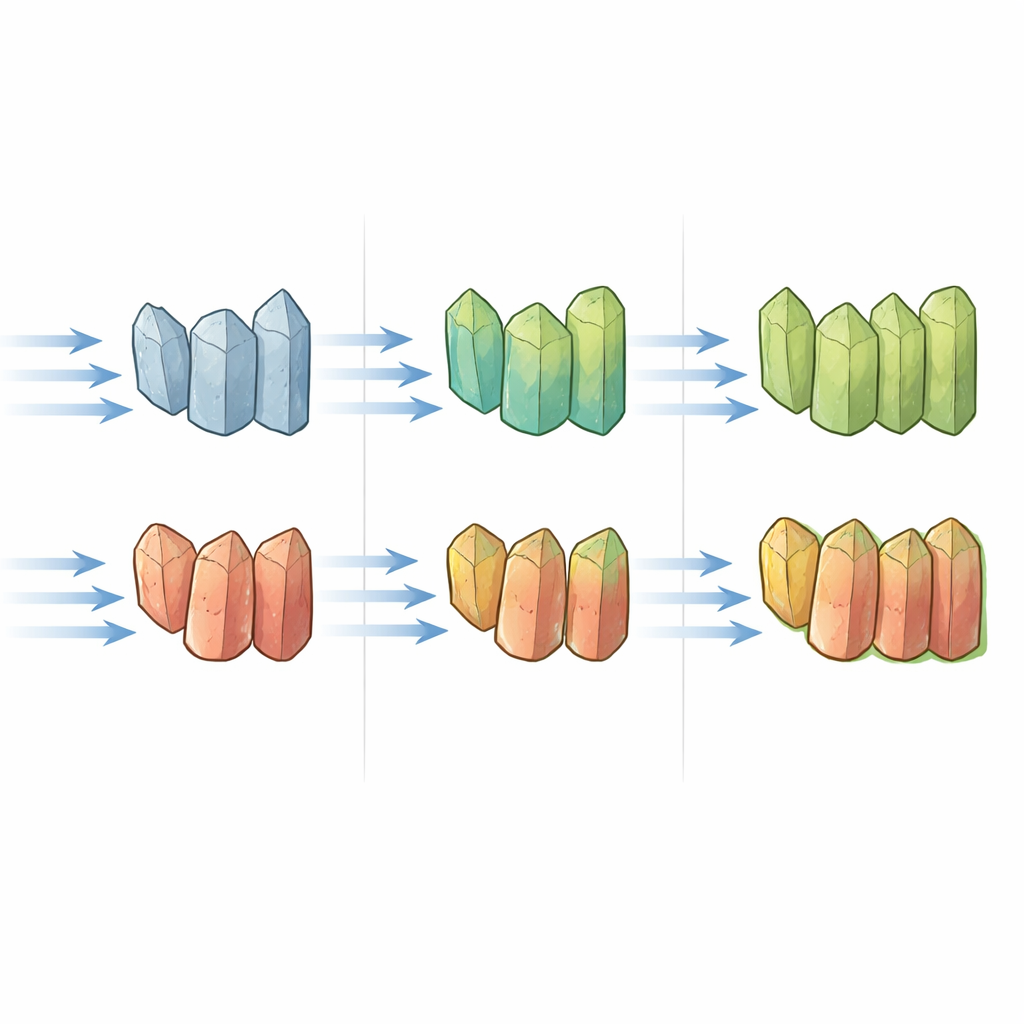
To quantify what moved where, the authors used laser-based mass spectrometry to measure lead isotopes together with rubidium, cesium, strontium, and barium inside single grains. Lead is highly mobile in hot fluids and its isotopic ratios shift dramatically when fluid-derived lead mixes with the rock. By treating lead as an internal reaction coordinate—a measure of how much fluid exchange has occurred—the team could ask how the other elements kept pace or lagged behind. Plagioclase shows tight, nearly ideal mixing trends: as its lead isotopes move toward fluid-like values, its strontium and barium contents shift in lockstep. In effect, plagioclase rapidly re-equilibrates with the passing fluid, almost completely erasing its original rubidium–strontium–barium “clock.”
A selective sieve in potassium feldspar
Potassium feldspar tells a more complicated story. Its lead isotopes clearly record fluid interaction, but rubidium, cesium, strontium, and barium do not follow simple linear mixing. Modeling shows a strong hierarchy of mobility in this mineral: lead is most easily exchanged, followed by cesium and rubidium, while strontium and barium are comparatively reluctant to move. Even in strongly altered zones, potassium feldspar crystals can keep much of their original strontium and barium budgets in their unreacted cores. At the same time, the study finds that a third lead component—extremely radiogenic lead released from the breakdown of a rare-earth mineral called allanite—also mixes into the system. This creates a three-way tug-of-war among magmatic lead, fluid-derived lead, and locally produced radiogenic lead, all recorded differently in coexisting feldspars.
Turning a nuisance into a tool
For geologists, the key message is that feldspars are not passive containers but active archives of fluid flow and element mobility. Plagioclase behaves like a sensitive reporter of the invading fluid’s composition, while potassium feldspar acts as a guarded vault that retains much of the original magmatic signal, especially for strontium and barium. By comparing these two minerals side by side in the same rock, researchers can now test whether isotope data truly reflect primary magmatic conditions or have been overwritten by later fluids, and even place bounds on how much fluid passed through. This "dual-feldspar" approach promises to improve age dating, source tracing, and reconstructions of fluid histories in crustal rocks that were once considered too altered to trust.
Citation: Zhang, HX., Jiang, SY., Liu, SQ. et al. Fluid-driven element mobility resets plagioclase rubidium strontium and barium clocks while potassium feldspar resists. Commun Earth Environ 7, 387 (2026). https://doi.org/10.1038/s43247-026-03383-5
Keywords: feldspar alteration, fluid–rock interaction, trace element mobility, isotope geochemistry, continental crust evolution