Clear Sky Science · en
Three-dimensional dynamic oasis effects of mesoscale fronts in the East China Shelf Sea
Hidden Highways in a Busy Sea
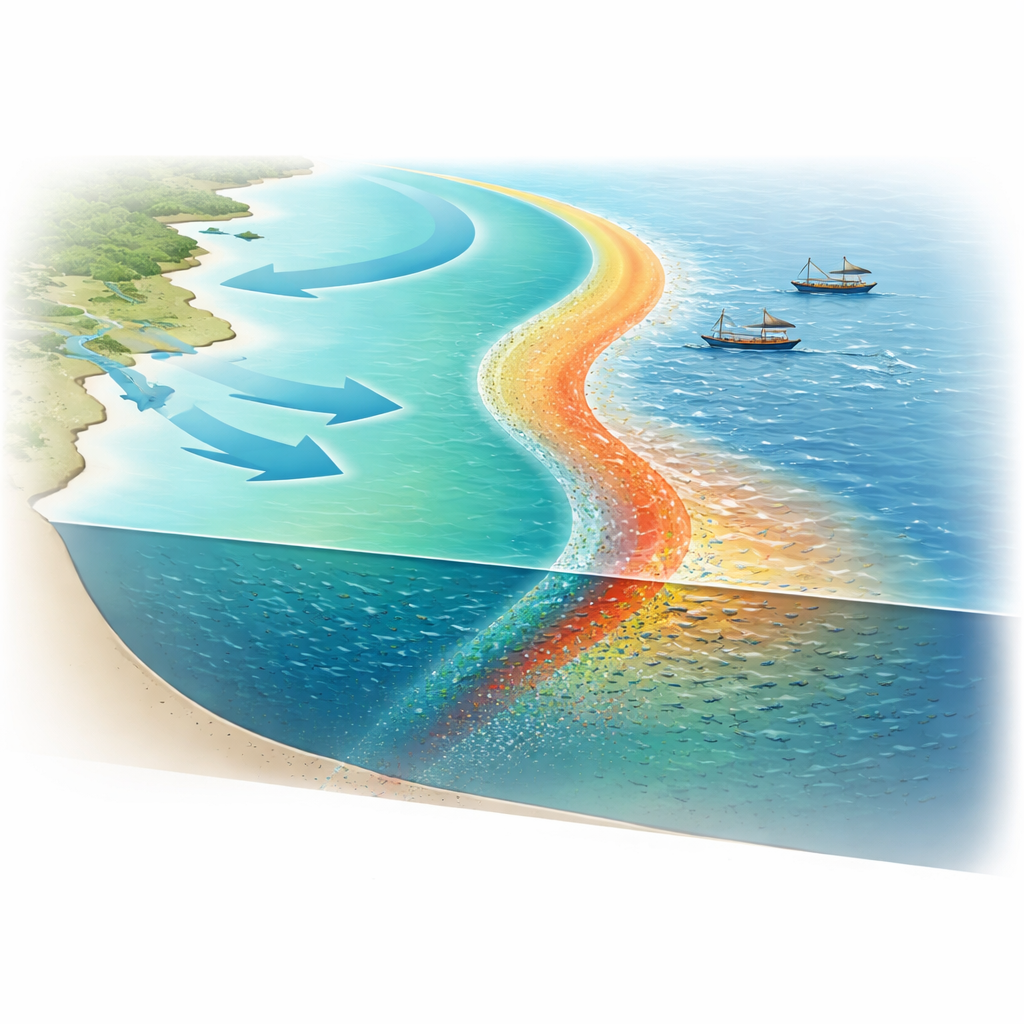
Along the coast of China, fishermen have long known that certain lines in the sea seem to teem with life. This study unpacks what those "hot lines" really are: invisible boundaries between water masses, called ocean fronts, that act like moving oases for microscopic plants, drifting animals, fish, and the people who catch them. Focusing on the East China Shelf Sea—a global fishing powerhouse—the researchers show that these fronts shape where life clusters not just at the surface, but from top to bottom, day and night, and across the seasons.
Where the Sea Sharpens Its Edges
Ocean fronts form where different waters meet—warm and cold, salty and fresh, clear and murky. In the East China Shelf Sea, currents such as the Kuroshio and runoff from major rivers like the Yangtze and Yellow Rivers collide over shallow seafloor, carving long, narrow bands tens to hundreds of kilometers wide. Using four years of ship-based acoustic surveys (which "see" animals with sound), underwater video, satellite maps of ocean color, and global fishing-boat tracking data, the team mapped 22 such fronts. They then compared what was happening on the cold versus warm sides of each front, near the surface versus near the bottom, and across spring, autumn, and winter.
Not All Oasis Effects Are Alike
The classic picture of a front is simple: nutrient-rich water fuels blooms of plant-like plankton, which attract tiny animals, then fish, then fishing boats. This study finds a much more mixed reality. Nearly all fronts (95%) boosted microscopic plants, seen as higher chlorophyll at the surface, and drew fishing effort. But only about two-thirds enhanced zooplankton, and fewer than six in ten increased fish. In many places, the cold side—with its cooler, nutrient-rich, often murkier waters—hosted the strongest plant growth, while zooplankton, fish, and boats often favored the warmer, clearer side near the coast, or the cold side farther offshore. In other words, different rungs of the food web did not always peak in the same place.
Seasons, Day–Night Rhythms, and Depth
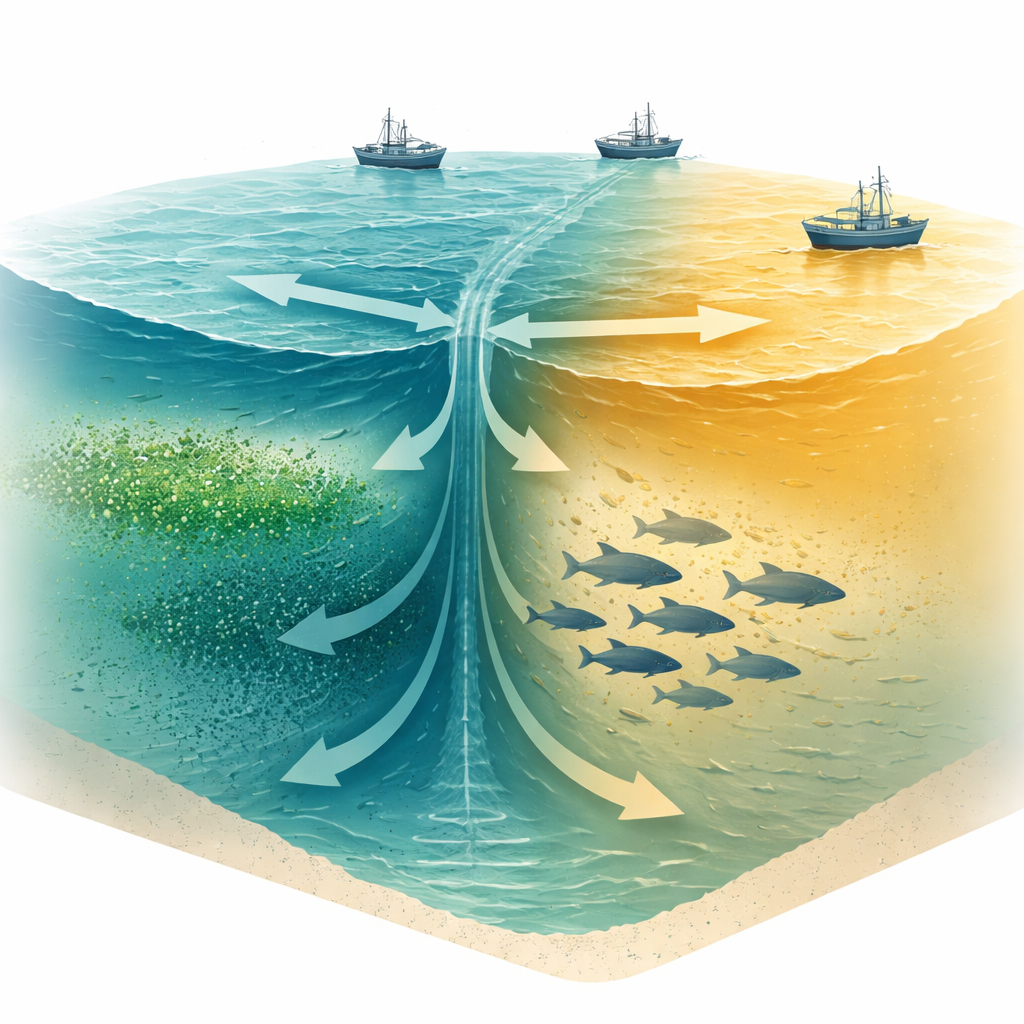
Fronts in this region change character over the year. Their temperature contrasts are sharpest in winter and weakest in autumn—and so are their biological effects. On average, fronts increased aggregation across all levels most strongly in winter and least in autumn. The vertical structure matters too. In autumn, a strong temperature layering separates warm surface waters from colder depths; in winter, storms mix the water more thoroughly. Sound-based measurements revealed that at night, animals tended to crowd into upper waters along fronts, while by day they retreated deeper, especially fish seeking cooler, darker habitat. This nightly upward migration, combined with the fronts’ physics, created intense, three-dimensional ribbons of life that shift with both time of day and season.
From Microscopic Life to Human Harvest
By linking biological patterns to the physical strength of the fronts, the authors found that denser plant growth and heavier fishing effort both rose with increasing thermal contrast. Zooplankton and fish, however, showed weaker or inconsistent ties to front strength, reflecting the influence of species-specific behavior, preferences for clearer or less salty waters, and the costs of moving across sharp temperature boundaries. Fishing boats, guided by satellite sea-surface maps and experience, strongly clustered along fronts even where fish did not obviously do so, especially near the coast. This mismatch suggests that models relying only on surface plant signals to forecast good fishing grounds can fail, particularly in complex coastal systems.
Why These Findings Matter
This work shows that ocean fronts are not simple, flat stripes of high productivity, but shifting, three-dimensional structures where physics, ecology, and human activity intertwine. In the East China Shelf Sea, these fronts can act as nurseries, feeding stations, or boundaries, depending on depth, season, and distance from shore. By revealing how microscopic plants, drifting animals, fish, and fishing fleets respond differently to the same physical features, the study provides a baseline for managing heavily exploited shelf seas as climate change alters the intensity and position of ocean fronts worldwide.
Citation: Nie, L., Li, J., Liu, Y. et al. Three-dimensional dynamic oasis effects of mesoscale fronts in the East China Shelf Sea. Commun Earth Environ 7, 364 (2026). https://doi.org/10.1038/s43247-026-03378-2
Keywords: ocean fronts, East China Shelf Sea, marine food webs, fisheries, satellite and acoustic monitoring