Clear Sky Science · en
Cutoffs as a sufficient condition for chaos in kinematic river channel evolution
Why wandering rivers matter
From space, many lowland rivers look like looping blue ribbons, endlessly reshaping the land around them. These bends and sudden shortcuts, called cutoffs, control how rivers move, erode farmland, threaten levees, and build fertile floodplains. This study asks a deceptively simple question with big implications: are these occasional cutoff events, by themselves, enough to make river paths fundamentally unpredictable over long times—behaving in a chaotic way, where tiny differences today grow into huge changes in the future?
Following a river in two different worlds
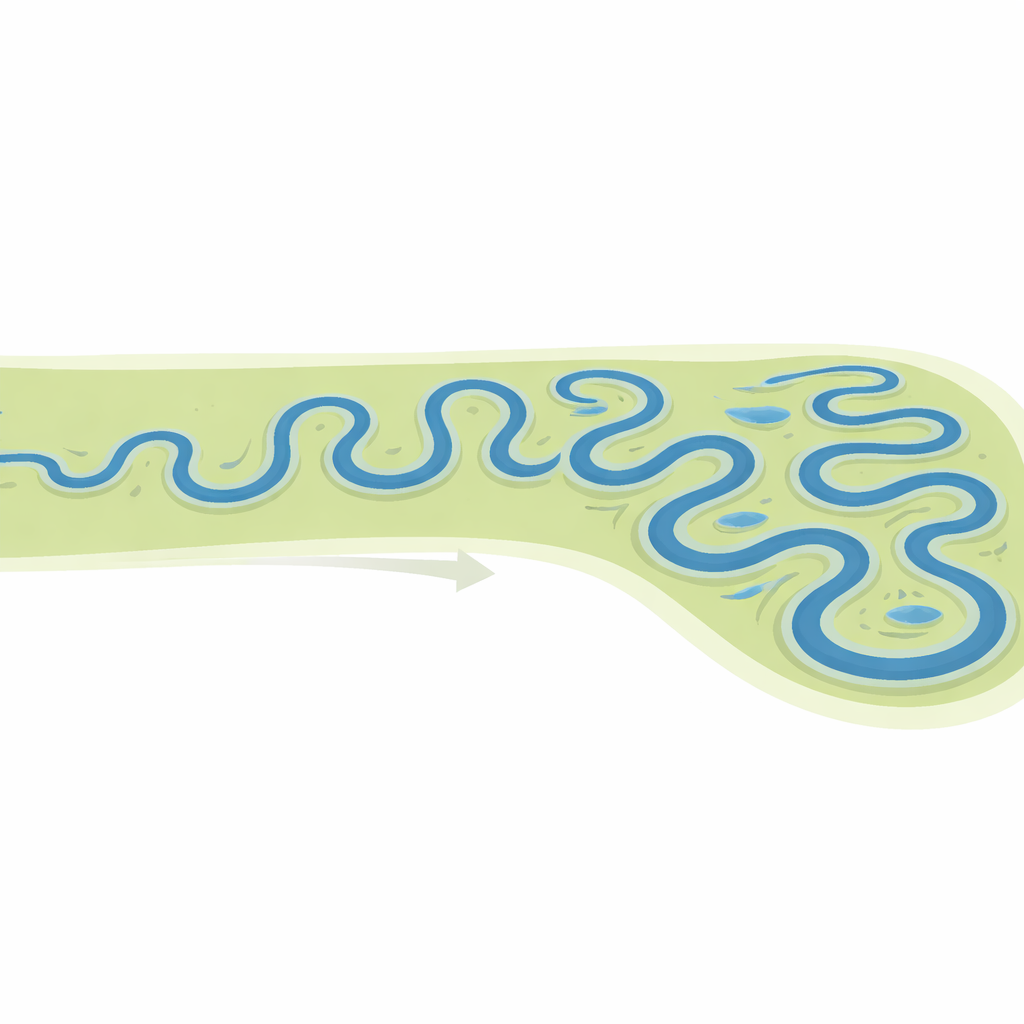
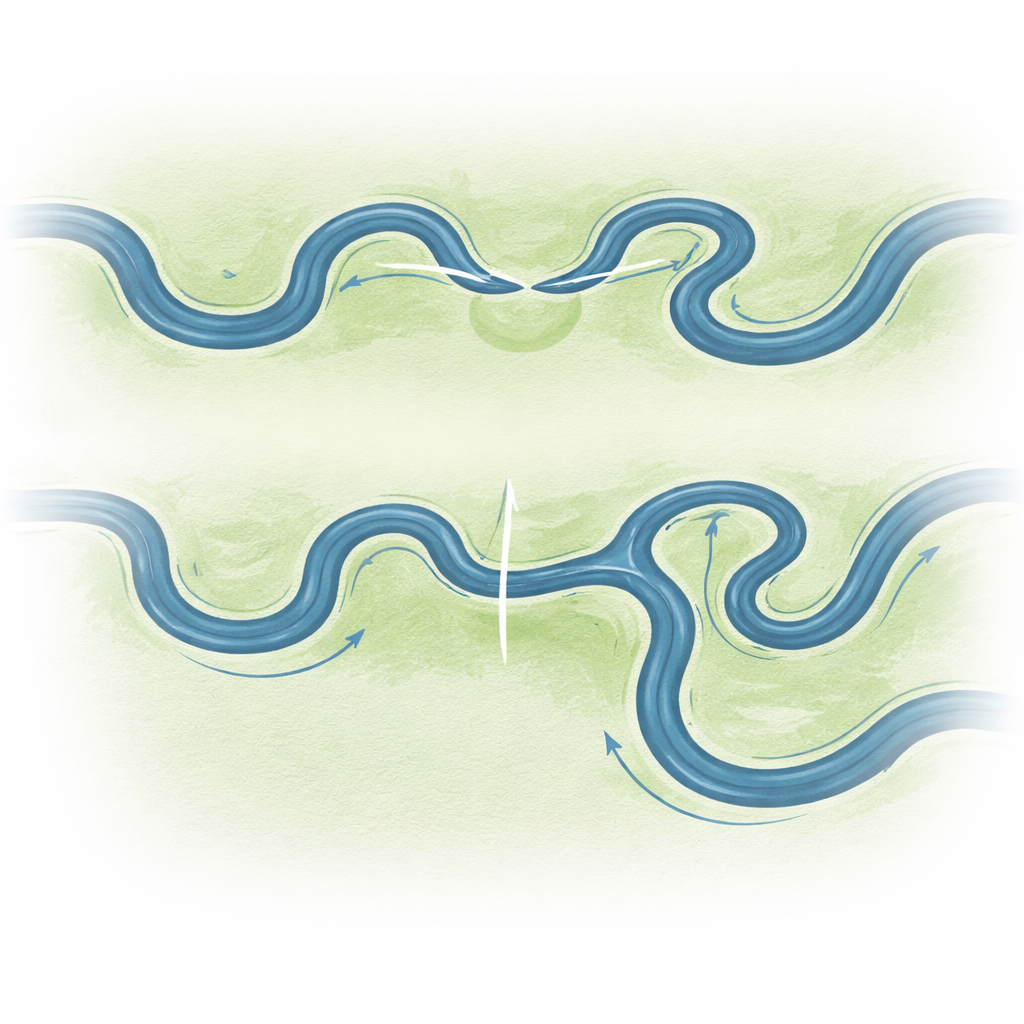
To tackle this, the authors use a computer model that tracks a river channel as a flexible line sliding sideways across its floodplain. In one set of experiments, this virtual river is allowed to behave like a real one: as bends grow and nearly touch, cutoffs slice off the tight loops, creating oxbow-like shapes and shortening the channel. In a counterfactual world, all the physics are left unchanged except for one rule: cutoffs are turned off, so the river is forced to keep stretching and folding without ever taking a shortcut. By comparing these two worlds side by side, the team can isolate exactly what cutoffs contribute to the river’s long-term behavior.
Measuring when small differences really matter
Instead of tracking every point on the snaking river, the researchers overlay the valley with a fixed grid, marking each tiny square as either “river” or “floodplain.” This turns each river shape into a simple black-and-white map that can be compared through time. They then run two nearly identical simulations, differing only by an almost unnoticeable nudge to the river at the start, and measure how many grid squares disagree between the two runs—a count known as the Hamming distance. If that number grows steadily and exponentially, it signals chaos: minuscule starting differences are being amplified by the system itself, not by added randomness.
Cutoffs switch chaos on, and set a prediction horizon
The results are striking. When cutoffs are disabled, the two nearly identical rivers remain visually the same on the grid even as their bends become unrealistically tangled; the distance between the two runs stays at zero, and there is no sign of chaos. Once cutoffs are enabled, however, the story changes: the first time a bend is sliced off, the two runs choose slightly different shortcuts, and their paths begin to diverge. With each subsequent cutoff, these differences spread and compound until the river layouts look completely different. This exponential separation is captured by a positive Lyapunov exponent, a standard measure of how fast nearby trajectories in a system fly apart. The authors show that this growth rate is robust: it does not depend on how finely they draw the grid (as long as the channel is resolved), on how tiny the initial perturbation is, or on the particular starting bend shape.
How fast rivers move versus how often they reset
Diving deeper, the study asks what actually controls the strength of this chaos. Two knobs matter in the model: how quickly bends migrate sideways, and how close two river segments must come before a cutoff is triggered. The authors find that the pace of sideways migration sets the rate of chaotic stretching: faster-migrating rivers amplify small differences more quickly. In contrast, the exact cutoff threshold hardly changes that stretching rate, but it strongly affects how often cutoffs occur. Tight, neck-style cutoffs let bends grow large before they are removed, leading to many cutoff events per unit of “chaotic time,” while early, chute-style cutoffs prune bends sooner and reduce the number of such resets. From this, the authors define an event-based “predictability horizon”: roughly how many cutoff events can be expected before forecasts of the river’s path lose practical value.
What this means for living with changing rivers
In this simplified but illuminating model, cutoff events alone are enough to tip river migration into deterministic chaos, creating a finite window beyond which we cannot reliably predict the exact course of the channel, even with near-perfect knowledge of the present. The speed of channel migration controls how quickly this horizon is reached, while the style of cutoffs controls how many major reshaping events can occur within that window. Real rivers are even more complex, influenced by floods, sediment, vegetation, and human engineering, which are likely to shorten predictability further. Nonetheless, the study shows that even in an idealized setting, the occasional slicing-off of meander loops builds in a hard limit to long-term river forecasts—an insight that can help scientists and planners think in terms of probabilities and horizons, rather than precise maps far into the future.
Citation: Noh, B., Wani, O. Cutoffs as a sufficient condition for chaos in kinematic river channel evolution. Commun Earth Environ 7, 379 (2026). https://doi.org/10.1038/s43247-026-03370-w
Keywords: river meandering, channel cutoffs, geomorphic chaos, predictability horizon, earth surface dynamics