Clear Sky Science · en
Air and soil warming have different effects on soil organic carbon storage
Why warm soils matter for our future
Most of the world’s carbon is not in trees or the air, but locked away in soils. As the planet warms, both the air above our heads and the ground under our feet heat up, which can change how much carbon soils store. This study asks a simple but important question for the climate: do warmer air and warmer soil affect this hidden carbon bank in the same way, or do they push it in different directions?
Two kinds of warming, two different stories
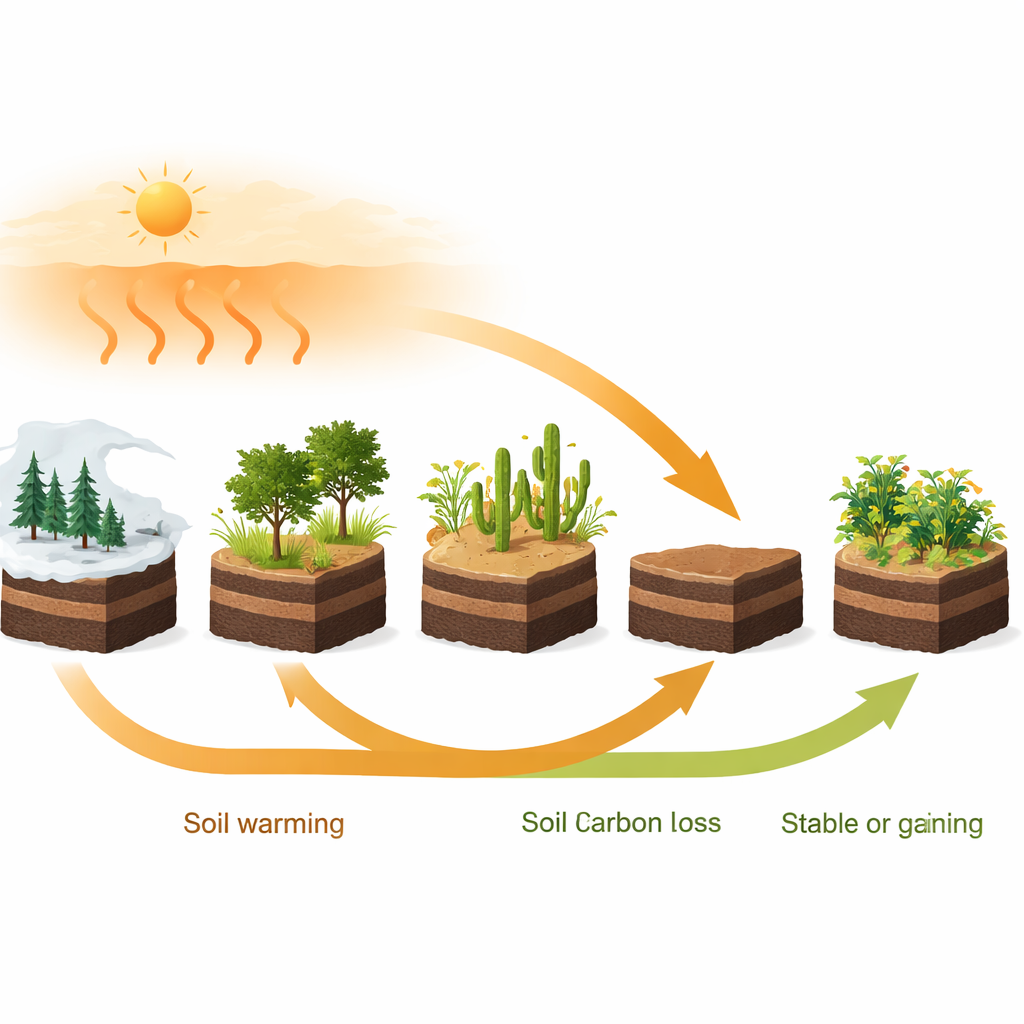
The authors pulled together results from 327 field experiments worldwide that deliberately warmed ecosystems, and combined them with a detailed computer model of land processes. The experiments used different tools to heat the environment: open top chambers mainly warmed the air around plants, heating cables mainly warmed the soil, and infrared heaters affected both. Across all sites combined, warming on average barely changed soil organic carbon, the dark carbon rich material in soils. But when the team separated the data by warming method, a pattern emerged. Air warming tended to leave soil carbon unchanged, while direct soil warming more often led to losses of stored carbon.
How warm air reaches into the ground
Using their model, the researchers explored why air and soil warming diverge. They found that raising air temperature does not always translate into equally warmer soils. How much extra warmth reaches the ground depends on how incoming energy is split between heating the air and evaporating water. In wetter places, more heat goes into evaporation, so the soil warms less. In drier places, more heat goes into sensible heating, so the soil warms more. Whole ecosystem warming, where both air and soil are heated, predictably produced the largest rise in soil temperature but still showed wide variation among climates.
Plants, water, and microbes in a changing climate
The model also tracked how plant growth and soil microbes respond. Net primary production, a measure of how much carbon plants take from the air and add to the land, changed in different directions at different sites. In cold, energy limited regions, warming often boosted plant growth by extending the growing season. In already warm regions, extra heat pushed plants beyond their comfort zone and raised their own breathing costs, so growth tended to fall. Direct soil warming had little impact on plant growth but sped up microbial breakdown of soil carbon, leading to consistent carbon losses from the soil bank.
When drier soils slow decay
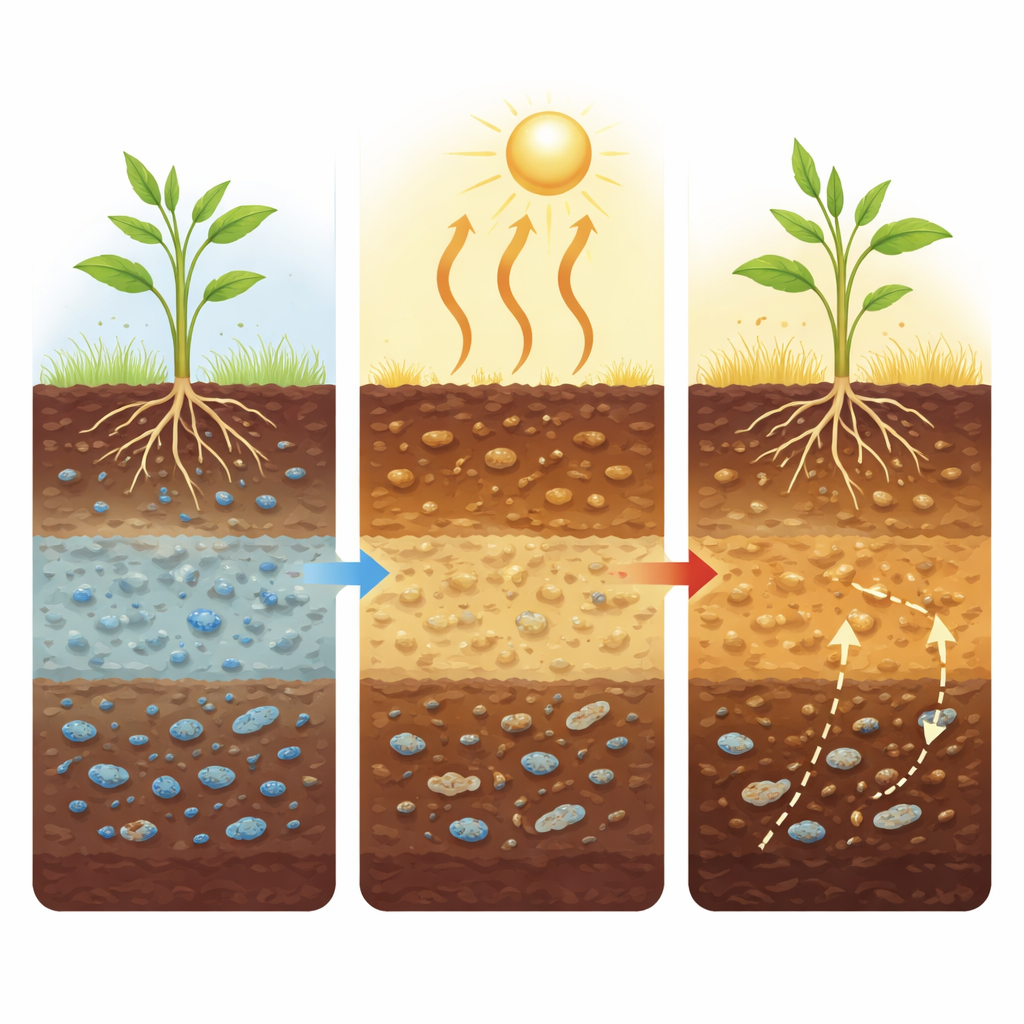
Air warming had a more tangled effect because it changed soil moisture as well as temperature. Warmer air increased the demand for water, drying out soils at many sites. Drier soils stressed plants and reduced their carbon inputs to the ground, which would usually mean less stored soil carbon. Yet the same drying also made life harder for soil microbes, which need water to decompose organic matter. In some simulations, this water stress slowed microbial activity so much that soil carbon stayed steady or even rose despite weaker plant growth. Where warming mainly increased temperature without strong drying, faster decomposition won out and soils lost carbon.
What this means for climate predictions
The study concludes that air and soil warming pull soil carbon in different ways, and the balance between them varies by climate and moisture conditions. Direct soil warming tends to shrink the soil carbon pool by speeding up decay, while air warming can either erode or protect soil carbon depending on how it alters plant growth and soil wetness. This means that lumping all warming experiments together, or ignoring how much soils dry out, can mislead climate projections. To better foresee how much carbon soils will release in a warmer world, scientists need to capture both the separate and combined effects of air and soil warming, and how microbes and plants adjust to changes in water and heat.
Citation: Luo, Z., Ren, J. & Fatichi, S. Air and soil warming have different effects on soil organic carbon storage. Commun Earth Environ 7, 394 (2026). https://doi.org/10.1038/s43247-026-03367-5
Keywords: soil carbon, climate warming, soil moisture, ecosystem experiments, carbon cycle