Clear Sky Science · en
Melting of fluorine-rich biotite as a mechanism for generating lithium-rich granites
Why hidden crystals matter for our battery future
Lithium is a cornerstone of modern rechargeable batteries, yet most of the world’s lithium still comes from a limited set of hard‑rock deposits. Many of these resources are hosted in pale, coarse‑grained rocks called granites that formed deep in Earth’s crust. This study asks a deceptively simple question with big implications: under what conditions can ordinary crustal rocks be melted and concentrated to produce granites that are exceptionally rich in lithium? The authors focus on a little‑known twist involving fluorine‑bearing mica minerals and show how this twist may unlock a powerful natural pathway for lithium enrichment.
A natural laboratory in southwest England
The work centres on the Cornubian granite batholith in southwest England, a 250‑kilometre‑long body of ancient granite that hosts a classic European tin and lithium province. These rocks formed roughly 295–275 million years ago during a mountain‑building episode and are divided into several types (G1 to G5) that record different stages of magma formation and evolution. The early, widespread granites (G1 and G3) are relatively poor in lithium, while later, rarer varieties (especially G5) can contain three to four times more lithium. The G5 granites also carry fluorine‑rich minerals such as fluorite and topaz and show unusual patterns in rare‑earth elements, signalling that something distinctive happened in their source or during their evolution. 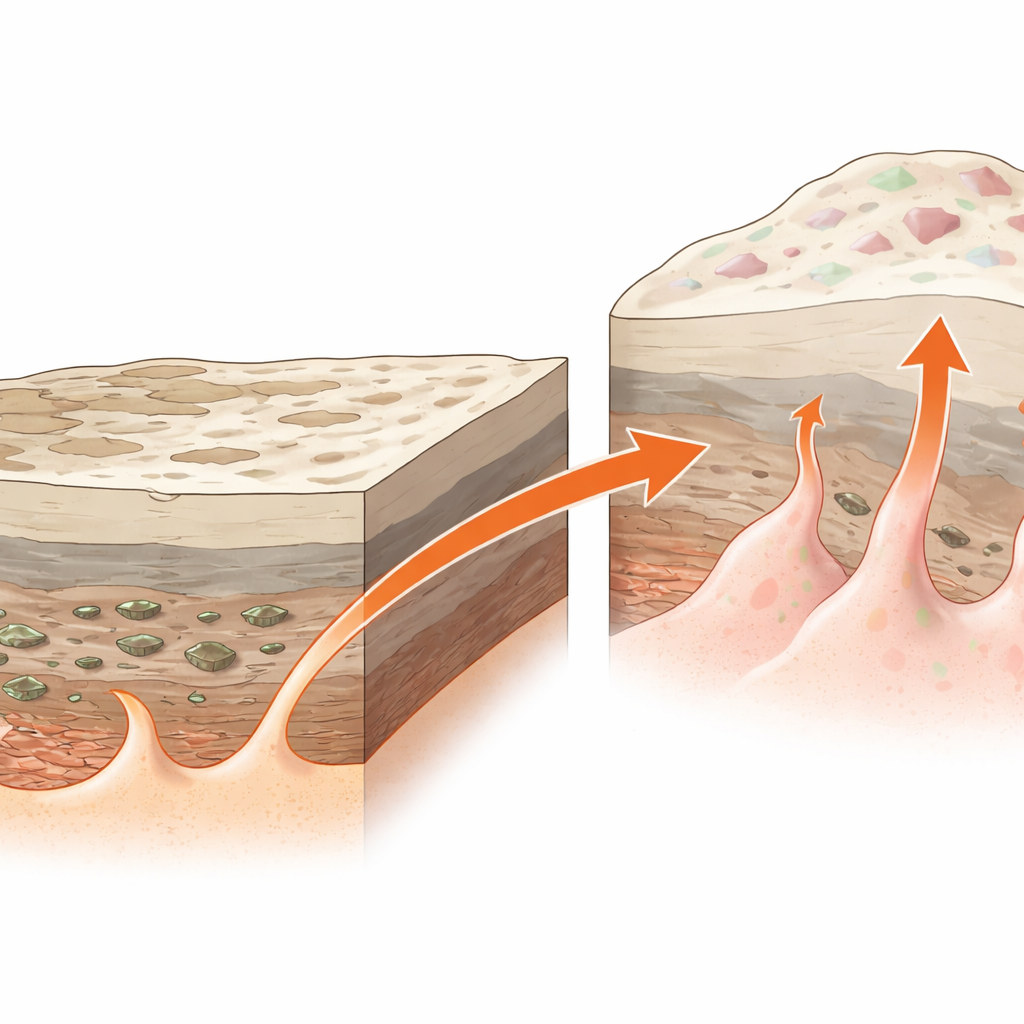
Melting old sediments to make new magma
To understand how these different granite types formed, the authors use state‑of‑the‑art thermodynamic modelling. They start with average compositions of ancient muddy sandstones (greywackes) that likely underlie the region, and compute how these rocks would behave as they are heated and partially melted at various depths and pressures in the crust. The models track which minerals are stable, how much melt is produced, and how its chemistry evolves as melt is repeatedly removed and the remaining solid continues to heat. The results show that the Cornubian granites are best explained by melting around 8 kilobars of pressure—roughly 25 kilometres depth—followed by upward movement and cooling of the melt while crystals gradually separate out, a process known as fractional crystallisation.
Following lithium through the melting process
Lithium’s fate during melting depends on how it divides between crystals and melt, described by “partition coefficients” for each mineral. Earlier models often assumed that lithium prefers to stay in the mica biotite, which would make it hard to build up high lithium levels in the melt. The new work systematically explores a wide range of published partition values, including a recent model where lithium can actually behave as if it dislikes biotite under typical conditions. The authors find that for ordinary, fluorine‑poor biotite, this distinction matters surprisingly little: the strongest lithium enrichment occurs not during initial melting, but during prolonged fractional crystallisation as crystals like quartz and feldspar separate from the liquid. Reasonable choices for the partition data reproduce the lithium contents of the more common Cornubian granites without invoking exotic sources or extreme conditions.
Fluorine‑rich mica as a lithium trap and trigger
The story changes dramatically when fluorine is introduced into the picture. Experiments show that fluorine‑rich biotite can hold lithium much more strongly—by more than an order of magnitude—than ordinary biotite and remains stable to higher temperatures. The authors test a scenario in which the source rocks contain both normal and fluorine‑rich biotite. As heating begins, the ordinary biotite melts first and contributes modest lithium to the magma, while the fluorine‑rich biotite clings to lithium in the solid residue. At higher temperatures, this fluorine‑rich biotite finally breaks down, suddenly releasing lithium into the melt and boosting its concentration several‑fold. Fluorine in the melt has further effects: it lowers viscosity, making the magma flow more easily, and depresses the temperature at which the melt starts to crystallise, allowing extended periods of fractionation. Together, these effects make it much more feasible to obtain the extreme lithium levels seen in the G5 granites without requiring unrealistically long or efficient crystal‑separation histories. 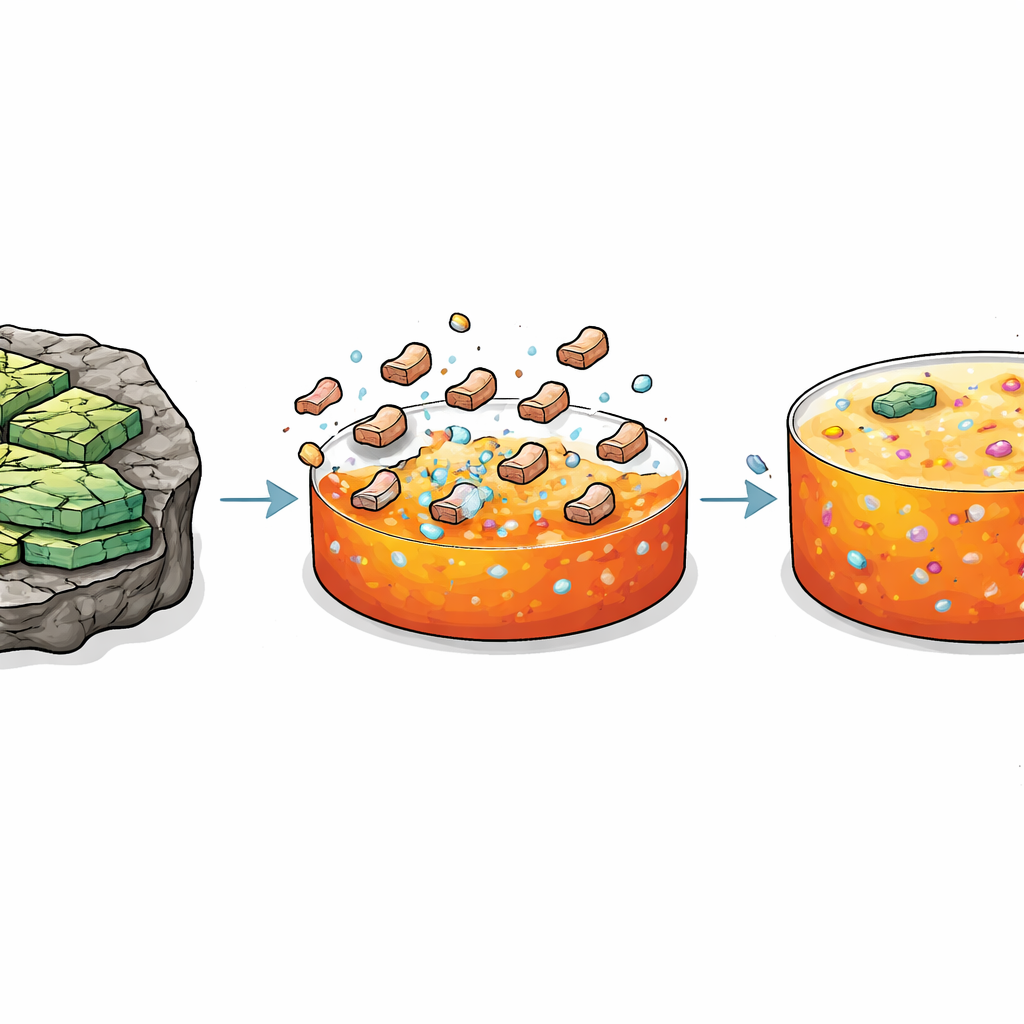
A new recipe for lithium‑rich granites
The authors conclude that melting of fluorine‑bearing biotite in metasedimentary rocks is a compelling mechanism for generating lithium‑rich granites like those of Cornwall. Their models show that while crystal fractionation is still the main engine of enrichment, the presence of fluorine‑rich biotite in the source dramatically enhances the final lithium content and helps explain associated features such as fluorite occurrence, rare‑earth element depletion, and the late timing of these magmas in mountain belts. For explorers and geoscientists, this work highlights fluorine distribution in crustal rocks—and particularly in micas—as a key clue for identifying regions where nature may have already concentrated lithium into accessible hard‑rock deposits.
Citation: Morris, M.C., Weller, O.M., Soderman, C.R. et al. Melting of fluorine-rich biotite as a mechanism for generating lithium-rich granites. Commun Earth Environ 7, 358 (2026). https://doi.org/10.1038/s43247-026-03361-x
Keywords: lithium-rich granites, fluorine-bearing biotite, Cornubian batholith, crustal melting, battery minerals