Clear Sky Science · en
Ichnofossils in volcanic glass from palaeoproterozoic hydrothermal vents were burrowed by microorganisms probably seeking phosphate
Ancient Clues Hidden in Volcanic Glass
Billions of years ago, Earth’s seafloor was a restless landscape of lava and hot springs. In this study, scientists show that even in that alien setting, tiny life forms were likely tunneling through fresh volcanic glass in search of vital nutrients. By reading the chemical and mineral “graffiti” left behind, the work helps explain how early microbes survived in harsh environments and suggests new ways to search for life’s traces on other worlds.
A Fossil Record Written in Glass
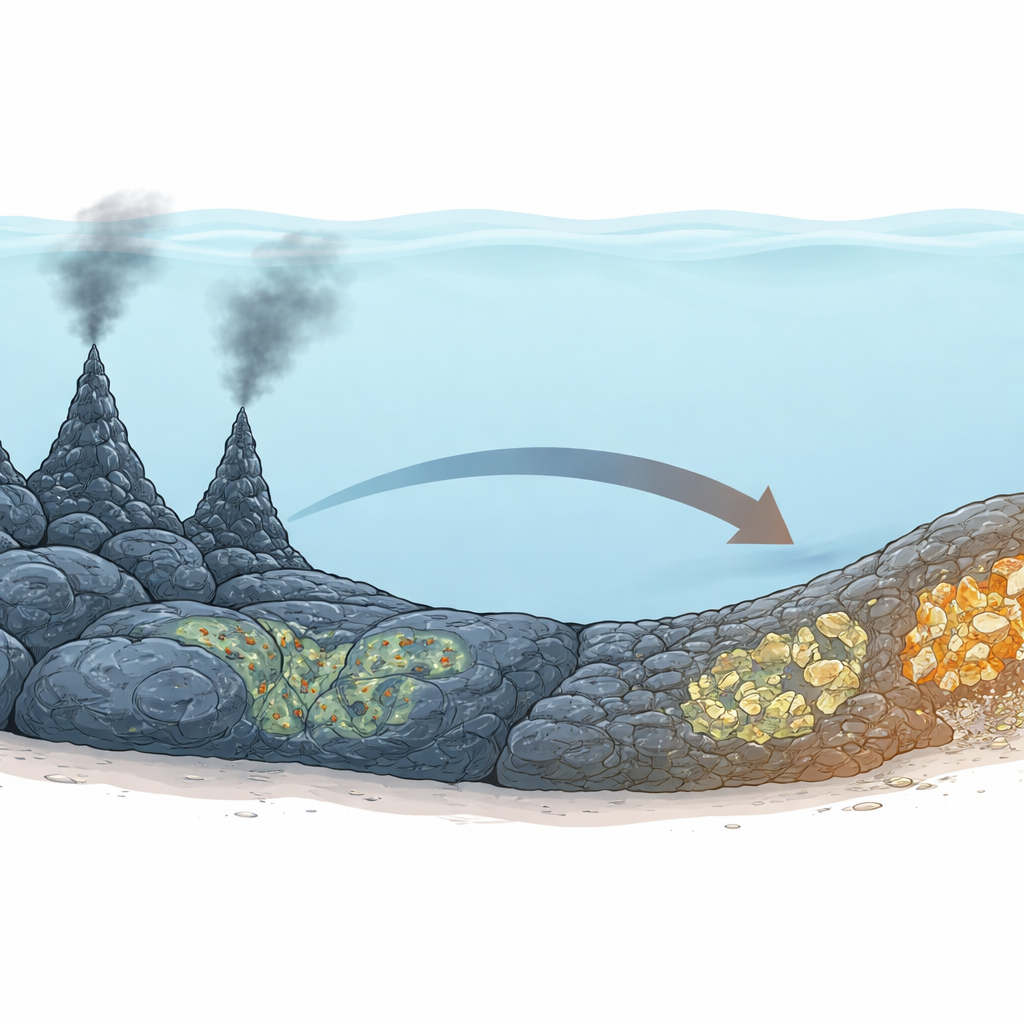
The research focuses on 1.87-billion-year-old rocks from the Flaherty Formation in the Belcher Islands of northern Canada. These rocks formed where lava erupted into shallow seawater, building bulbous “pillow” basalts and glassy debris known as hyaloclastite. Interlayered with these volcanic units are signs of ancient hydrothermal vents—chimney-like pinnacles, rusty iron-rich pods, and carbonate-rich concretions—indicating that hot, mineral-laden fluids once seeped through the seafloor. Such vent systems are widely considered prime habitats for early life because they provide strong chemical gradients that microbes can tap for energy.
Microscopic Trails of Hidden Life
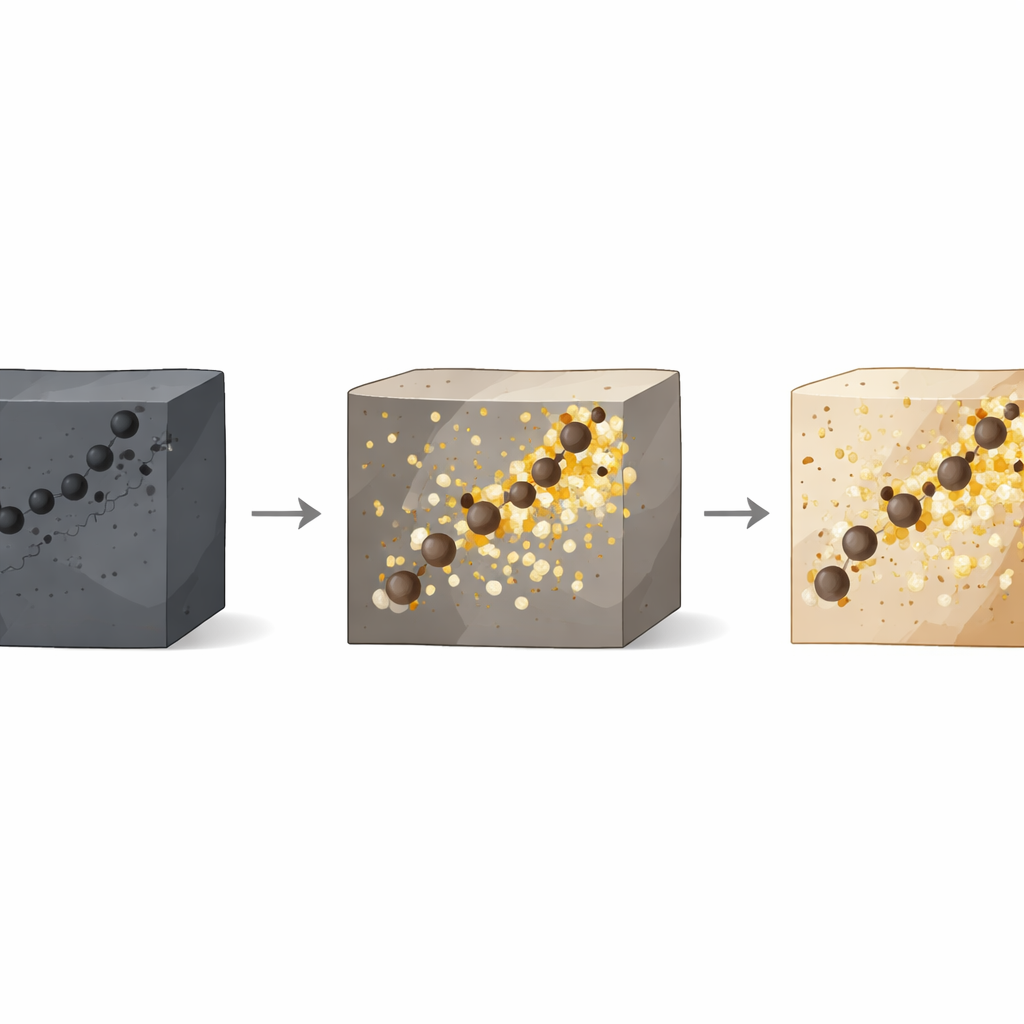
Within the altered volcanic glass, the author finds networks of tiny spherical and tubular structures called ichnofossils—trace fossils that record activity rather than preserved bodies. The spheres are remarkably uniform in size, typically about 14 micrometres across, and occur in bead-like trails linked by a thread of organic material. Detailed imaging and micro-spectroscopy reveal that these spheres consist mainly of the mineral titanite mixed with carbon-rich organic matter, while nearby zones contain nanoscale grains of apatite (a phosphate mineral) and lepidocrocite (an iron oxide). The close association of these minerals, along with the consistent shapes and sizes of the spheres, points to an origin in which microbes burrowed through the glass and later became mineralized.
Burrowing for Nutrients in Hot Rock
The distribution of phosphate- and iron-bearing minerals suggests a specific reason why microbes would tunnel into volcanic glass: to extract phosphorus, an essential ingredient of DNA, cell membranes, and energy-carrying molecules. Many apatite grains cluster near, but not inside, the spherical ichnofossils and are intergrown with organic matter and iron oxides. This pattern is best explained if early microbes used organic acids to dissolve the glass, releasing tiny amounts of phosphate and iron. Some of that phosphorus was probably consumed for growth, while some re-precipitated as apatite, together with iron forming lepidocrocite. Tubular titanite structures rich in organic matter, aligned in parallel groups, add a second style of trace fossil that resembles microbial tubes at modern and ancient hydrothermal sites, further supporting a biological origin.
Carbon and Sulfur Fingerprints of Ancient Microbes
Beyond shapes and minerals, the rocks carry strong chemical signatures of life. Carbon isotopes in both the organic matter and the surrounding calcite are unusually “light,” matching values expected when microbes use inorganic compounds as energy sources and then their biomass is oxidized during burial. At the same time, sulfur isotopes in pyrite from nearby black shales show patterns consistent with microbial sulfate reduction rather than purely chemical reactions. Together, these isotope data indicate that chemolithotrophic microbes—organisms that live off energy from rock- and vent-derived chemicals rather than sunlight—were active in this ancient seafloor environment, and that their remains were later recycled into new minerals.
What These Ancient Traces Tell Us Today
Taken separately, any one line of evidence—odd mineral shapes, unusual carbon, or specific iron and phosphate minerals—might be explained without life. But in the Flaherty Formation they occur together, in the right places, and in the right relationships to one another. The study concludes that tiny organisms once burrowed into hot volcanic glass near shallow hydrothermal vents, likely seeking phosphate and iron to fuel rock-powered metabolisms. Their activity etched a lasting record into the seafloor, preserved today as mineral-filled tunnels and spheres. By showing how such subtle traces can be recognized and cross-checked, this work strengthens the case for using similar features in volcanic glass as signposts of life’s deep past on Earth—and as potential guides in the search for life on other rocky planets.
Citation: Papineau, D. Ichnofossils in volcanic glass from palaeoproterozoic hydrothermal vents were burrowed by microorganisms probably seeking phosphate. Commun Earth Environ 7, 361 (2026). https://doi.org/10.1038/s43247-026-03359-5
Keywords: ancient hydrothermal vents, microbial trace fossils, volcanic glass alteration, early Earth life, phosphate-seeking microbes