Clear Sky Science · en
Effect of increasing persistence of alternating drought and rainfall events on grassland soil microbes intensifies over time
Why Shifting Weather Patterns Matter Belowground
When we think about climate change, we often picture withered crops, flooded rivers, or scorching heat. Yet a quieter drama is unfolding beneath our feet, where vast communities of microbes in the soil help feed plants, recycle nutrients, and store carbon. This study explores how a subtle but important feature of a changing climate—longer runs of dry or wet weather—reshapes those hidden soil communities over time in grassland ecosystems.
Longer Dry and Wet Spells as the New Normal
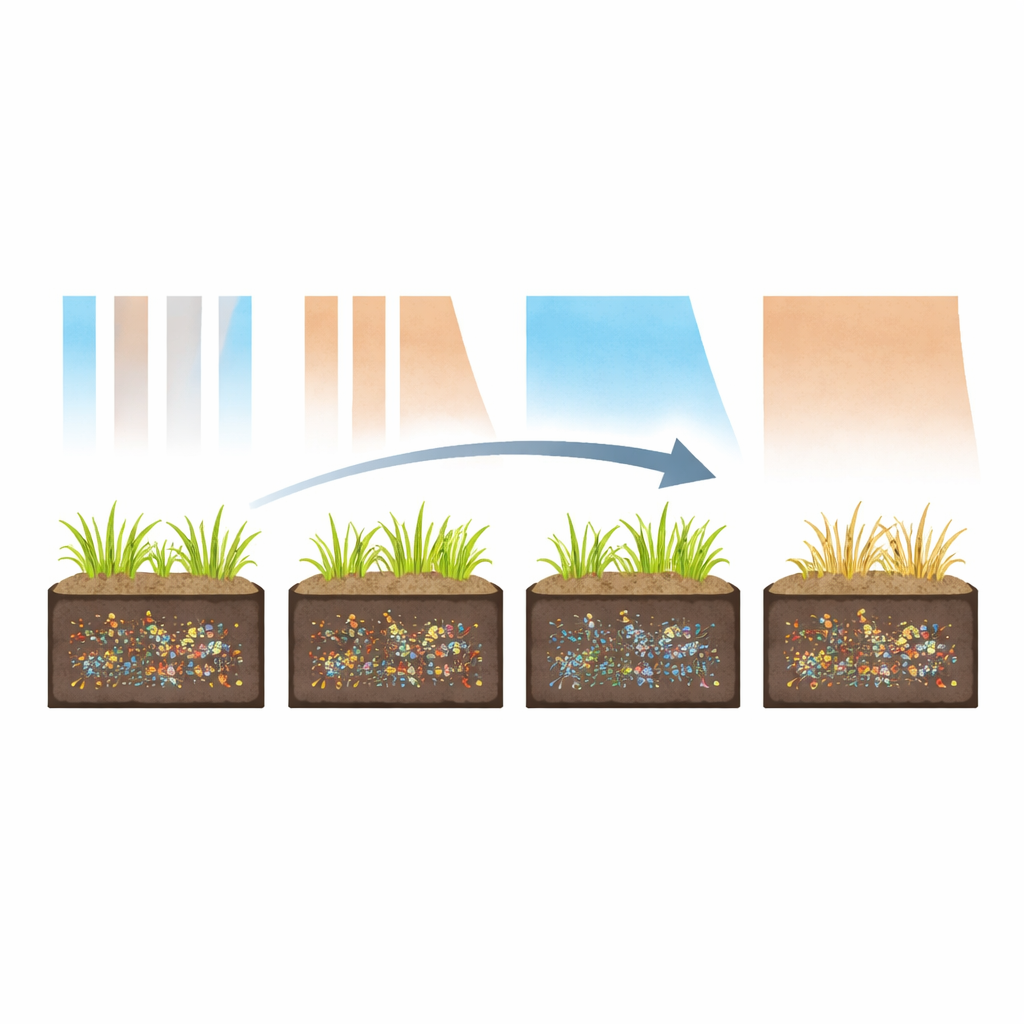
Scientists have observed that in many mid‑latitude regions, weather is becoming more “persistent”: dry periods and rainy periods each last longer before switching. Rather than simply getting a bit more or less annual rainfall, ecosystems now face extended droughts followed by prolonged soaking, and back again. Because water availability strongly controls how soil life breathes, grows, and breaks down organic matter, the researchers wanted to know how such drawn‑out weather patterns affect soil microbes over longer timescales, across many dry–wet cycles.
A Controlled Test Bed for Future Weather
To tackle this question, the team set up grassland communities in large outdoor containers filled with sandy soil and planted with common temperate grassland species. They then imposed eight different watering patterns, all receiving the same total amount of water but with very different rhythms: some shifted between dry and wet every day or every few days, while others stayed dry or wet for up to 60 days at a time before switching. These patterns mimic a spectrum from current conditions to possible future, more persistent weather. The experiment ran for two growing seasons, and soils were sampled three times—after about four months, then mid‑way through the second season, and again at the end. At each sampling, the team measured the makeup of bacterial and fungal communities using DNA sequencing, along with plant growth and soil moisture.
Microbial Communities Drift Further Apart Over Time
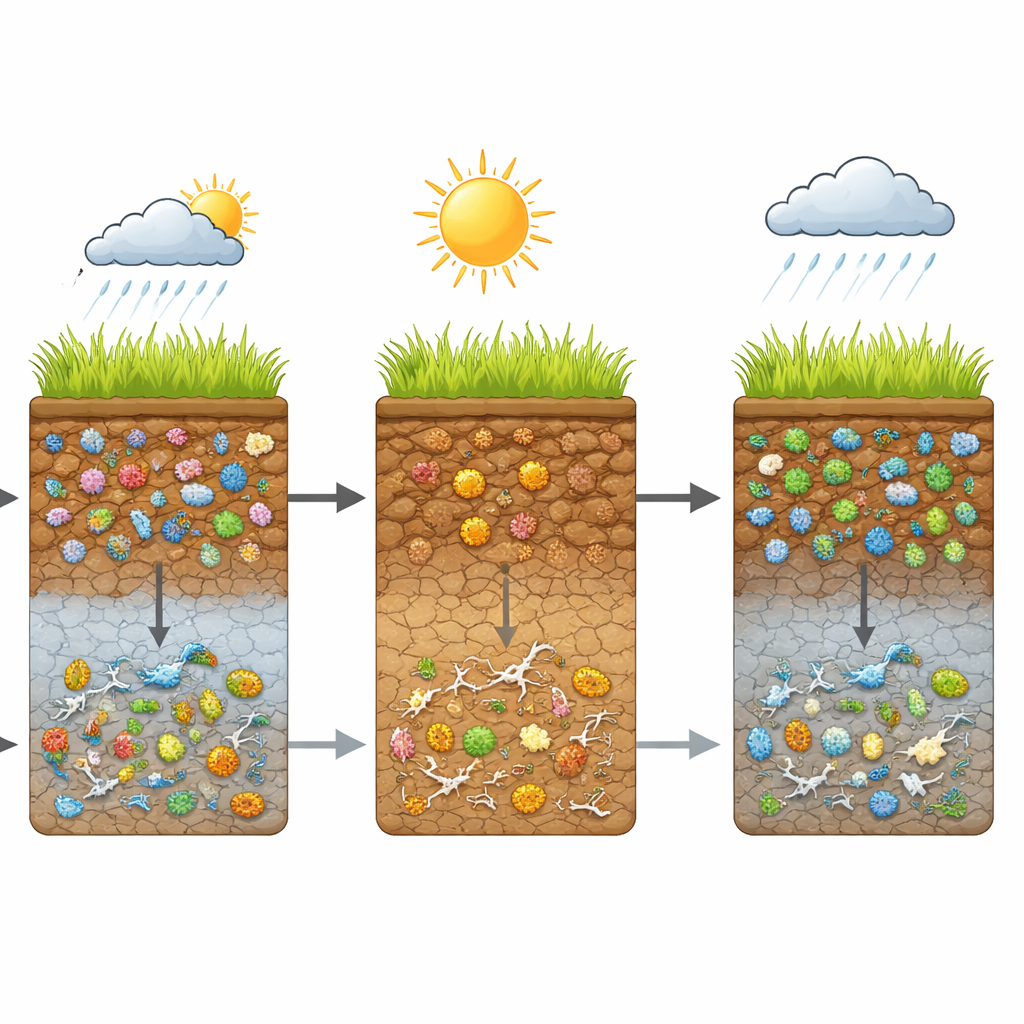
The clearest pattern to emerge was that the influence of persistent weather strengthened over time. In the first season, differences in microbial communities among the various watering treatments were modest. By the second year, bacteria and fungi under different dry–wet patterns had become much more distinct from one another. This suggests that microbes do not immediately reorganize when weather patterns change; instead, repeated long dry or wet spells gradually filter which species can cope, leading to increasingly different communities across treatments. At the same time, plant biomass declined in the second year and became less sensitive to the watering pattern, likely because nutrients became more limiting. As plants lost vigor, their ability to buffer soil microbes against climate stress appears to have weakened, allowing the effects of persistent weather to show through more strongly.
Stability, Memory, and Different Microbial Strategies
The researchers also examined how much microbial communities changed through time within each watering pattern. For most microbes, temporal swings between sampling dates became smaller as dry or wet spells grew longer, indicating that strong, steady stress favors a set of hardy organisms that change little once established. This fits with the idea of an ecological “memory”: after repeated droughts, communities become dominated by drought‑tolerant types that are less easily shaken by subsequent events. Bacteria and fungi, however, did not behave identically. Bacteria, with their rapid growth and short generation times, showed more complex patterns and were especially sensitive to whether soils were sampled at the end of a dry or a wet phase. Fungi, which tend to grow more slowly and form drought‑resistant filaments, adjusted more gradually and were less affected by the immediate wet or dry status at sampling, instead reflecting longer‑term conditions.
What This Means for Grasslands and Climate
Overall, the study shows that as climate change stretches out dry and wet spells, the resulting weather persistence can gradually but decisively reshape the unseen world of soil microbes in grasslands. Over time, communities become more different from one another across weather regimes but less changeable within a given regime, especially when plant growth declines. Because these microbes underpin nutrient cycling, plant productivity, and soil carbon storage, such shifts may have far‑reaching consequences for how grassland ecosystems function in a more volatile climate. While this experiment used controlled containers, the findings point to an important message: not just how much rain falls, but how it is spaced in time, will help determine the future health and resilience of soils.
Citation: Li, L., Radujković, D., Nijs, I. et al. Effect of increasing persistence of alternating drought and rainfall events on grassland soil microbes intensifies over time. Commun Earth Environ 7, 340 (2026). https://doi.org/10.1038/s43247-026-03355-9
Keywords: soil microbes, grassland ecosystems, drought and rainfall, climate change, weather persistence