Clear Sky Science · en
Nitrate stable isotopes complement subarctic new production estimates
Why This Ocean Story Matters
The Labrador Sea, a cold arm of the North Atlantic between Canada and Greenland, is a key engine in Earth’s climate and a rich feeding ground for marine life. Every spring, microscopic plants called phytoplankton bloom there, drawing carbon dioxide out of the atmosphere and into the ocean. This study asks a deceptively simple question: during that bloom, how much of the growth is powered by “new” nutrients arriving from the deep ocean versus “recycled” nutrients already in the sunlit layer? The answer helps us gauge how efficiently this region can lock carbon away in the deep sea as the climate warms.
The Ocean’s Seasonal Food Budget
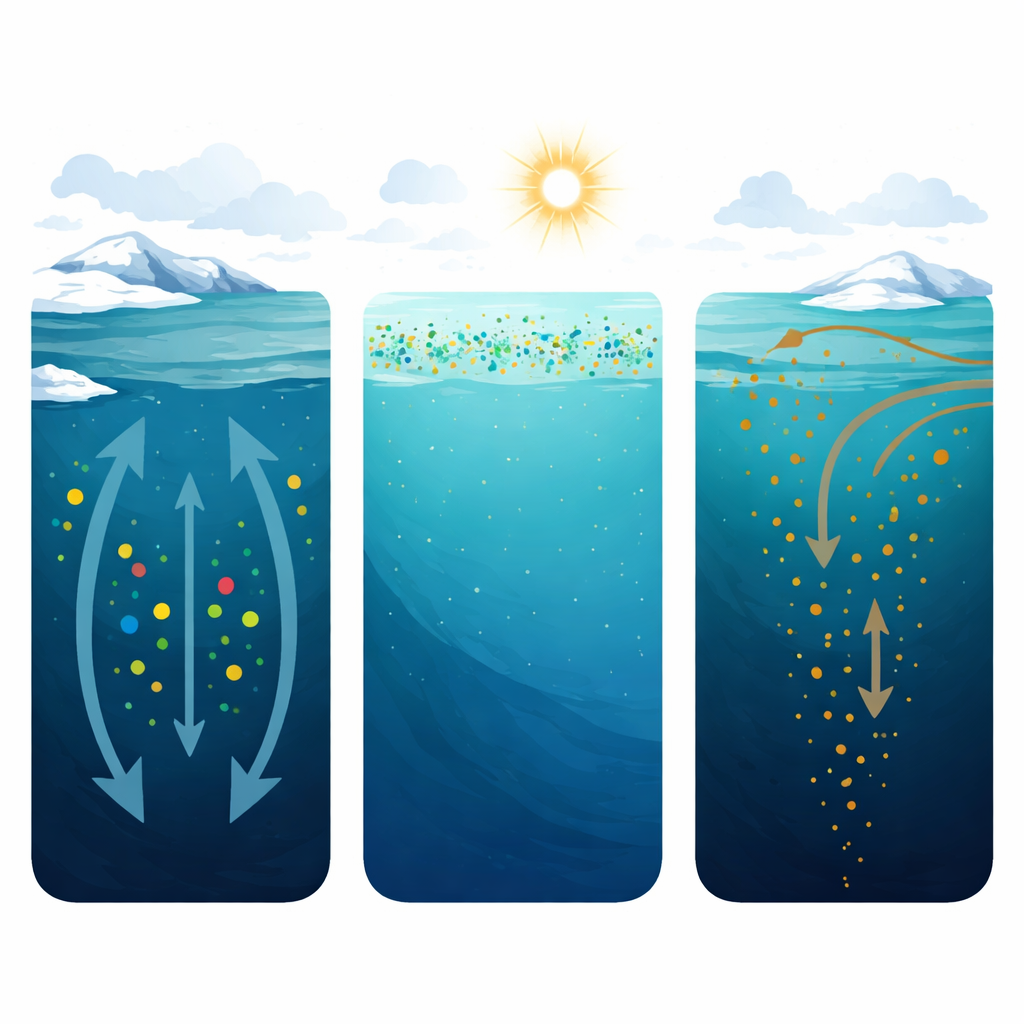
In winter, powerful storms stir the Labrador Sea, bringing nutrient-rich deep water up toward the surface. When sunlight returns in spring, phytoplankton use these nutrients—especially nitrate, a key form of nitrogen—to grow rapidly. Scientists call growth fueled by nitrate coming from below “new production,” because it can lead to a net export of organic matter and carbon to depth as particles sink. Growth fueled by nitrogen that has already cycled through surface organisms is “regenerated production,” which mostly keeps carbon circulating near the surface instead of storing it in the deep ocean. Tracking the balance between these two modes of growth is essential for understanding both marine food webs and long‑term carbon storage.
Using Natural Tracers as Detective Tools
Measuring this balance directly in the field is difficult, because standard experiments only capture what happens over a day or so, while blooms unfold over weeks. The authors tackled this by combining traditional nitrate measurements with natural “fingerprints” carried by that nitrate: subtle differences in the ratios of nitrogen and oxygen isotopes. Different processes—such as phytoplankton uptake, regeneration of nitrate from sinking organic matter, and mixing of deep water upward—leave distinct isotopic imprints. By building a one‑dimensional computer model of the upper 100 meters of the Labrador Sea and tuning it until it matched both the observed nitrate drawdown and these isotopic patterns during the 2022 spring bloom, the researchers could tease apart overlapping processes that concentrations alone cannot resolve.
New Growth Versus Recycling in the Spring Bloom
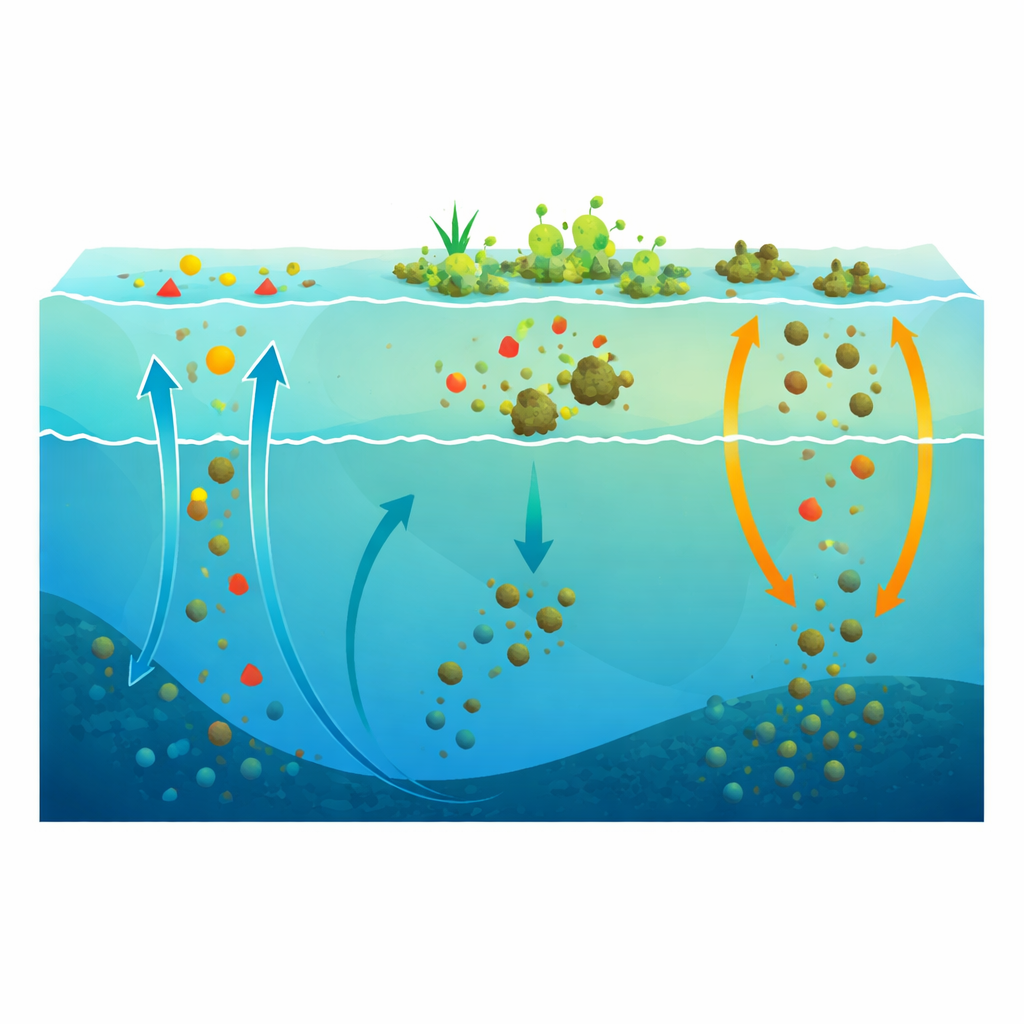
The model shows that most of the season’s phytoplankton growth was indeed powered by nitrate supplied from outside the surface layer, either present before the bloom or mixed up from below during the season. This “new production” closely matched simple estimates based on how much nitrate disappeared from the surface over the roughly 50‑day bloom. However, the isotope data revealed that a non‑trivial fraction of growth—between about 4% and 38%, depending on model assumptions—was supported by nitrate regenerated within or just below the sunlit layer. Vertical resupply from depth enhanced the total amount of new production beyond what would be inferred from drawdown alone, while regeneration helped sustain productivity as nutrients became scarcer.
A Delicate Dependence on Small Details
The study also highlights how sensitive productivity estimates are to a subtle parameter: how strongly phytoplankton prefer lighter versus heavier nitrogen atoms when they take up nitrate. This preference, known as isotopic fractionation, varies with the makeup of the plankton community. During the 2022 bloom, the data suggest a larger role for small cells such as Phaeocystis, which likely fractionate less than diatoms typically do. When the model assumed stronger fractionation, it could only match the observations by invoking much higher upward nutrient fluxes and total production than are considered realistic for the region. That sensitivity underscores the need to measure and carefully choose these isotope‑related parameters when using this kind of modeling framework.
What This Means for Climate and the Future Ocean
Put simply, the authors find that during the 2022 Labrador Sea spring bloom, most of the phytoplankton growth drew on fresh nitrate from outside the surface layer, meaning it had strong potential to export carbon to the deep ocean. Regenerated nitrate played an important but secondary role in supporting additional growth, especially later in the season, and there are likely other recycled forms of nitrogen not fully captured by nitrate isotopes alone. As climate change alters winter mixing and freshwater inputs in the subarctic Atlantic, methods that combine nutrient concentrations with stable isotope “fingerprints” and robotic float observations will be crucial for tracking how efficiently these northern seas continue to act as a planetary carbon sink.
Citation: Dempsey, B., Buchwald, C. Nitrate stable isotopes complement subarctic new production estimates. Commun Earth Environ 7, 355 (2026). https://doi.org/10.1038/s43247-026-03353-x
Keywords: Labrador Sea, new production, nitrate isotopes, phytoplankton bloom, carbon export