Clear Sky Science · en
A perceptual model indicates air pollution-induced shifts in honeybee floral-scent recognition
Why flower smells and city air matter to our food
Many of the fruits, vegetables, and oils we rely on exist thanks to insects that follow invisible scent trails from flowers. This study asks a simple but urgent question: as air pollution alters those scents, can honeybees still recognize the flowers they are looking for, or do their noses get confused in the haze?
Invisible messages between flowers and bees
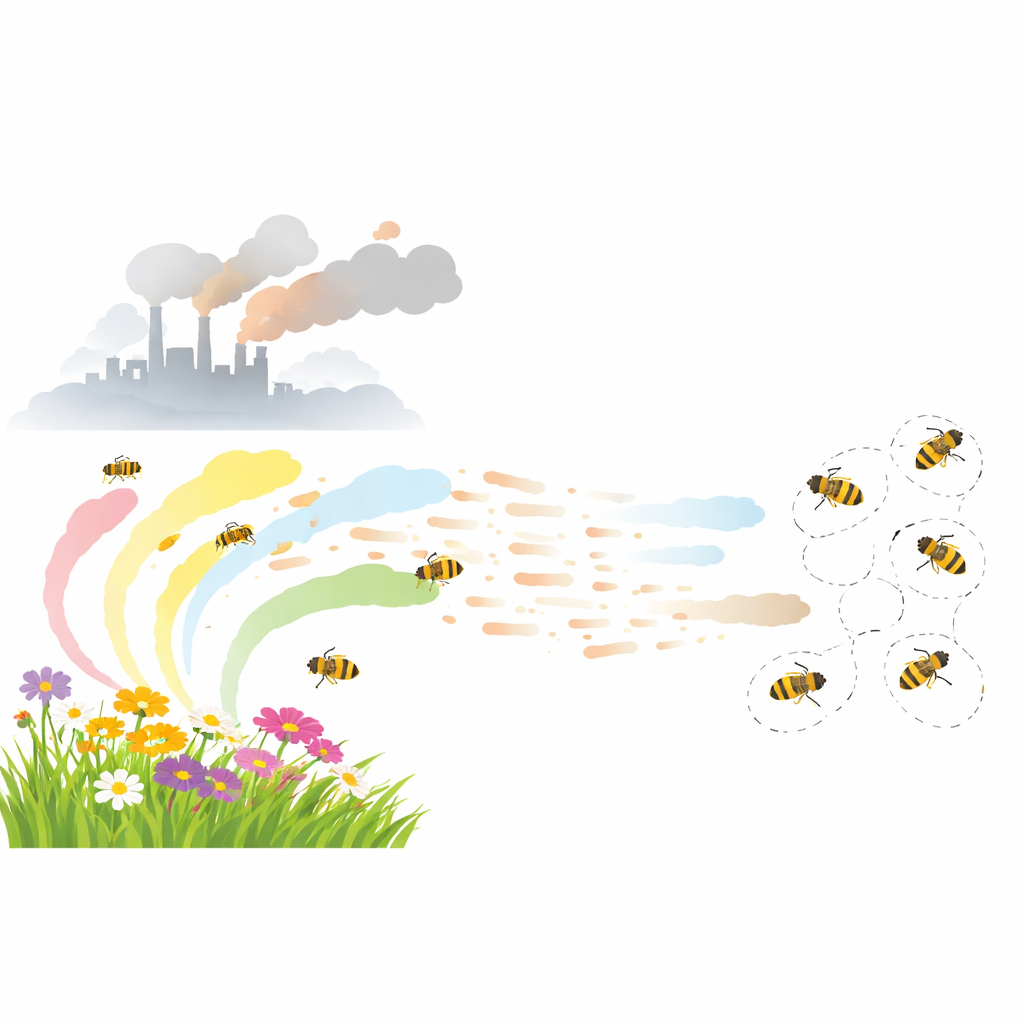
When a bee flies across a field, it does not just see colors—it also follows clouds of scent drifting downwind from blossoms. These floral smells are made of many different airborne chemicals, and together they form a kind of signature that tells a bee which flower it is dealing with and whether a reward like nectar is likely. Because scent can travel farther than sight, these odor signatures are especially important when bees are searching for new patches of food.
How dirty air scrambles these scent signals
Modern air is full of reactive gases such as ozone and chemicals from exhaust. As floral scents move through this polluted air, some of their components are broken down or transformed faster than others. That means the original mix of odor molecules gets reshuffled. Earlier work showed that this can make bees take longer to find flowers or visit them less often, but the impact is not simply about how many molecules disappear. Losing one key ingredient can matter far more than losing several minor ones, making it hard to predict which flowers and pollinators are most at risk.
A new way to measure what bees actually smell
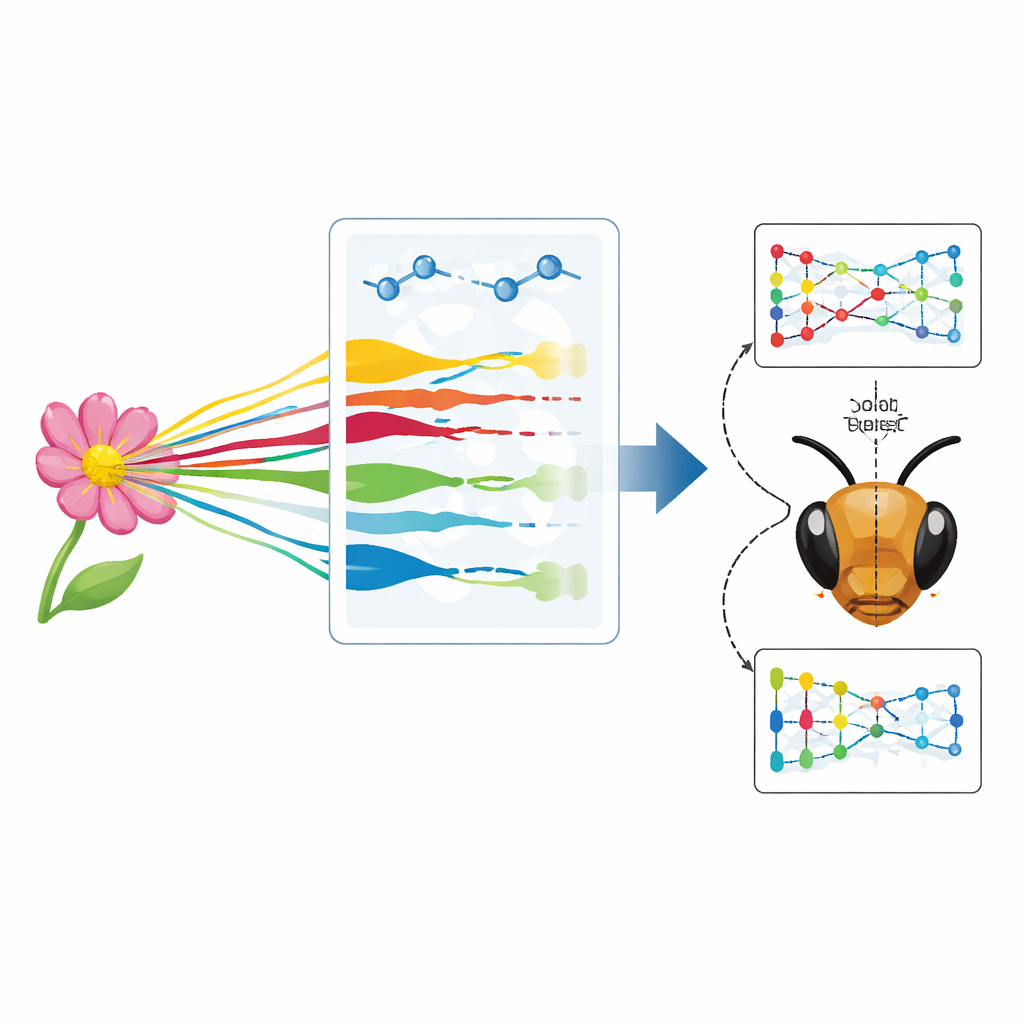
The researchers turned to a perceptual model called “Compounds Without Borders,” which treats a smell not as a list of chemical names but as a pattern of features that a bee’s nose can detect—such as the length of a molecule’s carbon chain or the type of chemical group it carries. Any scent, simple or complex, can be drawn as a multi‑dimensional arrow in this feature space. The angle between two arrows then captures how different those scents would appear to an insect. By re‑analyzing three existing experiments in which honeybees were trained to recognize a clean flower scent and then tested with polluted versions, the authors fine‑tuned this model to better match honeybee brain wiring. In particular, they boosted the impact of losing or gaining entire structural features, reflecting the strong network connections in the bee’s primary smell center.
A tipping point where bees stop recognizing flowers
Once adjusted, the model revealed a striking pattern: when pollution changed a scent’s “angle” by more than about 10–15 degrees in this odor feature space, honeybee responses to the learned smell dropped below half. Beyond that point, bees behaved as if they were smelling something largely unfamiliar. This gave the team a practical disruption threshold they could apply without running new animal tests each time. They then used published data on how quickly different floral scent components react with ozone and hydroxyl radicals to simulate how the overall scent signature of four major bee‑pollinated crops—canola, white mustard, strawberry, and apple—would evolve over an hour under varying ozone levels.
Which crops are most at risk in polluted air?
The simulations showed that not all crop scents are equally fragile. Canola’s scent signature shifted beyond the 15‑degree threshold in as little as three to five minutes under high ozone, meaning its odor trail could become unrecognizable within a few hundred meters, depending on wind. White mustard also crossed this threshold, though more slowly, while strawberry changed at an intermediate rate. Apple blossoms, by contrast, produced scents built from molecules that react more slowly with ozone, keeping their recognizable structure much longer even in dirtier air. Intriguingly, the model also revealed that two flowers whose chemical mixes change by similar amounts on paper may look very different to a bee’s nose, because what matters is which structural features in the odor space are lost.
What this means for bees, crops, and clean air
In everyday terms, the study shows that air pollution does not just fade flower smells—it can subtly rewrite them until bees no longer recognize the “brand logo” of certain crops. By identifying a scent‑change tipping point that matches honeybee behavior, and by showing which crop scents cross that line fastest, the Compounds Without Borders approach offers a new tool for predicting where and when pollination services are most vulnerable. Used alongside field measurements, this model could help farmers, planners, and policymakers design cleaner air and planting strategies that keep bee navigation reliable—and, in turn, help secure the harvests that depend on these tiny, scent‑guided workers.
Citation: Sprayberry, J.D.H., Girling, R.D., Ryalls, J.M.W. et al. A perceptual model indicates air pollution-induced shifts in honeybee floral-scent recognition. Commun Earth Environ 7, 357 (2026). https://doi.org/10.1038/s43247-026-03351-z
Keywords: pollination, honeybees, air pollution, floral scent, crop yield