Clear Sky Science · en
Colony formation sustains the global competitiveness of nitrogen-fixing Trichodesmium under ocean acidification
Why tiny ocean drifters matter for our future seas
Far from shore, vast stretches of blue water depend on microscopic life to supply the nutrients that fuel entire food webs. Among the most important of these microbes is Trichodesmium, a thread-like cyanobacterium that pulls nitrogen gas from the air and makes it usable for other organisms. As human-driven carbon dioxide emissions make the oceans more acidic, scientists worry that this natural fertilizer factory could slow down. This study asks a subtle but crucial question: does acidification hurt all Trichodesmium in the same way, or can some forms adapt and even thrive?
Two lifestyles of a marine fixer
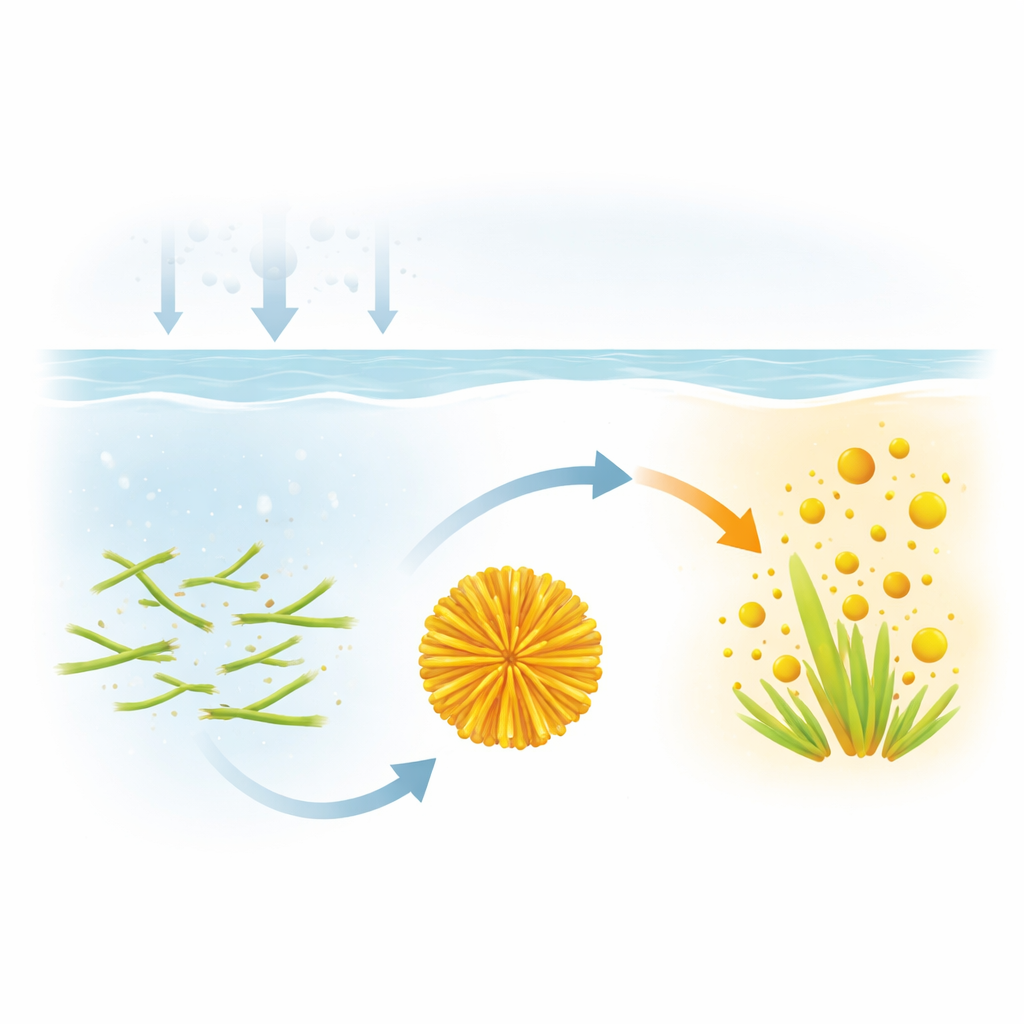
Trichodesmium lives in the sunlit surface ocean in two main forms. Sometimes it drifts as individual filaments, each a chain of cells. At other times, many filaments clump together into visible colonies shaped like puffs or tufts. These colonies create their own miniature world: inside them, oxygen, acidity, and nutrients can be very different from the surrounding seawater. Earlier experiments found that free filaments often grow more slowly and fix less nitrogen in more acidic water, while colonies sometimes show little change or even improve. To untangle this puzzle, the authors built detailed computer models that follow the daily cycles of light, photosynthesis, respiration, and nitrogen fixation in both single filaments and colonies, while also tracking how chemistry changes in and around them.
How acidification strains solitary filaments
The model shows that when seawater becomes more acidic, free Trichodesmium filaments pay several hidden costs. The enzyme that fixes nitrogen works less efficiently at lower pH, so the cells must invest more of their limited iron into that enzyme just to maintain activity. At the same time, acidification disrupts the tiny proton gradients that power the cell’s energy factories, cutting down the production of ATP, the chemical fuel that drives both carbon and nitrogen fixation. Because the filaments have less energy, they store fewer carbohydrates early in the day. Later, they struggle to burn enough of this stored carbon to keep oxygen low inside the cell, a condition needed to protect the oxygen-sensitive nitrogen-fixing machinery. Together, these stresses reduce growth and nitrogen fixation in solitary filaments by roughly one quarter in the simulations.
Inside colonies, a shifting chemical shelter
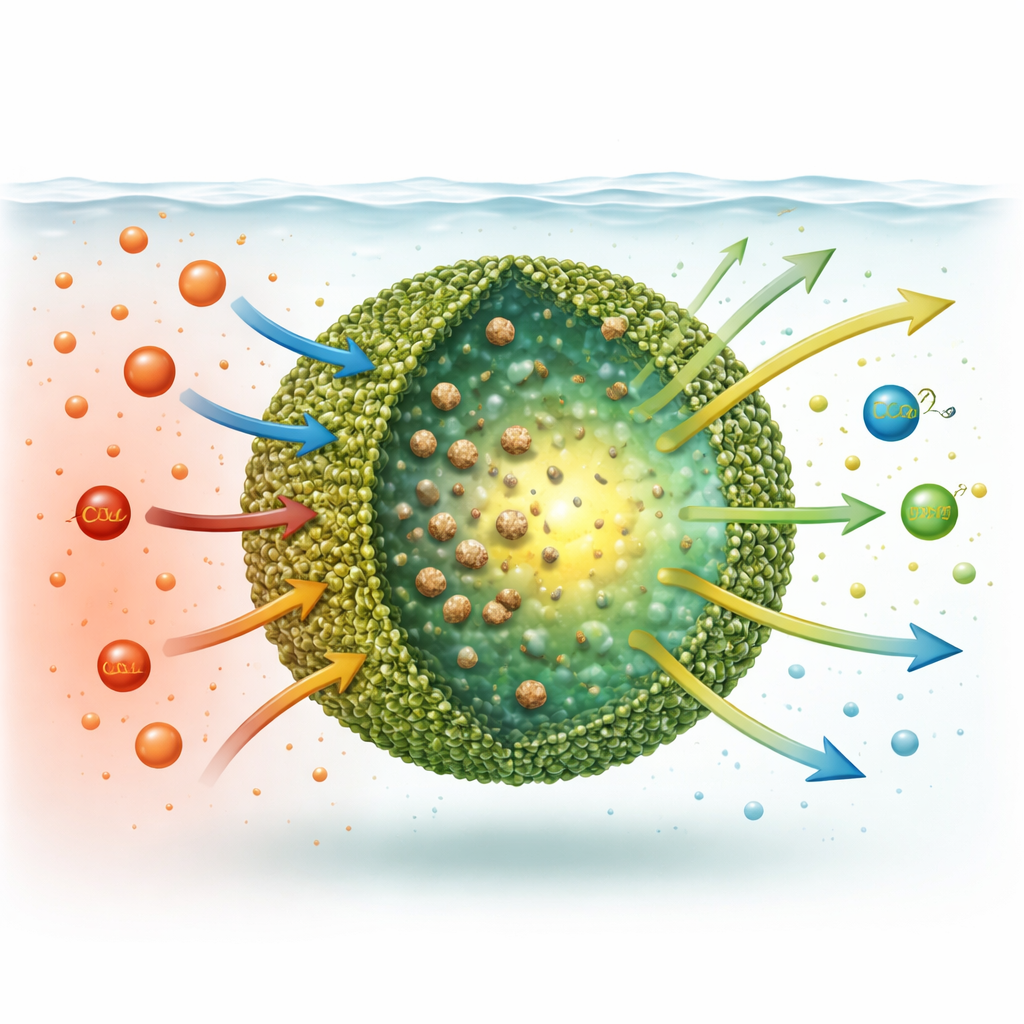
In colonies, the story is more complex. Their dense interior consumes carbon dioxide and oxygen in ways that create strong gradients from the center to the edge. Early in the day, intense photosynthesis inside the colony can raise local pH and draw down dissolved carbon, partly offsetting the external acidification. Later, when respiration dominates, oxygen is drawn down and carbon dioxide rises in the colony core, helping to maintain a low-oxygen, nitrogen-fixing niche. The model shows that acidification still weakens the nitrogen-fixing enzyme, but colonies are less harmed than free filaments because their microenvironment moderates pH swings and can ease shortages of inorganic carbon in their centers. Even so, these internal effects alone were not enough to reproduce the strongly positive responses to acidification seen in some field studies.
Hidden helpers: metals, toxins, and dust
To bridge the gap between model and observations, the authors explored additional processes that operate only, or mainly, in colonies. Trichodesmium colonies are known to trap iron-rich dust particles and host partner microbes that help dissolve and mobilize that iron. Acidification, along with extra hydrogen gas released by the cyanobacteria, can speed up this iron release, giving colonies more of the metal they need for both photosynthesis and nitrogen fixation. At the same time, colonies can accumulate copper and ammonia to levels that are toxic to Trichodesmium. Lower pH converts some of these harmful forms into safer ones, easing their impact on the cells’ energy systems. When the model included both enhanced iron supply and reduced metal and ammonia toxicity, colonies switched from being slightly harmed by acidification to being neutral or even helped, matching real-world measurements in dust-rich regions.
What this means for the global ocean
Using an Earth system model, the authors extended their results to the world’s tropical and subtropical oceans. They estimate that, under a mid-range climate scenario, nitrogen fixation by free Trichodesmium filaments could drop by about 16 percent by the end of this century. Colonies, however, are projected to increase their nitrogen fixation by roughly 19 percent on average, especially in regions with plentiful iron. When both lifestyles are considered together, the global total of nitrogen fixed by Trichodesmium may remain nearly unchanged. To a lay observer, this means that although ocean acidification poses real challenges to these microbes, their tendency to form colonies—tiny chemical islands that alter metals, toxins, and acidity—may allow the overall "fertilizer" supply they provide to the open ocean to hold steady, preserving a key support for marine food webs.
Citation: Luo, W., Eichner, M., Prášil, O. et al. Colony formation sustains the global competitiveness of nitrogen-fixing Trichodesmium under ocean acidification. Commun Earth Environ 7, 300 (2026). https://doi.org/10.1038/s43247-026-03344-y
Keywords: ocean acidification, Trichodesmium, nitrogen fixation, marine microbes, biogeochemical cycles