Clear Sky Science · en
Precipitation and soil moisture coupling constrains subseasonal predictability of a prolonged extreme heatwave
Why this deadly heatwave matters
In the summer of 2022, the Yangtze River Valley in China endured a blistering, weeks-long heatwave that dried rivers, strained power supplies, and threatened crops for hundreds of millions of people. As such extremes become more common in a warming world, we urgently need forecasts that can warn governments and communities weeks in advance. This study asks a deceptively simple question: what really limits our ability to predict such long-lasting heatwaves, even with today’s most advanced weather and climate models?
A record-breaking hot and dry summer
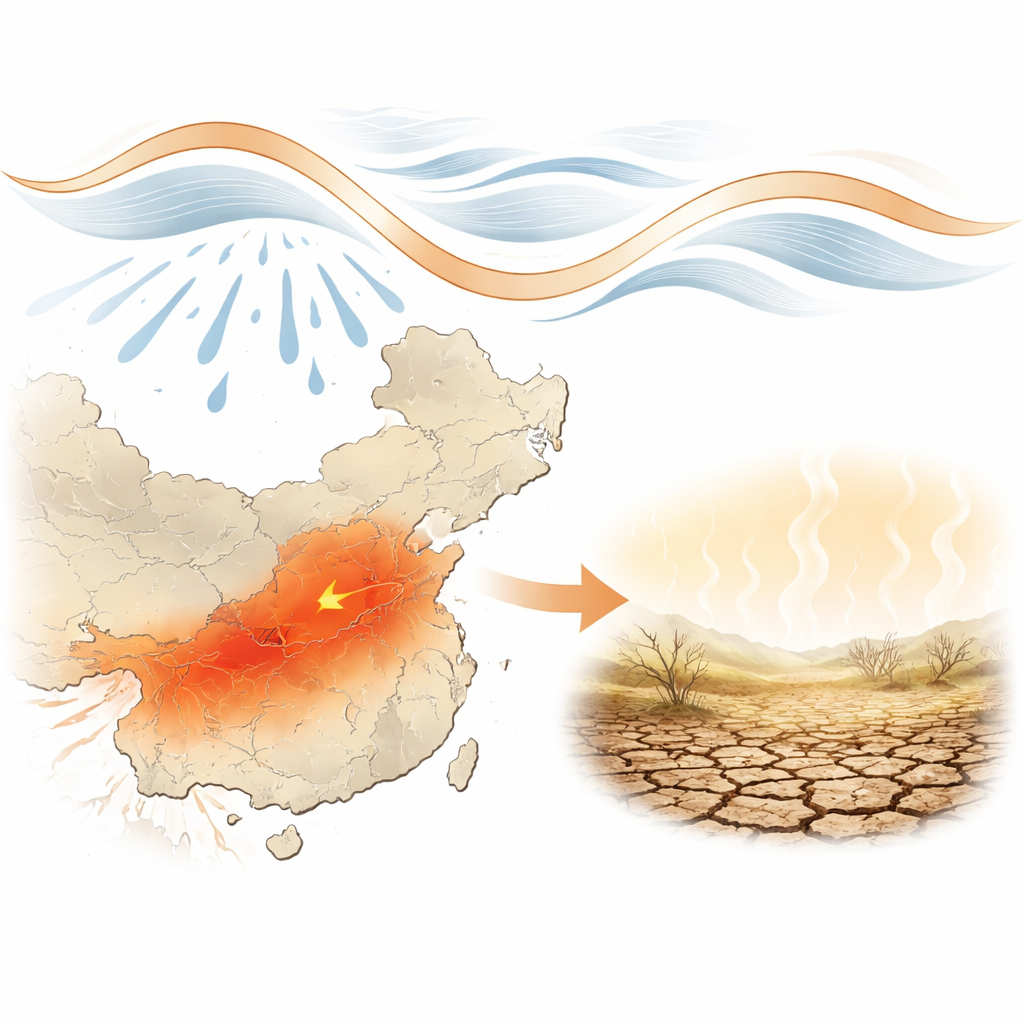
The researchers focus on July and August 2022, when temperatures in the Yangtze River Valley soared far above normal. During the peak in mid-August, daily maximum temperatures were nearly 6 degrees Celsius higher than usual in some areas, a level of heat that almost never occurs in the historical record. At the same time, rainfall nearly vanished, leaving the region with a monthly precipitation shortfall close to 100 millimeters. Together, the intense heat and deep drought formed a classic “compound event,” where different hazards strike at once and amplify each other’s impacts on agriculture, water resources, and human health.
Forecasts that see the heat, but miss its strength
The team evaluated so-called subseasonal-to-seasonal (S2S) forecasts, which aim to predict conditions weeks to months ahead. They analyzed ensemble forecasts from major prediction centers, including the widely used European model. During the 2022 event, these systems did detect that unusually hot conditions were coming, especially a few days before the worst heat. But as the lead time stretched beyond about a week, the models consistently underestimated how extreme the temperatures would become. Even the most accurate forecast group still fell more than 2 degrees Celsius short of the observed peak heat, a large error when dealing with temperatures that push human and infrastructure limits.
Looking beyond winds and pressure patterns
Heatwaves are often linked to large, sluggish high-pressure systems that trap warm air and clear skies over a region. The 2022 Yangtze heatwave displayed such a pattern, with a strong ridge of high pressure over the valley and companion features over Europe and western Asia. The study shows that the European model reproduced these large-scale circulation patterns fairly well for this event, especially at short lead times. When the scientists grouped forecast members according to how hot they predicted the surface would become, they found that differences in these faraway circulation features did not clearly explain why some forecasts were much hotter or cooler than others. In other words, the big atmospheric setup was necessary for the heatwave, but it was not what drove the spread in forecast outcomes.
Rain, soil, and a powerful land–air feedback
The key differences emerged closer to the ground. Forecasts that produced the hottest temperatures also tended to predict less rainfall and drier soils over the Yangtze River Valley. Those that stayed cooler had more rain and wetter ground. Statistical analysis across 20 years of forecasts revealed an unusually tight link in 2022 between maximum temperature and local precipitation, and between precipitation and soil moisture. When the authors built a simple regression model to explain why different ensemble members produced different peak temperatures, removing Yangtze-region rainfall from the model sharply reduced its explanatory power. Soil moisture, after accounting for its dependence on rain, was the next most important factor. Local high-pressure strength and distant circulation features contributed very little to the spread.
A simple model shows how much rain matters
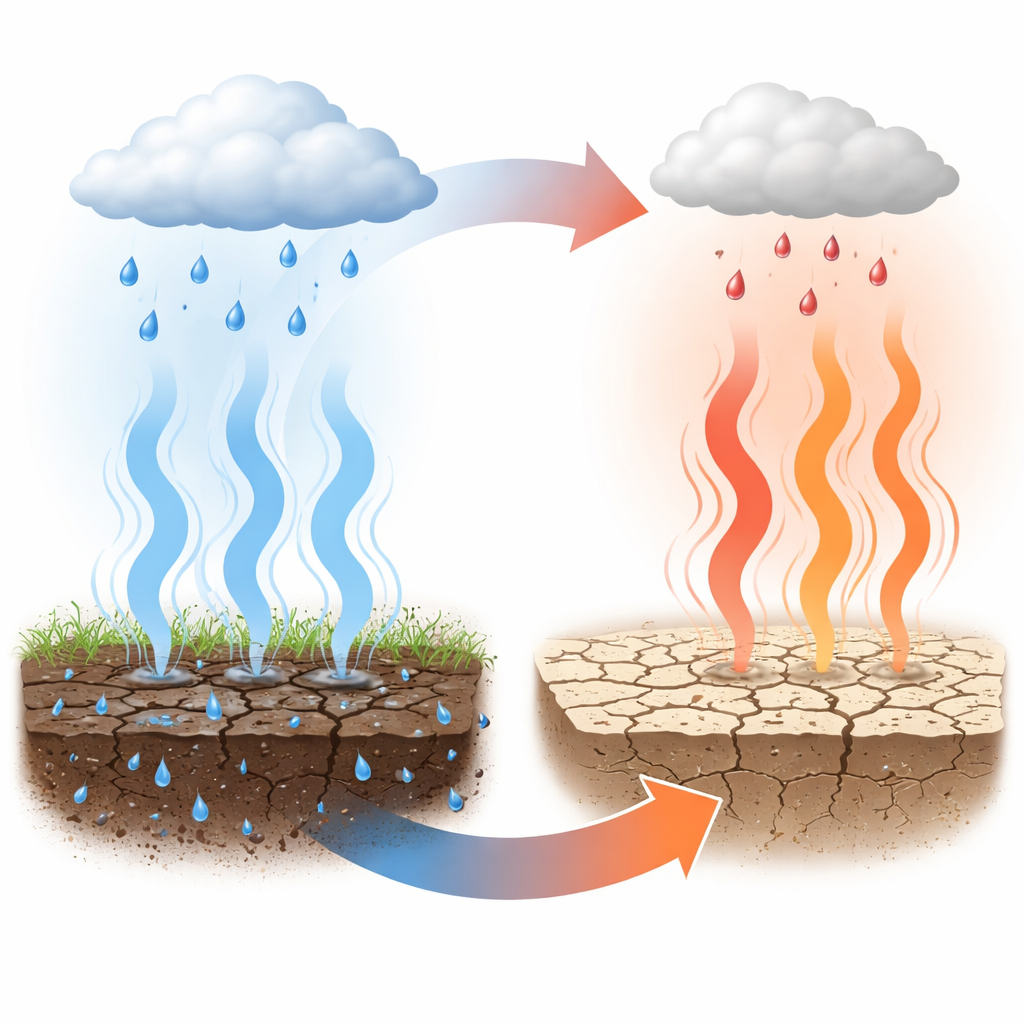
To probe the physics behind these relationships, the researchers used an idealized “heatwave model” that represents how sunlight, rainfall, and soil moisture interact to set surface temperature. Feeding it with precipitation and radiation taken from the real forecasts, they found an especially strong negative link between rain and heat: in the model, doubling rainfall during the peak two weeks would cool the surface by about 4 degrees Celsius, while cutting rainfall in half would add roughly 2 degrees. This asymmetric response reflects a feedback loop: when soils are moist, more of the sun’s energy goes into evaporation, which cools the surface; once soils dry, that energy instead heats the air directly, making further warming easier.
What this means for future heatwave warnings
Overall, the study concludes that for this historic Yangtze River heatwave, the main brake on forecast skill was not the large-scale weather pattern but the way models handle local precipitation and its coupling with soil moisture. Small differences in predicted rain and soil wetness cascaded into large differences in predicted peak temperatures. Improving how S2S models simulate thunderstorms, rainfall patterns, and land–atmosphere exchange may therefore be the most effective route to better advance warning of long-lasting, life-threatening heatwaves—not only in China but in other heat-prone regions worldwide.
Citation: Lv, B., Wang, S., Chen, G. et al. Precipitation and soil moisture coupling constrains subseasonal predictability of a prolonged extreme heatwave. Commun Earth Environ 7, 323 (2026). https://doi.org/10.1038/s43247-026-03341-1
Keywords: heatwaves, subseasonal forecasting, Yangtze River Valley, soil moisture, precipitation