Clear Sky Science · en
Flow composition mediates the sensitivity to air temperature of streams in a Qinghai-Tibetan watershed
Why Mountain Rivers Are Warming
High mountain rivers are often thought of as icy, stable lifelines for wildlife and people downstream. This study shows that their temperatures are changing in more complicated ways than simply "air gets warmer, water gets warmer." By peeling apart how rain, groundwater, snowmelt, and glacier melt each feed a major river system on the Tibetan Plateau, the researchers reveal how these hidden water sources can either amplify or soften the effects of climate change on streams and the creatures that depend on them. 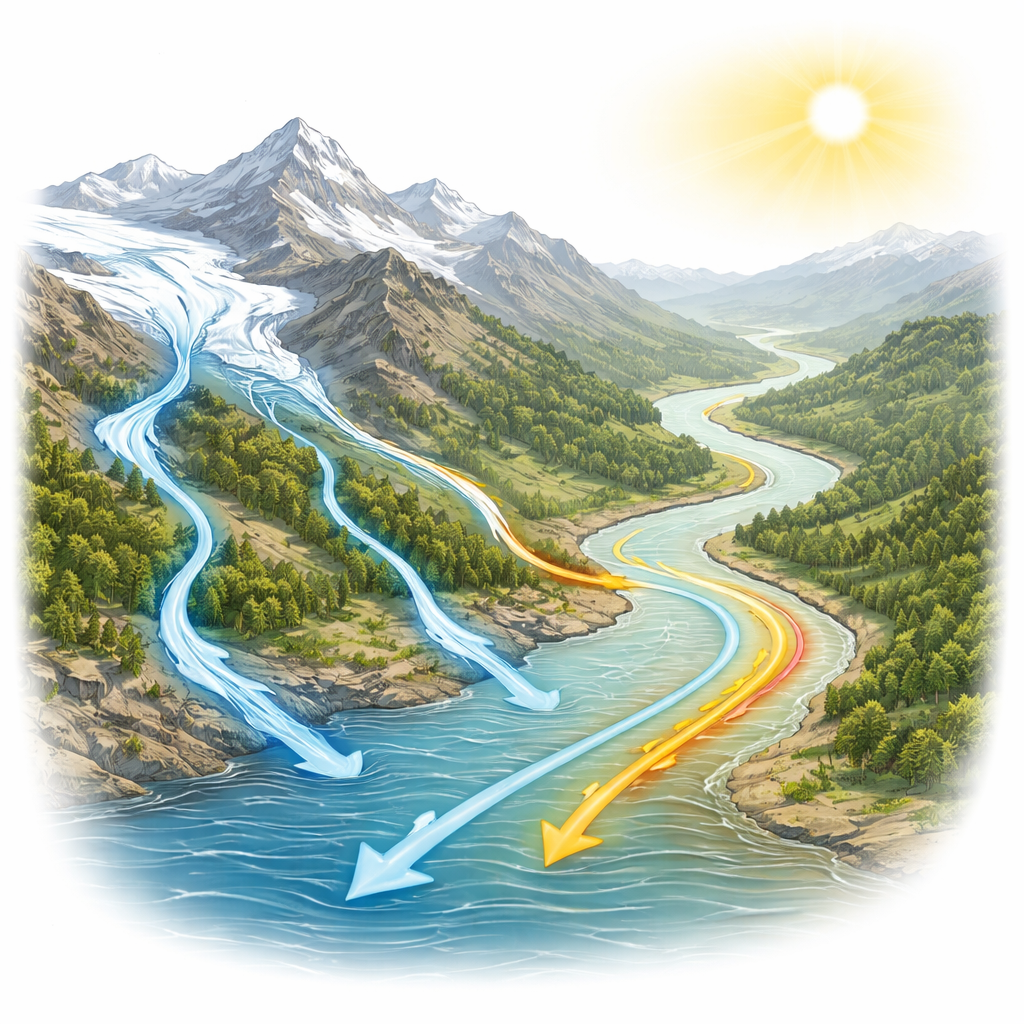
Where the Story Takes Place
The research focuses on the upper Jinsha River Basin, a huge high‑altitude watershed on the southeastern Tibetan Plateau that ultimately feeds the Yangtze River. This region spans deep valleys and towering peaks, with nearly 1,800 glaciers scattered across its slopes. Winters are cold and dry, while summers bring monsoon rains. In the headwaters, snow and ice play a large role; farther downstream, rain dominates. This mix of water sources makes the basin an ideal natural laboratory for understanding how mountain rivers respond as the climate becomes warmer and wetter.
How the Scientists Followed the Water
To untangle these influences, the team built an advanced computer model that simulates both water flow and temperature across the entire basin. They combined weather data, maps of land, soil, and glaciers, and records from four river‑monitoring stations collected between 1990 and 2023. They also sampled isotopes—natural “fingerprints” in water—from rain, rivers, groundwater, snowmelt, and glacier melt to check how well the model captured the true mix of sources. By tracking not just how much water each source contributed, but also how warm or cold that water was, they were able to estimate how much each ingredient shaped the final stream temperature.
What Controls River Temperature Today
The results overturn the simple idea that air temperature alone governs how warm a river becomes. On average, air temperature explained about 43% of stream temperature, while runoff sources collectively explained around 57%. Among these, water from rainfall had the strongest warming effect, especially from late spring through summer, because it typically flows over sun‑heated ground before reaching the river. Groundwater, which stays relatively mild year‑round, dominated in winter and early spring, helping to keep streams from becoming extremely cold. In the glacier‑fed headwaters, meltwater from ice and snow provided notable cooling in the warm season, slightly counteracting summer heat. However, snowmelt’s influence was brief and small when viewed over the whole year.
How Future Climate Will Reshape the Mix
Looking ahead to the rest of the century under various climate scenarios, the model projects that both air temperature and rainfall will increase. Overall river flow is expected to rise, but its composition will shift. The share of runoff coming directly from rainfall will decline somewhat, even as total rainfall‑fed flow grows, because more water will infiltrate into the ground and reappear later as groundwater. Groundwater itself is projected to grow dramatically and to become much more important for stream temperature—its thermal contribution could more than double, particularly in winter and early spring. Glacier melt will continue to add cool water in headwater regions and may partly soften future summer warming there, while the role of snowmelt will generally shrink and become more concentrated in shorter seasons. 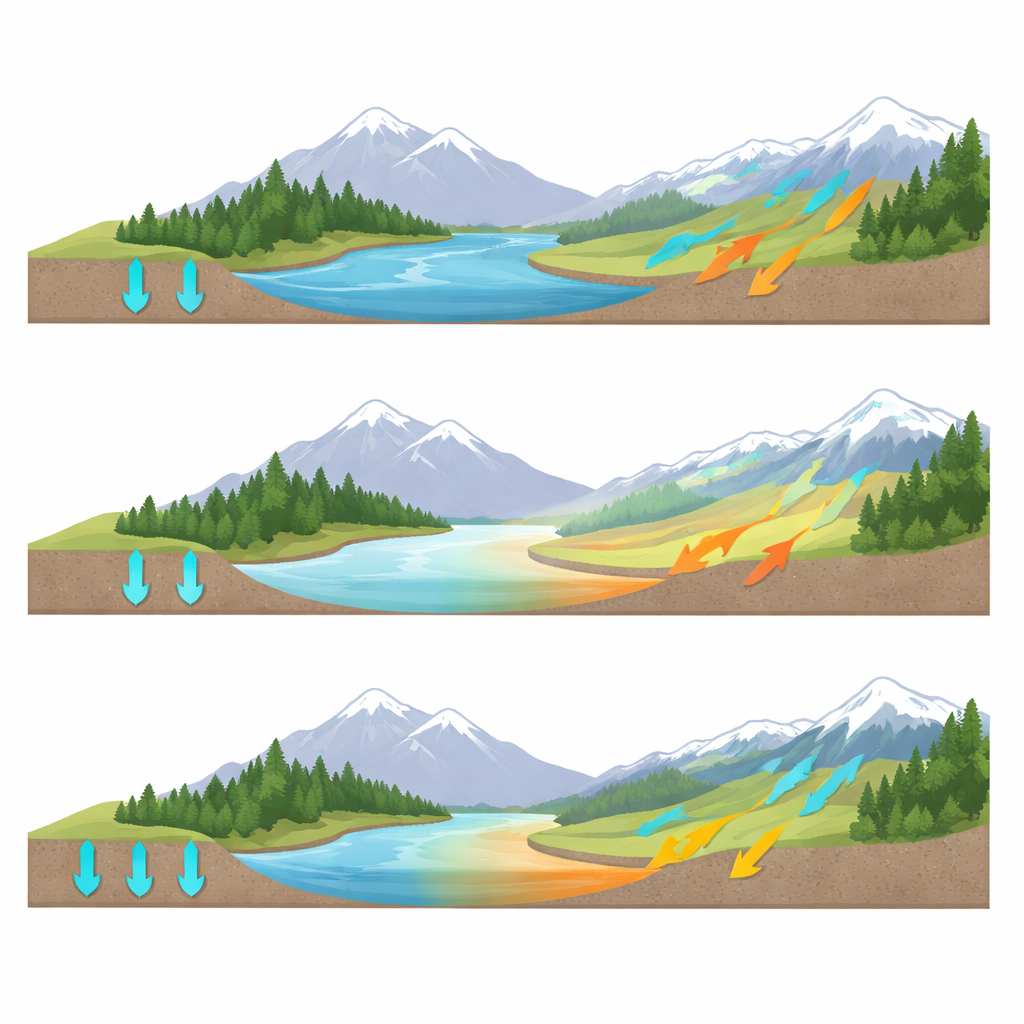
Why These Changes Matter for Life in Rivers
Warmer streams can lose oxygen and push cold‑water fish and other sensitive species beyond their comfort zones. The study suggests that in this Tibetan watershed, winter and spring warming will be driven increasingly by groundwater, not just the air above. At the same time, cool glacier melt and, to a lesser extent, groundwater may offer local thermal refuges in summer—patches of relatively cooler water that could help some species survive heat waves. Because similar high‑mountain river systems supply water to hundreds of millions of people across Asia, understanding this delicate balance between air temperature and the changing mix of water sources provides an essential guide for predicting ecological risks and planning conservation in a warming world.
Citation: Wei, M., Feng, T., Chen, Q. et al. Flow composition mediates the sensitivity to air temperature of streams in a Qinghai-Tibetan watershed. Commun Earth Environ 7, 327 (2026). https://doi.org/10.1038/s43247-026-03340-2
Keywords: stream temperature, Tibetan Plateau, runoff components, climate change, alpine rivers