Clear Sky Science · en
Reversible copper coordination redirects pyrolysis products in waste polyurethane enamelled copper wire
Turning Old Wires into New Resources
Every phone charger, motor and appliance hides a web of thin copper wires wrapped in plastic-like coatings. As millions of these cables reach the end of their lives, they become a fast-growing stream of electronic waste. This study explores how we can recover copper and useful carbon-based products from one common kind of coated wire by heating it in the absence of oxygen—and reveals that the copper itself quietly helps steer how the plastic breaks down.
Why Copper Wires Are Hard to Recycle
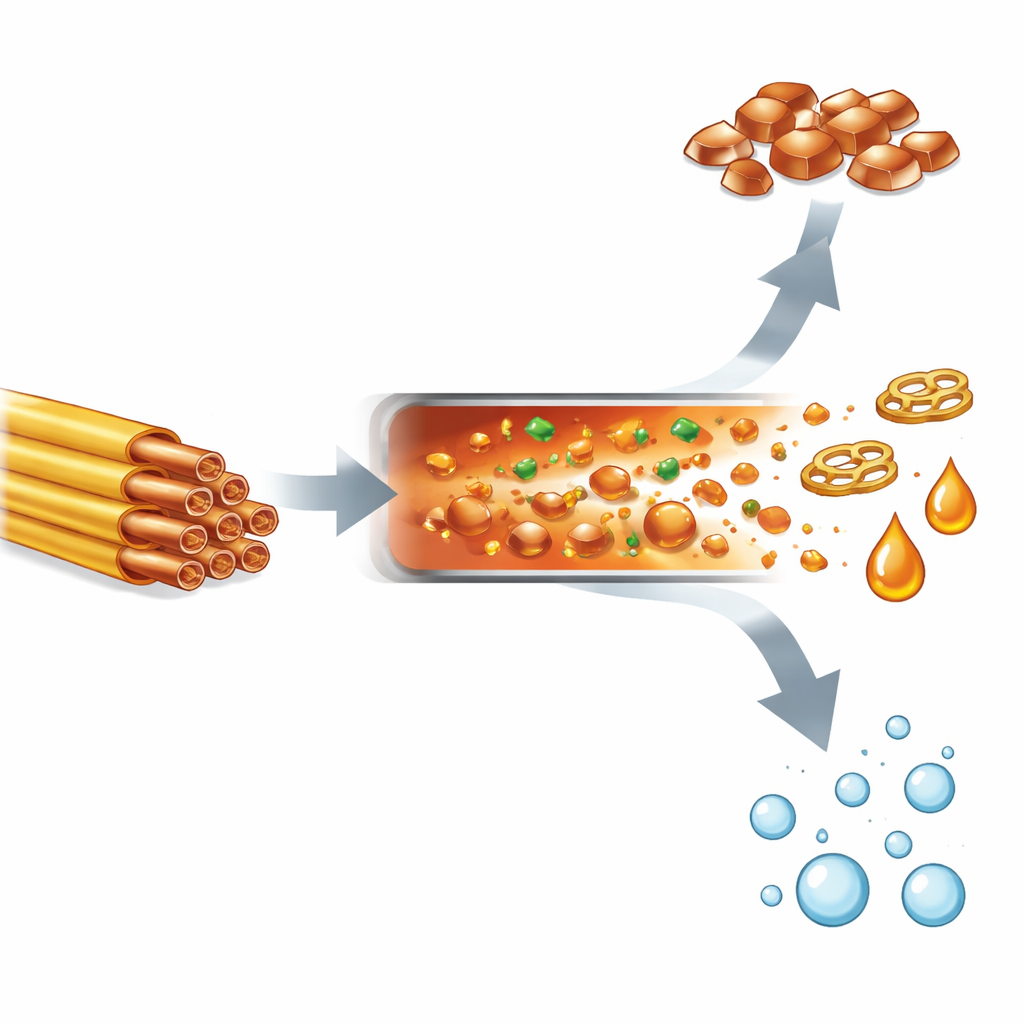
Copper is vital for electric vehicles, renewable power and electronics, yet new copper ore is limited and demand is soaring. Enamelled copper wires, widely used in motors and electronics, are especially challenging to recycle because the copper core is tightly wrapped in a tough polyurethane coating. Traditional recycling often burns off this coating or strips it mechanically, wasting the carbon-rich material and risking toxic emissions. Cleaner methods based on "pyrolysis"—carefully controlled heating without oxygen—offer a way to convert the coating into gases and oils while keeping the copper, but until now the metal’s true role in this process has been poorly understood.
Watching the Coating Fall Apart Step by Step
The researchers heated pieces of polyurethane enamelled wire in nitrogen and tracked how their mass changed with temperature. They found a repeatable three-stage pattern: a gentle initial phase, a rapid main breakdown, and a slower final phase where the remaining material reorganizes into more stable forms. By analysing how fast each stage proceeded at different heating rates, they calculated how the energy barriers to decomposition changed as more of the coating converted. These barriers rose sharply in the late stage, consistent with a shift from simple bond breaking to more complex rearrangements and char formation. Crucially, when they compared wires with copper to similar material without copper, the copper-containing samples reached the same level of breakdown at noticeably lower temperatures, even though they left much more solid residue. This shows that copper is not just a passive lump of metal; it actually lowers the hurdles that the reactions must clear.
Following the Chemical Fingerprints
To see what kinds of molecules were produced at different temperatures, the team fed the vapours from pyrolysis into a combined gas chromatograph and mass spectrometer. They discovered that copper consistently increased the share of simple aromatic compounds such as benzene and reduced oxygen-rich molecules like phenols. As the temperature rose from 300 to 600 °C, light fragments became more common and heavier compounds declined, while multi-ring aromatics grew more abundant. Infrared spectroscopy of the solid coating before and after heating showed that bonds involving oxygen and nitrogen were preferentially broken, and new signals appeared that hinted at temporary bonding between these atoms and copper. Together, these measurements painted a picture in which copper shifts the balance away from early gas release and towards the formation of aromatic-rich liquids and finely structured carbon.
How Copper Quietly Guides the Chemistry
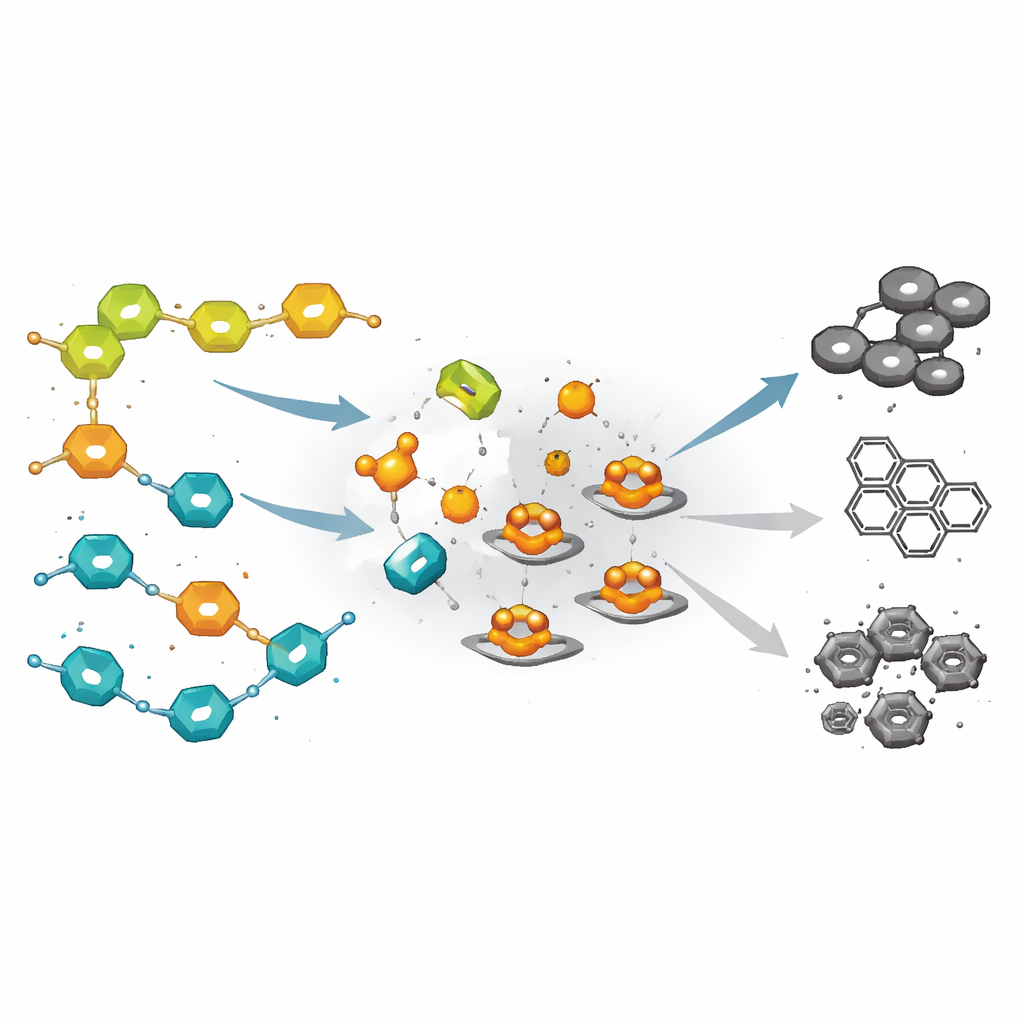
To explain this behaviour at the molecular level, the authors built computer models of the polyurethane units and their key breakdown fragments. Quantum-chemical calculations showed which bonds are easiest to break and how much energy each pathway requires. They then added copper atoms to the models. In these copper-containing systems, electrons rearranged so that copper briefly coordinated with oxygen and nitrogen sites, narrowing the gap between filled and empty electron levels and making it easier for electrons to move. This change stabilised reactive fragments called radicals and encouraged them to recombine into ring-shaped aromatics instead of scattering into many small molecules. The calculations also indicated that copper cycles between different charge states, acting as an adjustable electronic hub that repeatedly nudges the reactions toward certain outcomes.
A Smarter Way to Recycle Copper Cables
Overall, the work shows that the copper core in coated wires is not just something to be recovered at the end, but an active partner that can be harnessed to control how the plastic insulation breaks down. By coordinating briefly with parts of the polymer, copper lowers key energy barriers, promotes the formation of valuable aromatic liquids and well-structured carbon, and helps protect the metal itself from oxidation so it can be easily reclaimed. For non-specialists, the key message is that smarter recycling of everyday wires can use the metal already inside them as a built-in helper, turning a difficult waste stream into a more efficient source of both copper and useful carbon-based products.
Citation: Zhang, W., Zhang, X., Geng, Y. et al. Reversible copper coordination redirects pyrolysis products in waste polyurethane enamelled copper wire. Commun Earth Environ 7, 333 (2026). https://doi.org/10.1038/s43247-026-03339-9
Keywords: copper recycling, electronic waste, pyrolysis, polyurethane coatings, aromatic hydrocarbons