Clear Sky Science · en
Marine sedimentary evidence reveals East Asian Winter Monsoon forcing on Neolithic Cultural transitions in Central and Eastern China
Winds, Seas, and Ancient Civilizations
Why did some ancient societies collapse while others, facing similar climate shocks, managed to adapt and endure? This study looks for answers beneath the waves of the Yellow Sea, where layers of mud quietly recorded both past winters and the fortunes of Neolithic cultures in Central and Eastern China. By reading this natural archive and comparing it with archaeological evidence, the authors show how shifting winter winds helped shape early Chinese farming societies—and how those societies developed a surprising resilience to climate stress.
A Climate Story Written in Seafloor Mud
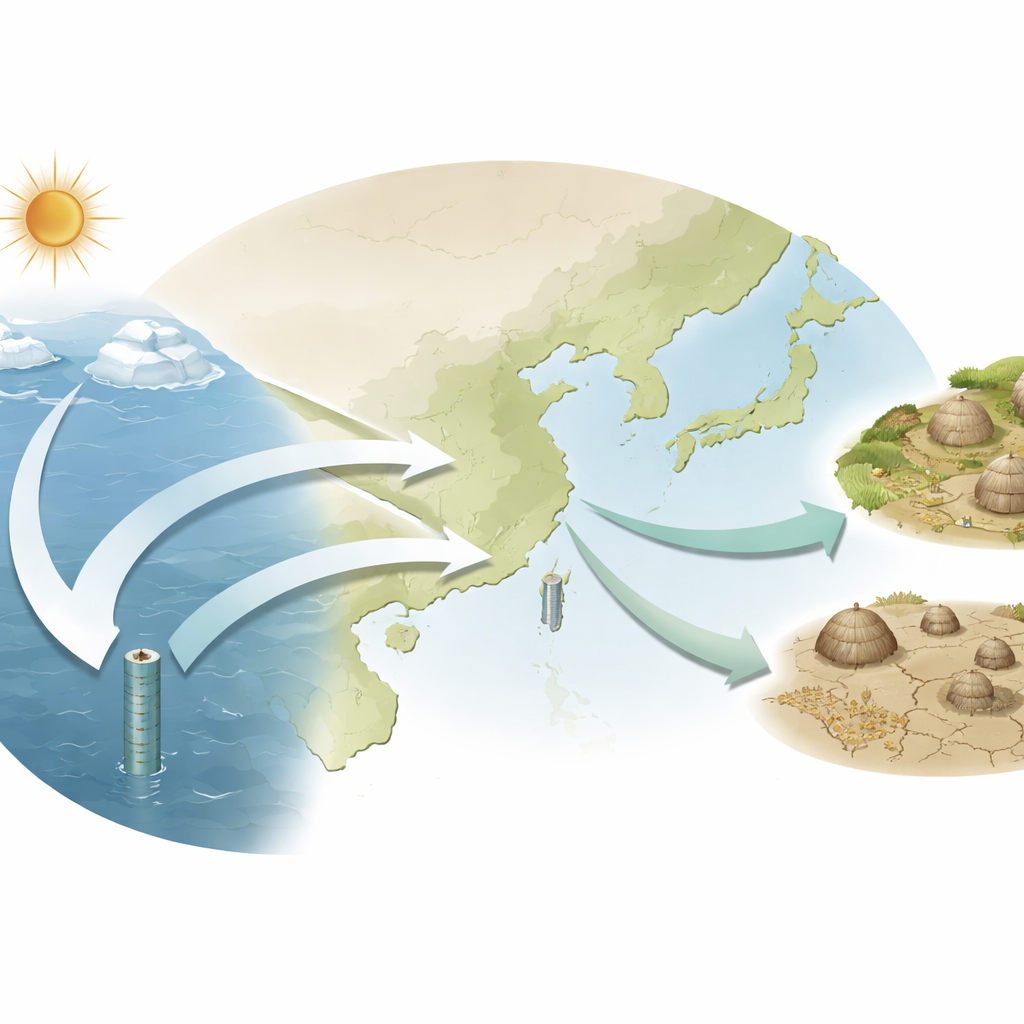
The research centers on a 34-meter-long sediment core, SD-01, drilled off the Shandong Peninsula in the southern Yellow Sea. Each layer in this core holds chemical traces left by microscopic marine life that thrived in cold, wind-mixed winter waters. By analyzing special lipids produced by these organisms, the team reconstructed winter sea-surface temperatures over the past 11,500 years. Because winter temperatures along this coast are tightly linked to the strength of the East Asian Winter Monsoon—a system of cold, dry winds blowing from Siberia toward China and the surrounding seas—the temperature record becomes a detailed history of monsoon behavior through the Holocene.
Long Rhythms and Sudden Jolts in Winter Winds
The core reveals three main chapters in winter monsoon history. Early in the Holocene, as Earth’s orbit brought more sunlight to northern summers, the region was relatively warm and the winter monsoon weak. Around 6,000 years ago, this trend reversed: declining sunlight and changes in the Atlantic Ocean’s overturning circulation strengthened the winter monsoon and made conditions cooler. By about 1,500 years ago, winter monsoon intensity peaked, with larger temperature swings. Superimposed on this long trend were millennial and centennial pulses, many synchronized with well-known cold events in the North Atlantic and dips in solar activity. The authors show that high-latitude ocean–ice–atmosphere feedbacks, and the way they transmitted cooling through atmospheric and oceanic pathways, were crucial drivers of East Asia’s winter climate.
Cold Winds, Weak Rains, and Farming Stress
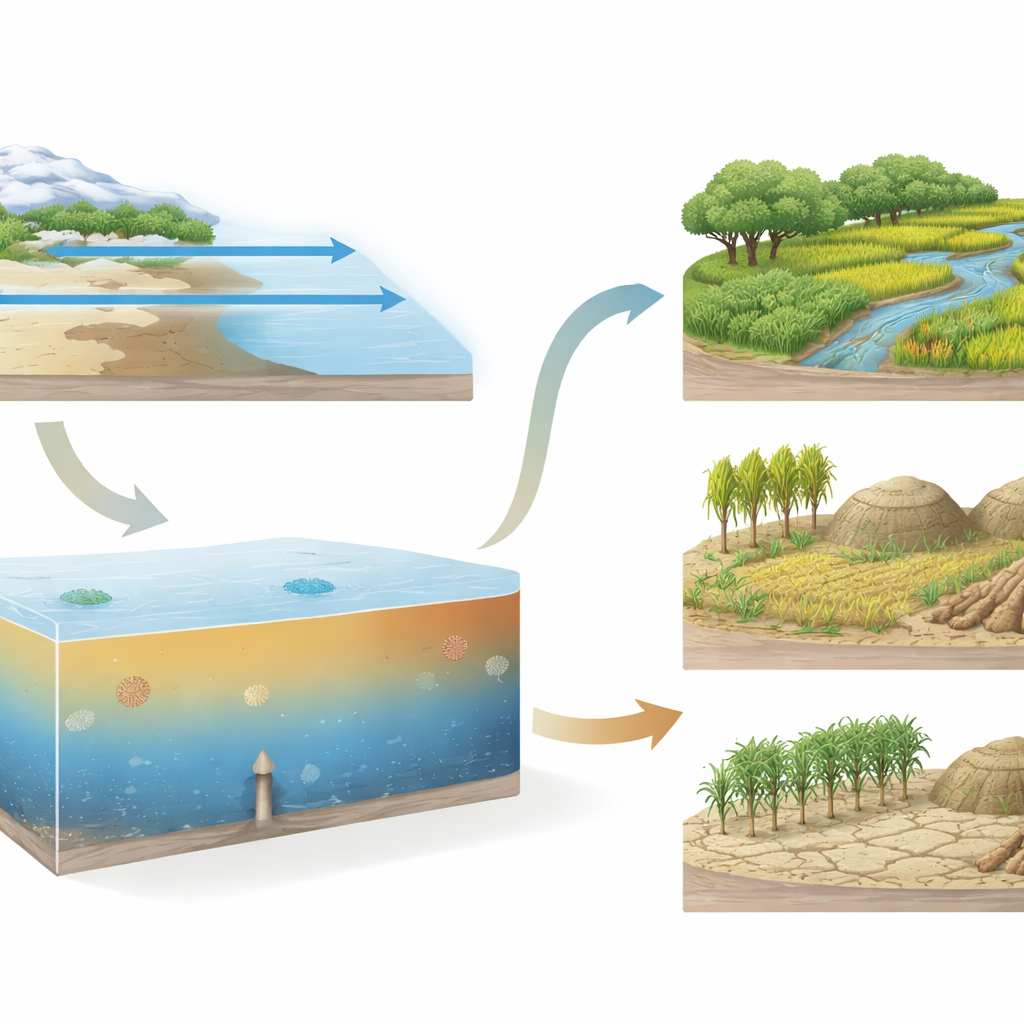
Climate alone does not determine human fate, so the team paired their marine record with a broad suite of land-based clues: radiocarbon-dated archaeological sites, chemical markers of human waste in nearby marine sediments, and isotope measurements from charred grains and human and animal bones. Together, these indicators trace how intensely Neolithic people occupied the landscape and what they ate. The results show that when the winter monsoon intensified at the same time as the summer monsoon weakened, Central and Eastern China experienced compound “cold-dry” conditions. These shifts undermined millet and rice cultivation, shortened growing seasons, and increased drought risk, particularly around the dramatic 4.2-thousand-year event, when sea-surface temperatures dropped by about 4 °C and regional rainfall declined sharply.
Innovation Instead of Collapse
Yet the archeological record does not show a simple story of collapse. Instead, changes in the intensity of human activity tend to lag major climate swings by about 120 years, suggesting that societies absorbed stress gradually and responded through adaptation rather than abrupt abandonment. In the coastal Haidai region, communities diversified their livelihoods, shifting toward drought-tolerant millets and making increasing use of marine resources, as reflected in carbon and nitrogen isotope signatures in human remains. Defensive settlements and reduced luxury goods signal social downsizing rather than disappearance. Inland, in the Central Plain, communities invested in simple irrigation, centralized grain storage, and new forms of political organization. Elite-controlled granaries and dietary differences between social classes point to the rise of more complex governance aimed at buffering food shortages.
Lessons on Resilience for a Changing World
By weaving together marine climate records and archaeological evidence, this study argues that Neolithic societies in Central and Eastern China followed a distinct path under monsoon-driven climate stress. Rather than fleeing or collapsing, they relied on diversification of crops and food sources, storage infrastructure, and evolving social institutions to maintain continuity through colder, drier centuries. In contrast to other ancient monsoon-dependent civilizations that fragmented under similar pressures, these early Chinese cultures exemplify a resilience strategy built on local innovation and cooperation. Their experience offers a long-term perspective on how modern, monsoon-dependent regions might navigate the intertwined challenges of cooling or warming, shifting rainfall, and growing societal complexity.
Citation: Yuan, R., Zhang, R., Jiang, L. et al. Marine sedimentary evidence reveals East Asian Winter Monsoon forcing on Neolithic Cultural transitions in Central and Eastern China. Commun Earth Environ 7, 347 (2026). https://doi.org/10.1038/s43247-026-03335-z
Keywords: East Asian winter monsoon, Holocene climate, Neolithic China, climate and society, cultural resilience